. 2023 Dec;199(12):1173-1190.
doi: 10.1007/s00066-023-02097-3. Epub 2023 Jun 22.

Modulation of tumor-associated macrophage activity with radiation therapy: a systematic review

Affiliations

Modulation of tumor-associated macrophage activity with radiation therapy: a systematic review

Carlotta Becherini et al. Strahlenther Onkol. 2023 Dec.

Abstract

Objective: Tumor-associated macrophages (TAMs) are the most represented cells of the immune system in the tumor microenvironment (TME). Besides its effects on cancer cells, radiation therapy (RT) can alter TME composition. With this systematic review, we provide a better understanding on how RT can regulate macrophage characterization, namely the M1 antitumor and the M2 protumor polarization, with the aim of describing new effective RT models and exploration of the possibility of integrating radiation with other available therapies.

Methods: A systematic search in line with the Preferred Reporting Items for Systematic Reviews and Meta-Analyses (PRISMA) guidelines was carried out in PubMed, Google Scholar, and Scopus. Articles from January 2000 to April 2020 which focus on the role of M1 and M2 macrophages in the response to RT were identified.

Results: Of the 304 selected articles, 29 qualitative summary papers were included in our analysis (16 focusing on administration of RT and concomitant systemic molecules, and 13 reporting on RT alone). Based on dose intensity, irradiation was classified into low (low-dose irradiation, LDI; corresponding to less than 1 Gy), moderate (moderate-dose irradiation, MDI; between 1 and 10 Gy), and high (high-dose irradiation, HDI; greater than 10 Gy). While HDI seems to be responsible for induced angiogenesis and accelerated tumor growth through early M2-polarized TAM infiltration, MDI stimulates phagocytosis and local LDI may represent a valid treatment option for possible combination with cancer immunotherapeutic agents.

Conclusion: TAMs seem to have an ambivalent role on the efficacy of cancer treatment. Radiation therapy, which exerts its main antitumor activity via cell killing, can in turn interfere with TAM characterization through different modalities. The plasticity of TAMs makes them an attractive target for anticancer therapies and more research should be conducted to explore this potential therapeutic strategy.

Keywords: Cancer; Immunomodulation; Macrophages; Radiobiology; Radiotherapy.


Conflict of interest statement

C. Becherini, A. Lancia, B. Detti, S. Lucidi, D. Scartoni, G. Ingrosso, M.G. Carnevale, M. Roghi, N. Bertini, C. Orsatti, M. Mangoni, G. Francolini, S. Marani, I. Giacomelli, M. Loi, S. Pergolizzi, E. Bonzano, C. Aristei, and L. Livi declare that they have no competing interests.

Figures
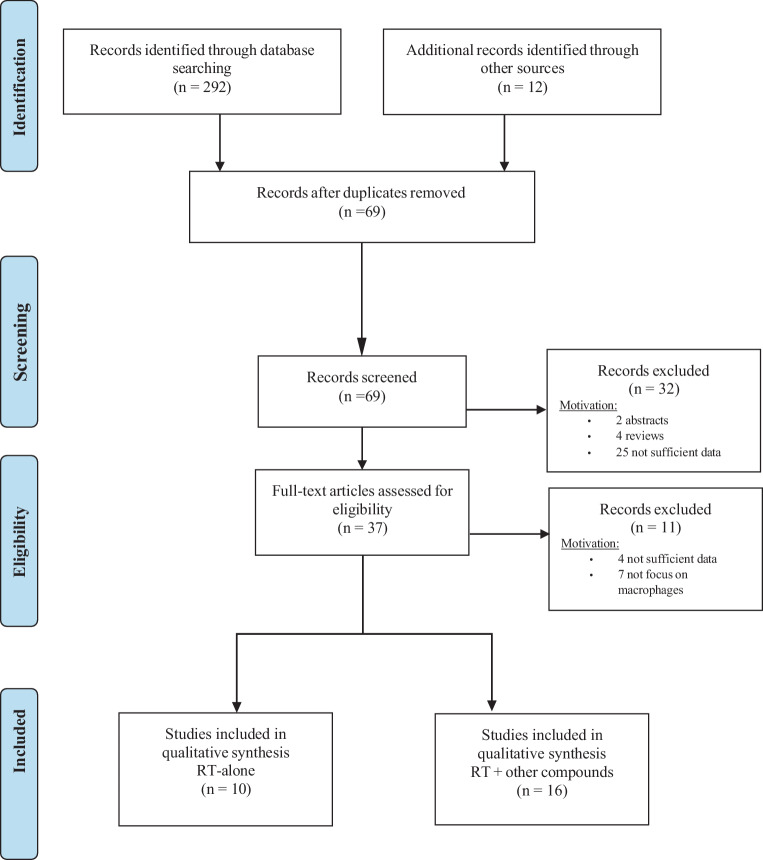
Fig. 1
Fig. 1
Flowchart of inclusion of studies in the systematic review. RT radiotherapy (From: [6]. For more information, visit www.prisma-statement.org)
Fig. 2
Fig. 2
Schematic representation of radiation-induced effects on macrophages. TAMs within the tumor are either present as tissue-resident macrophages or are formed after circulating monocytes are recruited and subsequently differentiated. Soluble factors such as the chemokine ligand 2 (CCL2, also known as monocyte chemoattractant protein 1, MCP1), complement anaphylatoxins (C3a and C5a), and colony-stimulating factor 1 (CSF 1) are well-documented signaling molecules involved in the recruitment process. Furthermore, physical changes such as upregulation of HIF‑α subunits and damaging of the extracellular matrix leads to TAM infiltration and tumor cell proliferation. Polarization of monocytes into mature macrophages phenotypically falls into a wide spectrum of either inflammatory or immunosuppressive behaviors, depending on the expression of interleukins and lipopolysaccharides. IR irradiation, miRNA micro-ribonucleic acid, CCL CC chemokine ligand, CC CC chemokine receptor, CX3CR1 C-X3‑C motif chemokine receptor 1, IL interleukin, TGF transforming growth factor, IRF4 interferon regulatory factor 4, STAT signal transducer and activator of transcription, NFkB p50/p50 nuclear factor kappa B subunit 1, miR micro-ribonucleic acid, MRC1 mannose receptor C-type 1, ECM extracellular matrix, MMP matrix metallopeptidase, CD206 mannose receptor, CD163 cell-surface glycoprotein receptor member of the scavenger receptor cysteine-rich family class B, Fizz1 resistin-like molecule alpha‑1, Ym1 rodent-specific chitinase-like protein 3, Arg1 arginase 1, VEGF vascular endothelial growth factor, TH2 type 2 helper T, DNA deoxyribonucleic acid, NF-kB nuclear factor kappa light chain enhancer of activated B cells, CD80 ligand for the proteins CD28, CD86 cluster of differentiation 86, HLA-DR human leukocyte antigen–DR isotype, IRF5 interferon regulatory factor 5, IFN‑γ interferon-gamma, VCAN versican, NOX2 nicotinamide adenine dinucleotide phosphate (NADPH) oxidases 2, ROS oxygen-containing reactive species, ATM ataxia telangiectasia mutated, CXCL10 C-X‑C motif chemokine ligand 10, NO nitric oxide, iNOS inducible nitric oxide synthase (Created with BioRender.com)

References

    1. Dehne N, Mora J, Namgaladze D, Weigert A, Brüne B. Cancer cell and macrophage cross-talk in the tumor microenvironment. Curr Opin Pharmacol. 2017;35:12–19. doi: 10.1016/j.coph.2017.04.007. - DOI - PubMed
    1. Ostuni R, Kratochvill F, Murray PJ, Natoli G. Macrophages and cancer: from mechanisms to therapeutic implications. Trends Immunol. 2015;36(4):229–239. doi: 10.1016/j.it.2015.02.004. - DOI - PubMed
    1. Jeannin P, Paolini L, Adam C, Delneste Y. The roles of CSFs on the functional polarization of tumor-associated macrophages. FEBS J. 2018;285(4):680–699. doi: 10.1111/febs.14343. - DOI - PubMed
    1. Sica A, Schioppa T, Mantovani A, Allavena P. Tumour-associated macrophages are a distinct M2 polarised population promoting tumour progression: potential targets of anti-cancer therapy. Eur J Cancer. 2006;42(6):717–727. doi: 10.1016/j.ejca.2006.01.003. - DOI - PubMed
    1. Barker HE, Paget JT, Khan AA, Harrington KJ. The tumour microenvironment after radiotherapy: mechanisms of resistance and recurrence. Nat Rev Cancer. 2015;15(7):409–425. doi: 10.1038/nrc3958. - DOI - PMC - PubMed

Publication types
