Trends in Maternal Mortality and Severe Maternal Morbidity During Delivery-Related Hospitalizations in the United States, 2008 to 2021
- PMID: 37347486
- PMCID: PMC10288331
- DOI: 10.1001/jamanetworkopen.2023.17641
Trends in Maternal Mortality and Severe Maternal Morbidity During Delivery-Related Hospitalizations in the United States, 2008 to 2021
Abstract
Importance: Maternal mortality and severe maternal morbidity (SMM) are important focus areas in public health. Further understanding trends, health disparities, and risk factors for these adverse outcomes is vital to public health decision-making.
Objective: To describe trends and risk factors for delivery-related maternal deaths and SMM in the United States.
Design, setting, and participants: This is a retrospective cross-sectional study using data from a large, geographically diverse, all-payer hospital administrative database. Hospital discharges from January 2008 to December 2021 with any Medicare Severity Diagnosis Related Group, International Classification of Diseases, Ninth Revision, Clinical Modification, or International Classification of Diseases, Tenth Revision, Clinical Modification delivery diagnosis or procedure code were included. Data analysis took place from February 2021 to March 2023.
Exposures: Year, quarter (Q), age, race and ethnicity, delivery method.
Main outcomes and measures: Maternal mortality, SMM during delivery-related hospitalization.
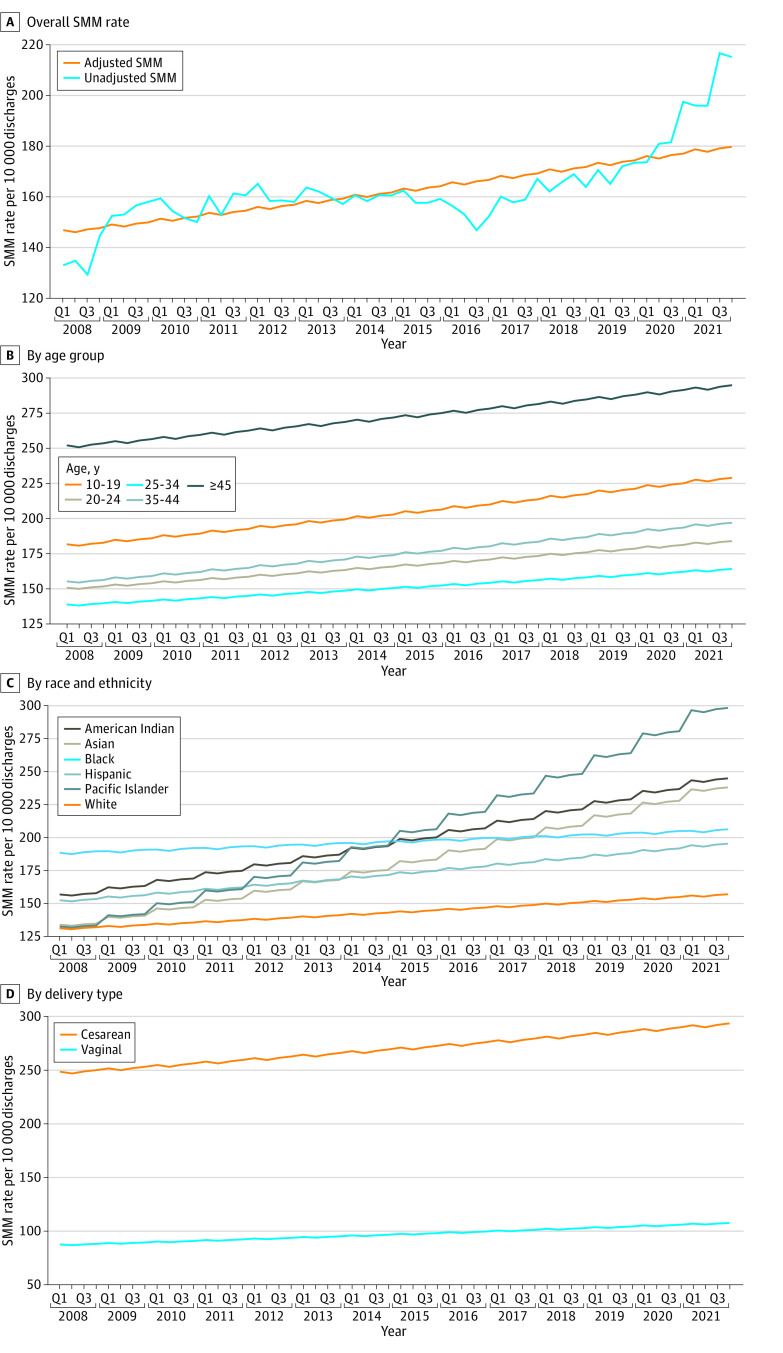
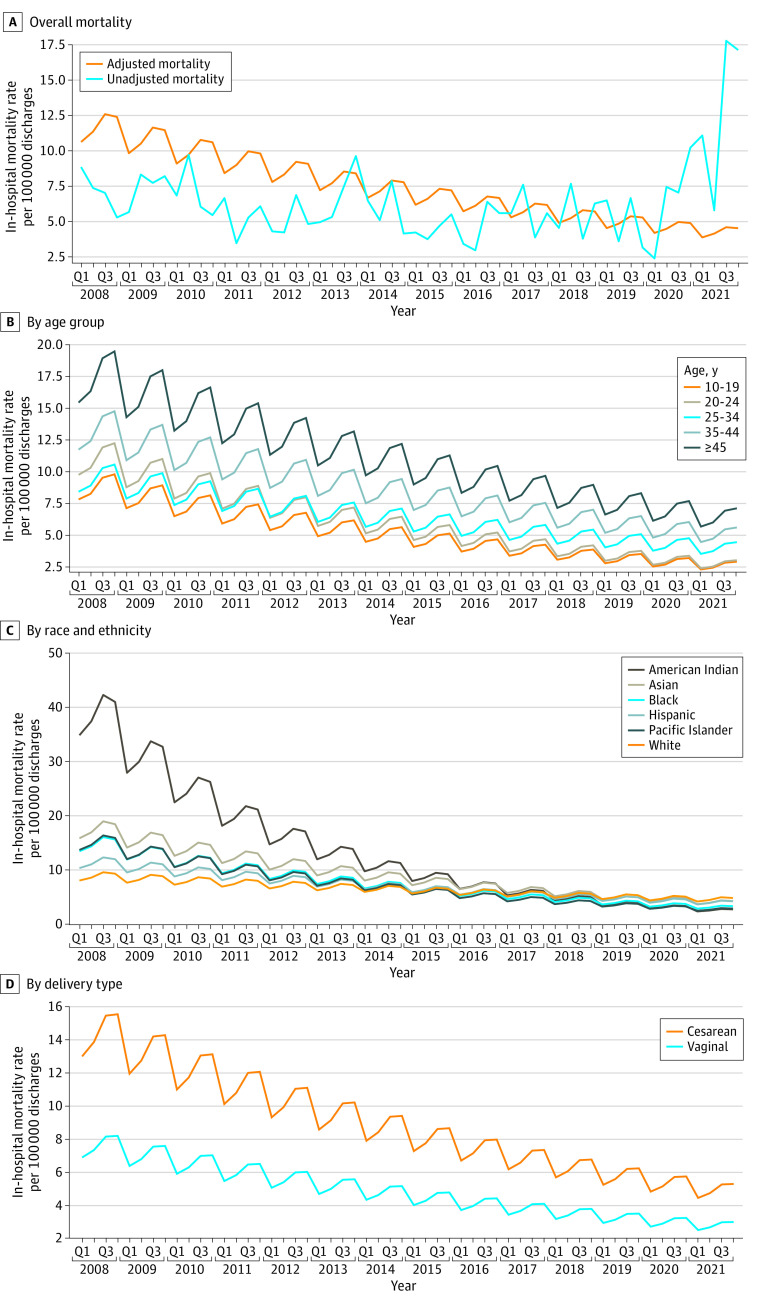
Results: Overall, 11 628 438 unique hospital discharges were analyzed, with a mean (SD) age of 28 (6) years. There were 437 579 (3.8%) Asian, 92 547 (0.8%) American Indian, 1 640 355 (14.1%) Black, 1 762 392 (15.2%) Hispanic, 83 189 (0.7%) Pacific Islander, and 6 194 139 (53.3%) White patients. Regression-adjusted maternal mortality per 100 000 discharges declined from 10.6 deaths in Q1 2008 to 4.6 deaths in Q4 2021. Mortality was significantly higher among patients with advanced maternal age (eg, age 35-44 years vs 25-34 years: adjusted odds ratio [aOR], 1.49; 95% CI, 1.22-1.84). Other significant risk factors for mortality included cesarean delivery, comorbid conditions, complications, and COVID-19 diagnosis (eg, cesarean delivery: aOR, 2.28; 95% CI, 1.87-2.79). The prevalence of any SMM increased from 146.8 per 10 000 discharges in Q1 of 2008 to 179.8 per 10 000 discharges in Q4 of 2021. SMM risk factors included age 24 years or younger or age 35 years or older, belonging to a racial or ethnic minority group, cesarean delivery, Medicaid insurance, and having 1 or more comorbidities (eg, age 10-19 years: aOR, 1.39; 95% CI, 1.36-1.42).
Conclusions and relevance: This cross-sectional study found that delivery-related mortality in US hospitals decreased for all racial and ethnic groups, age groups, and modes of delivery during 2008 to 2021, likely demonstrating the impact of national strategies focused on improving maternal quality of care provided during delivery-related hospitalizations. SMM prevalence increased for all patients, with higher rates for racial and ethnic minority patients of any age. Advanced maternal age, racial or ethnic minority group status, cesarean delivery, and comorbidities were associated with higher odds of mortality and SMM.
Conflict of interest statement
Figures
References
-
- US Centers for Disease Control and Prevention . Severe maternal morbidity in the United States. Accessed April 7, 2021. https://www.cdc.gov/reproductivehealth/maternalinfanthealth/severematern...
-
- US Centers for Disease Control and Prevention . Births and natality. Accessed April 7, 2021. https://www.cdc.gov/nchs/fastats/births.htm
-
- US Centers for Disease Control and Prevention . Pregnancy mortality surveillance system. Accessed February 15, 2021. https://www.cdc.gov/reproductivehealth/maternal-mortality/pregnancy-mort...
-
- Ashford LS, Ransom E, Yinger N. Hidden Suffering: Disabilities from Pregnancy and Childbirth in Less Developed Countries. Population Reference Bureau; 2002.