


A model for malaria treatment evaluation in the presence of multiple species
- PMID: 37348379
- PMCID: PMC7614843
- DOI: 10.1016/j.epidem.2023.100687
A model for malaria treatment evaluation in the presence of multiple species
Abstract
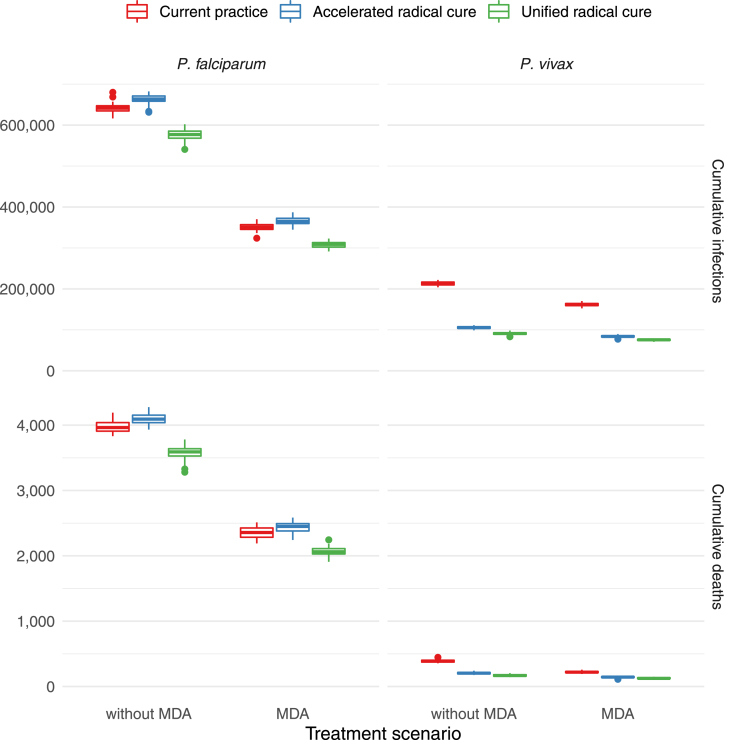
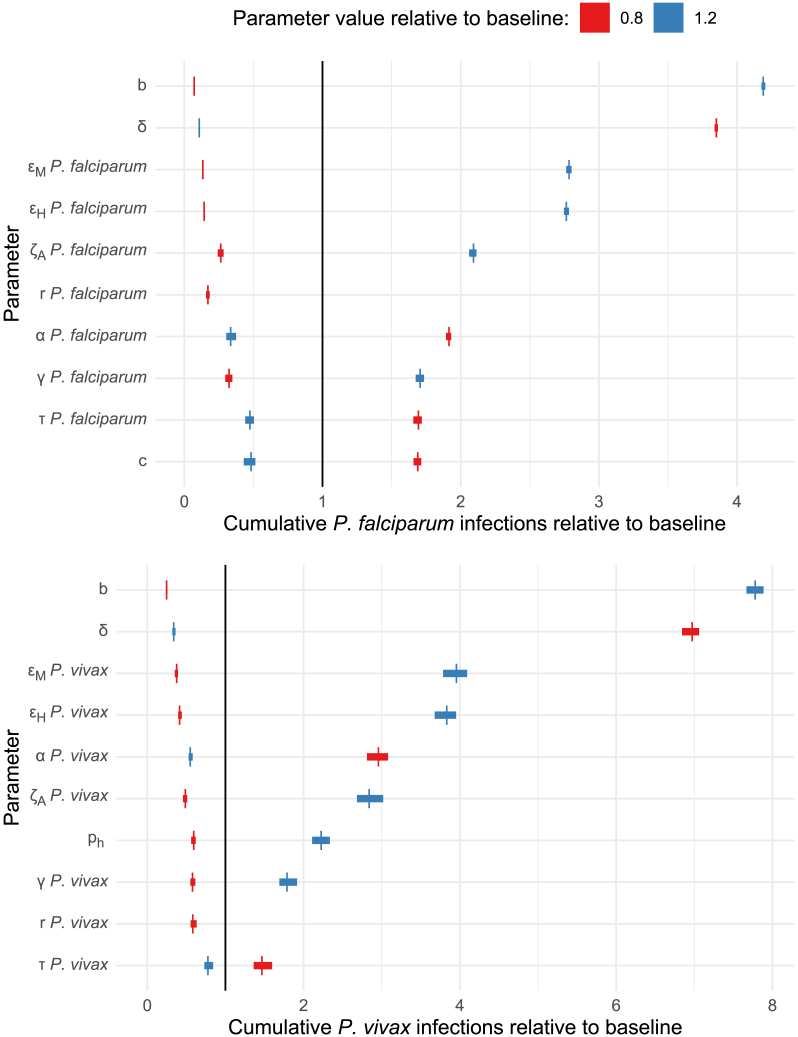
Plasmodium falciparum and P. vivax are the two most common causes of malaria. While the majority of deaths and severe morbidity are due to P. falciparum, P. vivax poses a greater challenge to eliminating malaria outside of Africa due to its ability to form latent liver stage parasites (hypnozoites), which can cause relapsing episodes within an individual patient. In areas where P. falciparum and P. vivax are co-endemic, individuals can carry parasites of both species simultaneously. These mixed infections complicate dynamics in several ways: treatment of mixed infections will simultaneously affect both species, P. falciparum can mask the detection of P. vivax, and it has been hypothesised that clearing P. falciparum may trigger a relapse of dormant P. vivax. When mixed infections are treated for only blood-stage parasites, patients are at risk of relapse infections due to P. vivax hypnozoites. We present a stochastic mathematical model that captures interactions between P. falciparum and P. vivax, and incorporates both standard schizonticidal treatment (which targets blood-stage parasites) and radical cure treatment (which additionally targets liver-stage parasites). We apply this model via a hypothetical simulation study to assess the implications of different treatment coverages of radical cure for mixed and P. vivax infections and a "unified radical cure" treatment strategy where P. falciparum, P. vivax, and mixed infections all receive radical cure after screening glucose-6-phosphate dehydrogenase (G6PD) normal. In addition, we investigated the impact of mass drug administration (MDA) of blood-stage treatment. We find that a unified radical cure strategy leads to a substantially lower incidence of malaria cases and deaths overall. MDA with schizonticidal treatment was found to decrease P. falciparum with little effect on P. vivax. We perform a univariate sensitivity analysis to highlight important model parameters.
Keywords: Malaria; Plasmodium falciparum; Plasmodium vivax; Stochastic modelling; Unified treatment.
Copyright © 2023. Published by Elsevier B.V.
Conflict of interest statement
Declaration of Competing Interest None.
Figures


References
-
- Ashton Ruth A., Kefyalew Takele, Tesfaye Gezahegn, Counihan Helen, Yadeta Damtew, Cundill Bonnie, Reithinger Richard, Kolaczinski Jan H. Performance of three multi-species rapid diagnostic tests for diagnosis of Plasmodium falciparum and Plasmodium vivax malaria in Oromia Regional State, Ethiopia. Malar. J. 2010;9(1):297. - PMC - PubMed
-
- Carrara Verena I., Lwin Khin Maung, Phyo Aung Pyae, Ashley Elizabeth, Wiladphaingern Jacher, Sriprawat Kanlaya, Rijken Marcus, Boel Machteld, McGready Rose, Proux Stephane, Chu Cindy, Singhasivanon Pratap, White Nicholas, Nosten François. Malaria burden and artemisinin resistance in the mobile and migrant population on the Thai–Myanmar border, 1999–2011: An observational study. PLoS Med. 2013;10(3) - PMC - PubMed
Publication types
MeSH terms
Grants and funding
LinkOut - more resources
Full Text Sources
Medical
Miscellaneous
