Review
. 2023 Jun 21;14(6):430-446.
doi: 10.1016/j.cels.2023.05.001.

The computational capabilities of many-to-many protein interaction networks

Affiliations
Review

The computational capabilities of many-to-many protein interaction networks

Heidi E Klumpe et al. Cell Syst. .

Abstract

Many biological circuits comprise sets of protein variants that interact with one another in a many-to-many, or promiscuous, fashion. These architectures can provide powerful computational capabilities that are especially critical in multicellular organisms. Understanding the principles of biochemical computations in these circuits could allow more precise control of cellular behaviors. However, these systems are inherently difficult to analyze, due to their large number of interacting molecular components, partial redundancies, and cell context dependence. Here, we discuss recent experimental and theoretical advances that are beginning to reveal how promiscuous circuits compute, what roles those computations play in natural biological contexts, and how promiscuous architectures can be applied for the design of synthetic multicellular behaviors.

Keywords: biological circuit; biological computation; combinatorial protein interactions; molecular computation; promiscuous protein interactions; protein networks; signal transduction.


Conflict of interest statement

Declaration of interests M.B.E. is a scientific advisory board member or consultant at TeraCyte, Primordium, and Spatial Genomics. Y.E.A. is a scientific advisory board member or consultant at TeraCyte.

Figures
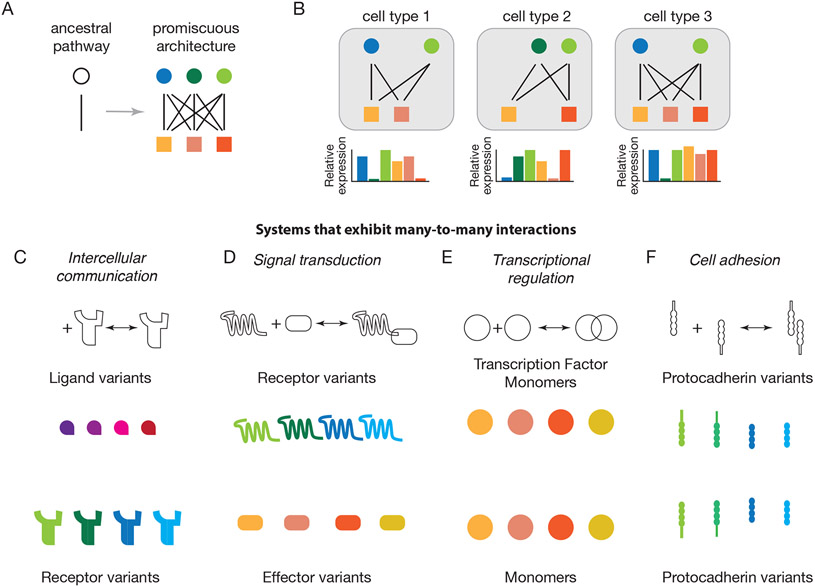
Figure 1:
Figure 1:. Diverse cellular pathways exhibit many-to-many interactions among protein families.
(A) Extant pathways, such as signaling from one component (circle) to another (square) can evolve from simpler ancestral pathways through gene duplications, resulting in many-to-many interaction networks (right). (B) Different cell types (gray) typically express different protein variant profiles (schematic bar plots). (C) Intercellular communication systems often comprise multiple ligand (upper) and receptor (lower) variants that interact in a many-to-many fashion, with each ligand binding to multiple receptors and each receptor binding to multiple ligand variants. (D) In signal transduction systems, receptor variants (upper) interact with variant intracellular signal transducers, or effectors, in a many-to-many fashion. (E) In cell adhesion processes, protocadherin variants interact with other protocadherins in adjacent cells, also in a many-to-many fashion. (F) Eukaryotic transcription factor variants can often bind to one another to form a large repertoire of distinct dimers, each with distinct DNA binding specificities.
Figure 2:
Figure 2:. Many-to-many interaction systems can provide key functional capabilities.
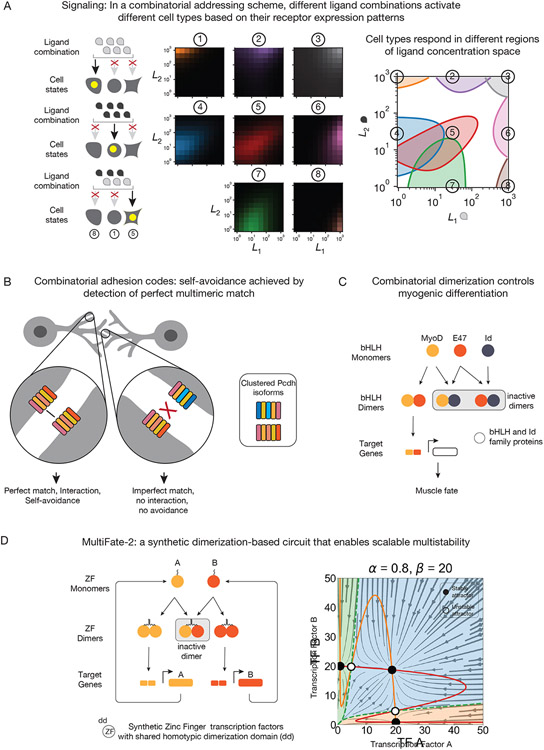
(A) In cell-cell signaling, many-to-many interactions between ligands and receptors allow ligands mixtures to “address” messages to specific cell types, rather than broadcasting messages to any cell expressing receptors (left). This works by generating responses in specific regions of a multi-dimensional ligand concentration space. A model of BMP signaling showed that particular parameters for receptor-ligand interactions allow a single ligand pair to activate up to 8 distinct receptor configurations, depending on the ligand concentrations (middle, right). In each plot, the x- and y-axes show concentrations of two ligands, L1 and L2. (B) In cell-cell adhesion, combinations of Pcdh isoforms (different colors) can encode cellular identity, allowing neurons to distinguish self from non-self. (C) In gene regulation circuits, dimerization of bHLH transcription factors partitions the protein variants into active and inactive dimers. Perturbations of monomer expression can thus alter dimer abundance to produce nuanced effects on target gene expression. (D) Naturally occurring protein-protein dimerization networks can guide the design of synthetic circuits for more complex computations. For example, the MultiFate-2 system includes a synthetic transcription mechanism that, like bHLH transcription factors, includes dimerization, DNA binding, and transcriptional activation domains. These programmed interactions (left) give rise to diverse stable cell states (right) defined by concentrations of active transcription factor dimers, analogous to differentiated cell states.
Figure 3:
Figure 3:. Strategies to understand and control combinatorial complexity of protein dimerization networks.
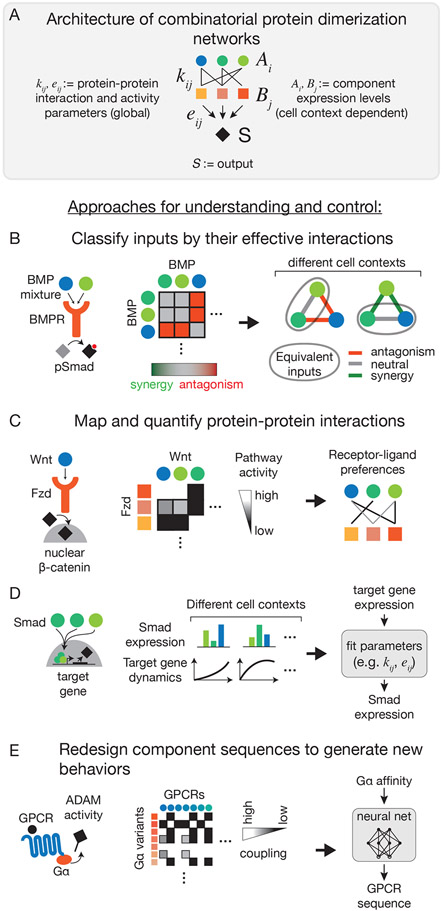
(A) In combinatorial protein dimerization networks, one set of protein variants (Ai) binds combinatorially to another set of protein variants (Bj); the resulting complexes produce a common output (S). Global parameters describe the protein-protein binding (kij) and complex activity (eij) parameters. The output of the network depends on the complex levels, and thus on the abundance of various components (Ai,Bj), which can vary between cell contexts. (B) The functional differences between protein variants are often unclear because of the variants’ high sequence similarity. For example, the highly homologous BMP ligands activate a common output (pSmad), but can produce distinct effects in combinations. Mapping pairwise responses allows individual ligands to be classified by their effective interactions, highlighting functional differences between the ligands . These differences are not global, but can vary between cell contexts. (C) While all dimerizations are possible in principle, they do not necessarily produce output. For example, in the Wnt pathway, not all Wnt ligands bind and activate the associated receptors (Fzd). Exposing cell lines engineered to express only a single Fzd receptor to each Wnt ligand revealed patterns of receptor-ligand preferences that were not clear from protein sequence alone. (D) Quantitatively predicting the output produced by protein-protein interactions requires careful parameterization of binding affinity and overall activity (i.e. kij, eij). Combining measurements of component abundance (Ai, Bj) with output dynamics (S) allows the inference of these parameters. For example, quantifying expression of Smad proteins and the expression of their downstream target genes fit a model that predicted target gene expression from Smad expression, and vice versa. (E) Redesigning a given component’s sequence can alter its protein-protein interactions and, in some cases, produce entirely new responses and computations. The coupling interactions of 148 GPCRs with 11 Gα subunits were used to train a machine learning predictor of coupling strength. This model then guided the design of a less promiscuous GPCR, by generating GPCR sequences predicted to couple uniquely to a given Gα subunit.
Box figure:
Box figure:. Mathematical model of computation by promiscuous protein dimerization networks
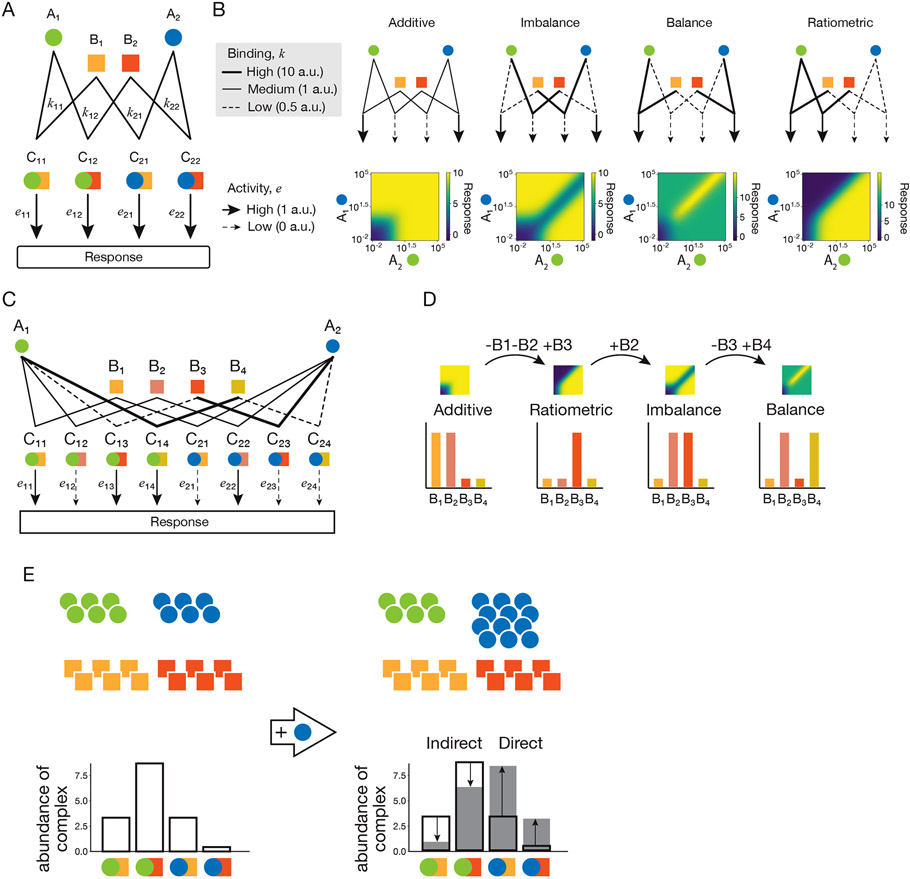
(A) In a minimal promiscuous protein dimerization network, two A-type components (circles) interact with two B-type components (squares) to form complexes that induce a response. The binding affinities of the components Ai and Bj to form the complex Cij are denoted by kij, and their response activity levels are denoted by eij. (B) Heatmaps representing the response of the minimal network as a function of the A concentrations. Parameter values are indicated by line weights, as indicated in the legend (a.u. = arbitrary units). All levels of B-type components are set at 10 a.u. The code to generate these plots can be found at https://github.com/dsb-lab/MinimalPromiscuousCircuit. (C) All four distinct classes of computations shown in (B) can be generated by a single model with specific biochemical parameters using only four B-type components. Parameter values are indicated by line weights as in (B). (D) By changing the expression levels of the B-type components the model can transition smoothly between the four computation classes. See also Movie S1. (E) When the concentration of a ligand is increased (blue circles), the stoichiometric nature of the biochemical reaction results in a global redistribution of complexes. Outline bars and shaded bars show the amount of each complex before and after the increase in ligand, respectively. The increase results in direct effects on complexes containing the varying ligand (marked ‘Direct’). Additionally, the redistribution of complexes has indirect effects on complexes that do not contain the varying ligand (marked ‘Indirect’).

References

    1. Carretero-Paulet L, Galstyan A, Roig-Villanova I, Martínez-García JF, Bilbao-Castro JR, and Robertson DL (2010). Genome-wide classification and evolutionary analysis of the bHLH family of transcription factors in Arabidopsis, poplar, rice, moss, and algae. Plant Physiol. 153, 1398–1412. 10.1104/pp.110.153593. - DOI - PMC - PubMed
    1. Yan J, Ma Z, Xu X, and Guo A-Y (2014). Evolution, functional divergence and conserved exon–intron structure of bHLH/PAS gene family. Mol. Genet. Genomics 289, 25–36. 10.1007/s00438-013-0786-0. - DOI - PubMed
    1. Wotton KR, Alcaine Colet A, Jaeger J, and Jimenez-Guri E (2013). Evolution and expression of BMP genes in flies. Dev. Genes Evol 223, 335–340. 10.1007/s00427-013-0445-9. - DOI - PMC - PubMed
    1. Marques CL, Fernández I, Viegas MN, Cox CJ, Martel P, Rosa J, Cancela ML, and Laizé V (2016). Comparative analysis of zebrafish bone morphogenetic proteins 2, 4 and 16: molecular and evolutionary perspectives. Cell. Mol. Life Sci 73, 841–857. 10.1007/s00018-015-2024-x. - DOI - PMC - PubMed
    1. Gul IS, Hulpiau P, Saeys Y, and van Roy F (2017). Evolution and diversity of cadherins and catenins. Exp. Cell Res 358, 3–9. 10.1016/j.yexcr.2017.03.001. - DOI - PubMed

Publication types

MeSH terms

LinkOut - more resources