


In-hospital outcomes after SAVR or TAVI in patients with severe aortic stenosis
- PMID: 37349628
- PMCID: PMC10764526
- DOI: 10.1007/s12928-023-00942-x
In-hospital outcomes after SAVR or TAVI in patients with severe aortic stenosis
Abstract
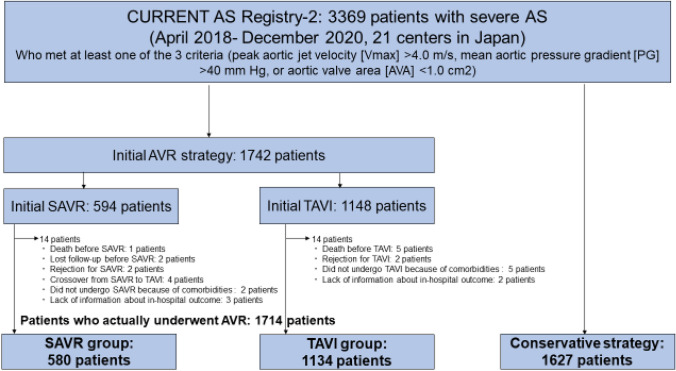
There were no data comparing the in-hospital outcomes after transcatheter aortic valve implantation (TAVI) with those after surgical aortic valve replacement (SAVR) in Japan. Among consecutive patients with severe AS between April 2018 and December 2020 in the CURRENT AS Registry-2, we identified 1714 patients who underwent aortic valve replacement (TAVI group: 1134 patients, and SAVR group: 580 patients). Patients in the TAVI group were much older (84.4 versus 73.6 years, P < 0.001) and more often had comorbidities than those in the SAVR group. In-hospital death rate was numerically lower in the TAVI group than in the SAVR group (0.6% versus 2.2%). After excluding patients with dialysis, in-hospital death rate was very low and comparable in the TAVI and SAVR groups (0.6% versus 0.8%). The rates of major bleeding and new-onset atrial fibrillation during index hospitalization were higher after SAVR than after TAVI (72% versus 20%, and 26% versus 4.6%, respectively), while the rate of pacemaker implantation was higher after TAVI than after SAVR (8.1% versus 2.4%). Regarding the echocardiographic data at discharge, the prevalence of patient-prosthesis mismatch was lower in the TAVI group than in the SAVR group (moderate: 9.0% versus 26%, and severe: 2.6% versus 4.8%). In this real-world data in Japan, TAVI compared with SAVR was chosen in much older patients with more comorbidities with severe AS. In-hospital death rate was numerically lower in the TAVI group than in the SAVR group.
Keywords: Aortic stenosis; Surgical aortic valve replacement; Transcatheter aortic valve implantation.
© 2023. The Author(s).
Conflict of interest statement
Dr. Shiomi reports personal fees from Abbott Vascular, Boston Scientific, and Daiichi Sankyo. Dr. Morimoto reports lecturer's fees from Bristol-Myers Squibb, Daiichi Sankyo, Japan Lifeline, Kowa, Kyocera, Novartis, and Toray; manuscript fees from Bristol-Myers Squibb and Kowa; advisory board for Sanofi. Dr. Kimura reports advisory board for Abbott Vascular; grants from Edwards Lifescience, Daiichi Sankyo, Takeda Pharmaceutical, Bayer, Otsuka Parmaceutical, Boehringer Ingelheim, Mitsubishi Tanabe Pharma, Sumitomo Dainippon Pharma, Kowa, Abiomed, Japan Academic Research Forum, NIPRO, W. L. Gore & Associates G.K., RPM Co.,Ltd., CSL Behring, Pfizer R&D Japan G.K., EP-CRSU Co., Ltd; modest honoraria from MSD, Eisai, Edwards Lifescience, Ono Pharmaceutical, Tsumura, Medical Review, Kowa, Sanofi, Pharmaceuticals and Medical Devices Agency, Bristol-Myers Squibb, Boston Scientific, Lifescience, Toray, Astellas Amgen Biopharma, Astellas, AstraZeneca, OrbusNeich, MSD Life Science Foundation, Public Health Research Foundation, Chugai Pharmaceutical, Japan Society for the Promotion of Science, Interscience, Philips, Kowa Pharmaceutical, Mitsubishi Tanabe Pharma, Terumo, Novartis Pharma, HeartFlow Japan G.K., CROSSCO Co.
Figures

References
-
- Schwarz F, Baumann P, Manthey J, Hoffmann M, Schuler G, Mehmel HC, Schmitz W, Kübler W. The effect of aortic valve replacement on survival. Circulation. 1982;66(5):1105–10. 10.1161/01.CIR.66.5.1105. - PubMed
MeSH terms
LinkOut - more resources
Full Text Sources
Research Materials
Miscellaneous
