. 2023 Jun 7:14:1206141.
doi: 10.3389/fgene.2023.1206141. eCollection 2023.

Vasculogenic mimicry score identifies the prognosis and immune landscape of lung adenocarcinoma

Affiliations

Vasculogenic mimicry score identifies the prognosis and immune landscape of lung adenocarcinoma

Weichang Yang et al. Front Genet. .

Abstract

Background: Lung cancer has a high incidence and mortality rate worldwide. Vasculogenic mimicry (VM) is a specific modality of tumor angiogenesis that could potentially be a new target for tumor therapy. The purpose of this study was to explore the role of VM-related genes in assessing the prognosis and immune landscape of lung cancer. Methods: VM-related genes were obtained from previous studies, and the expression data and clinical data of lung adenocarcinoma (LUAD) patients were obtained from the TCGA database and GEO database. We performed enrichment analysis of 24 VM-related genes and screened hub genes by constructing a protein-protein interaction network and using Cytoscape software. Subsequently, we developed the VM score based on univariate Cox regression analysis and Lasso analysis and validated the VM score on the GSE72094 dataset. In addition, we constructed a nomogram based on the VM score in the TCGA cohort. Finally, we explored the correlation between the VM score and the tumor microenvironment, immune cell infiltration, immune checkpoints, and drug sensitivity. Results: Enrichment analysis revealed that VM-related genes were associated with the HIF signaling pathway and angiogenic pathway. We developed a VM score based on 3 genes (EPHA2, LAMC2 and LOXL2) in LUAD patients. Kaplan-Meier analysis showed that the VM score was associated with poor prognosis in LUAD patients. The receiver operating characteristic curve suggested that the VM score and nomogram are valid predictors for the overall survival of LUAD patients. The VM score was significantly correlated with immune cell infiltration, such as naïve B cells, neutrophils, and eosinophils, and there was a difference in the TME between the high VM score group and the low VM score group. LUAD patients in the high VM score group were more sensitive to antitumor drugs. Conclusion: In summary, the VM score developed in this study is a valuable indicator for evaluating the prognosis and immune landscape of LUAD patients. VM may be a potential target for antitumor therapy in lung cancer.

Keywords: immune landscape; lung adenocarcinoma; prognosis; tumor microenvironment (TEM); vasculogenic mimicry.


Conflict of interest statement

The authors declare that the research was conducted in the absence of any commercial or financial relationships that could be construed as a potential conflict of interest.

Figures

FIGURE 1
FIGURE 1
Flow chart of this study.
FIGURE 2
FIGURE 2
VM-related genes expression and Hub genes screening. (A). The expression of VM-related genes between tumor and normal. (B). GO enrichment analysis of VM-related genes. (C) KEGG enrichment analysis of VM-related genes. (D) PPI network of VM-related genes. (E) Top 20 hub genes of VM-related genes. VM: vasculogenic mimicry. GO: Gene Ontology. KEGG: Kyoto Encyclopedia of Genes and Genomes. PPI: protein–protein interaction. Molecular Function: the molecular activities of individual gene products. Cellular Component: where the gene products are active. Biological Process: the pathways and larger processes to which that gene product’s activity contributes.
FIGURE 3
FIGURE 3
Development of VM score. (A) Forest plot of univariate Cox regression analysis of VM-related genes. (B) LASSO coefficient profiles of 5 genes. (C) Cross-validation of tuning parameter selection in the LASSO Cox regression. (D) KM analysis of overall survival in high VM score group and low VM score group based on TCGA database. (E) Time-dependent ROC curve of VM score. (F) VM score distribution, (G) survival status of patients, and (H) heatmap of VM-related genes distribution in TCGA cohort. VM: vasculogenic mimicry. TCGA: the Cancer Genome Atlas. ROC: Receiver operating characteristic.
FIGURE 4
FIGURE 4
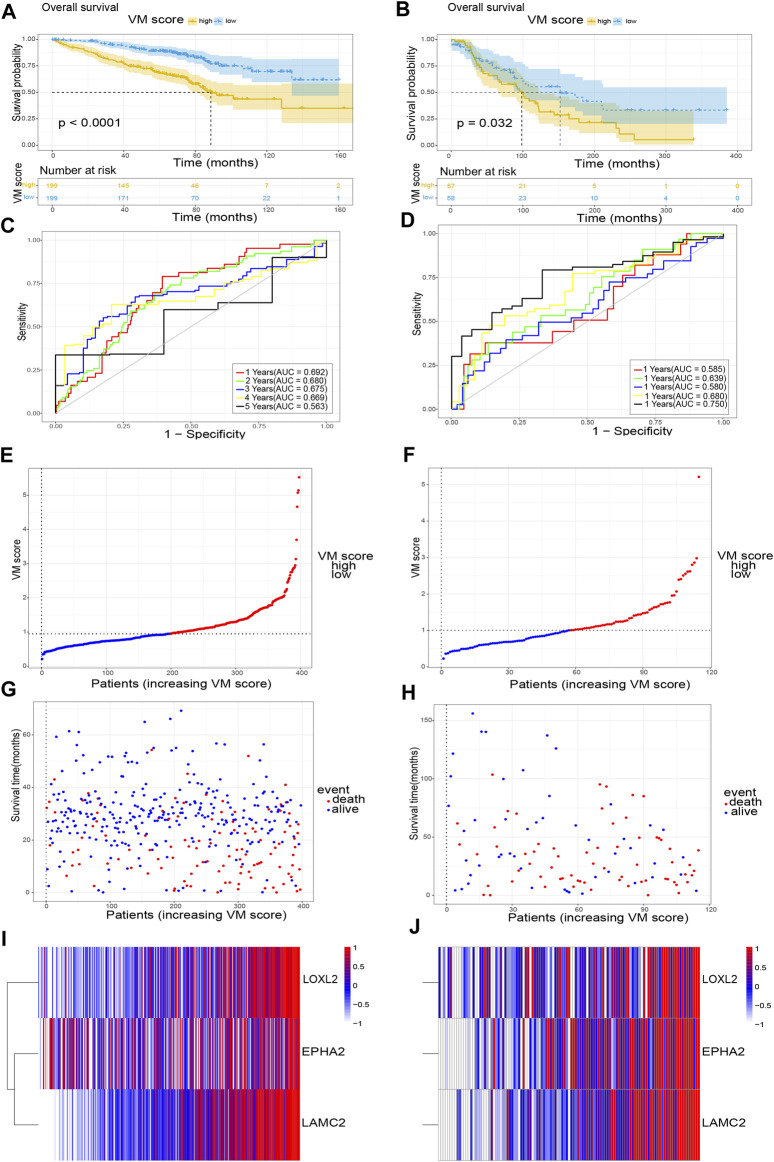
Validation of VM score. (A), (C), (E), (G) and (I) The validation of VM score in GSE72094; (B), (D), (F), (H) and (J) The validation of VM score in GSE36471. (A), (B) KM analysis of OS. (C), (D) Time-dependent ROC curve of VM score. (E), (F) VM score distribution, (G), (H) survival status of patients, and (I), (J) heatmap of VM-related genes distribution. VM: vasculogenic mimicry. KM: Kaplan-Meier. ROC: Receiver operating characteristic.
FIGURE 5
FIGURE 5
Expression of LAMC2 and LOXL2 in LUAD and normal tissues.
FIGURE 6
FIGURE 6
Development of a nomogram based on VM score. (A) Forest plot of univariate Cox regression analysis. (B) Forest plot of multivariate Cox regression analysis. (C) Nomogram for LUAD patients based VM score. (D) Time-dependent ROC curve of nomogram. (E) Calibration curves of nomogram model. (F–K): Box plots of VM score with clinical factors. (F) Age, (G) Gender, (H) Stage, (I) T-stage, (J) N-stage, (K) M-stage. VM: vasculogenic mimicry. LUAD: lung adenocarcinoma.
FIGURE 7
FIGURE 7
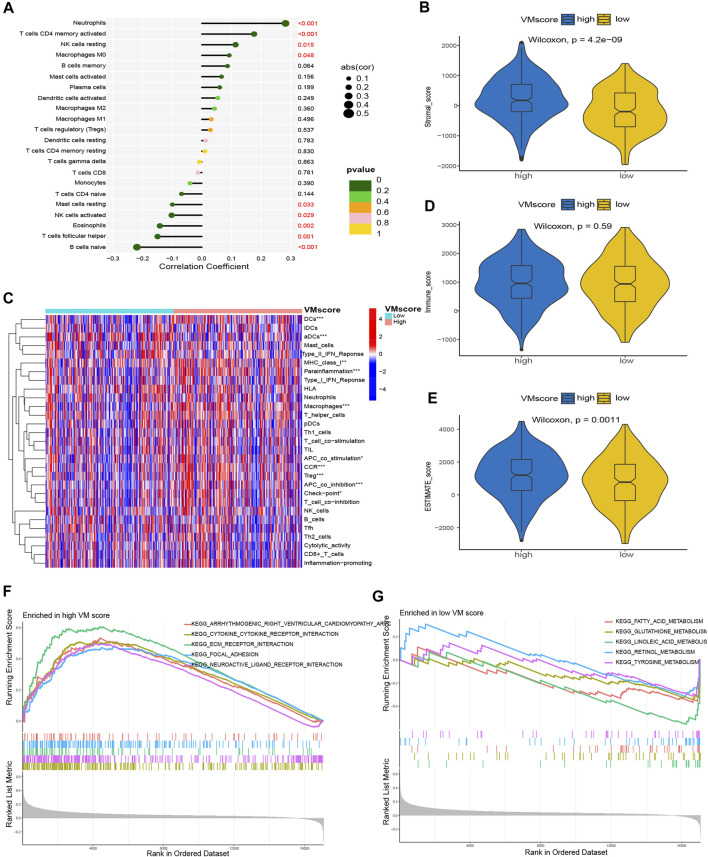
Correlation between VM score and immune landscape. (A) Correlation of VM score with immune cell infiltration based on CIBERSORT. (C) Differences in immune cell infiltration in high VM score and low VM score based on ssGSEA. (B), Dand (E) The difference in TME between the high VM score and low VM score groups. (B) Stromal score, (D) Immune score, (E) ESTIMATE score. (F) GSEA in high VM score group. (G) GSEA in low VM score group. VM: vasculogenic mimicry. GSEA: gene set enrichment analysis.
FIGURE 8
FIGURE 8
Correlation of VM score with immune checkpoints and drug sensitivity. (A) Correlation of VM score with immune checkpoints. (B) Correlation of VM score with TMB. (C–I): Correlation of VM score with drug sensitivity. (C) Docetaxel, (D) Cisplatin, (E) Gemcitabine, (F) Paclitaxel, (G) Vinblastine, (H) Sorafenib, (I) Pazopanib. VM: vasculogenic mimicry. TMB: tumor mutation burden.

References

    1. Andreucci E., Peppicelli S., Ruzzolini J., Bianchini F., Calorini L. (2022). Physicochemical aspects of the tumour microenvironment as drivers of vasculogenic mimicry. Cancer Metastasis Rev. 41 (4), 935–951. 10.1007/s10555-022-10067-x - DOI - PMC - PubMed
    1. Cao Z., Bao M., Miele L., Sarkar F. H., Wang Z., Zhou Q. (2013). Tumour vasculogenic mimicry is associated with poor prognosis of human cancer patients: A systemic review and meta-analysis. Eur. J. Cancer 49 (18), 3914–3923. 10.1016/j.ejca.2013.07.148 - DOI - PubMed
    1. Chen P., Liu Y., Wen Y., Zhou C. (2022). Non-small cell lung cancer in China. Cancer Commun. (Lond) 42 (10), 937–970. 10.1002/cac2.12359 - DOI - PMC - PubMed
    1. Delgado-Bellido D., Serrano-Saenz S., Fernández-Cortés M., Oliver F. J. (2017). Vasculogenic mimicry signaling revisited: Focus on non-vascular VE-cadherin. Mol. Cancer 16 (1), 65. 10.1186/s12943-017-0631-x - DOI - PMC - PubMed
    1. Ding J., Jia X., Zuo B., He J., Yang J., He Y. (2018). A novel monoclonal antibody targeting a novel epitope of VE-cadherin inhibits vasculogenic mimicry of lung cancer cells. Oncol. Rep. 39 (6), 2837–2844. 10.3892/or.2018.6374 - DOI - PubMed