


Serum neurofilament light as a predictor of outcome in subarachnoid haemorrhage
- PMID: 37351672
- PMCID: PMC10542720
- DOI: 10.1007/s00701-023-05673-9
Serum neurofilament light as a predictor of outcome in subarachnoid haemorrhage
Abstract
Background: Prognostication of clinical outcome in patients suffering from aneurysmal subarachnoid haemorrhage (SAH) is a challenge. There are no biochemical markers in routine use that can aid in prognostication. Neurofilament light (NFL) measured in cerebrospinal fluid (CSF) has been associated with clinical outcome in previous studies.
Objective: To investigate if serum levels of NFL correlate with CSF levels and long-term clinical outcome in patients suffering from SAH.
Methods: We conducted an observational cohort study of 88 patients treated for SAH at Umeå University Hospital in 2014-2018. Serum and CSF samples were analysed using an enzyme-linked immunosorbent assay to quantify NFL levels. Outcome was assessed using Glasgow Outcome Scale Extended and dichotomised as favourable or unfavourable. Differences in NFL levels between outcome groups were analysed using repeated measurements ANOVA. Relationship between CSF and serum NFL levels was analysed using Pearson's correlation. A multivariate binary logistic regression model and a receiver operation characteristic curve were used to assess the predictive value of serum NFL.
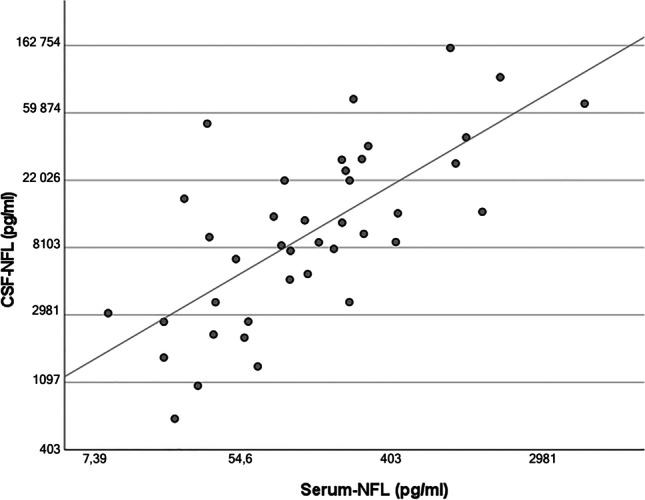
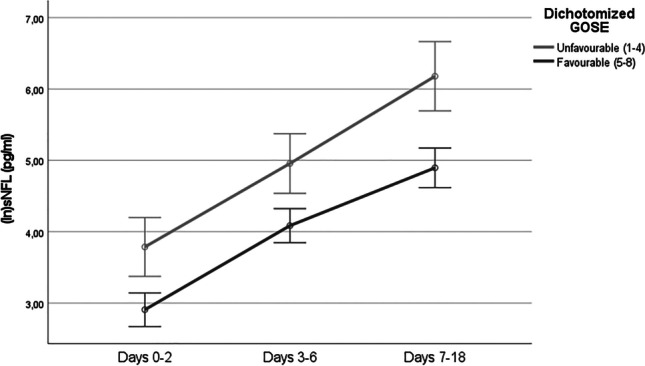
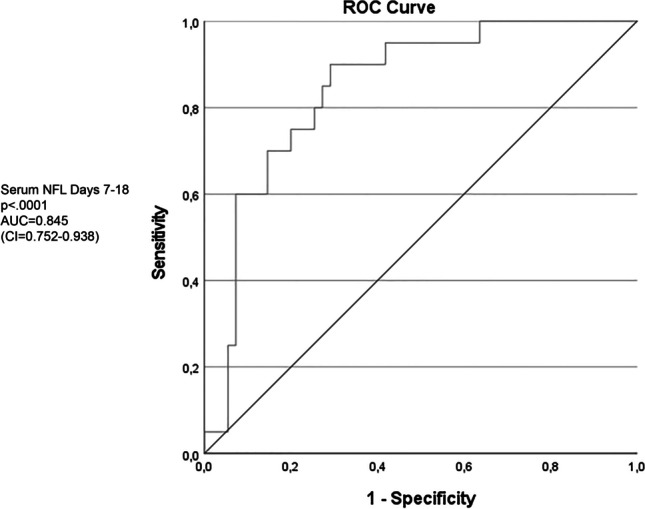
Results: A significant correlation between serum and CSF-NFL levels could be seen (Pearson's correlation coefficient = 0.7, p < .0001). Mean level of serum NFL was higher in the unfavourable outcome group than the favourable outcome group (p < .0001), in all epochs of SAH, and correlated with initial disease severity on the World Federation of Neurosurgical Societies scale. Serum NFL in the late phase displayed the best predictive potential in a receiver operation characteristic curve analysis (AUC=0.845, p < .0001).
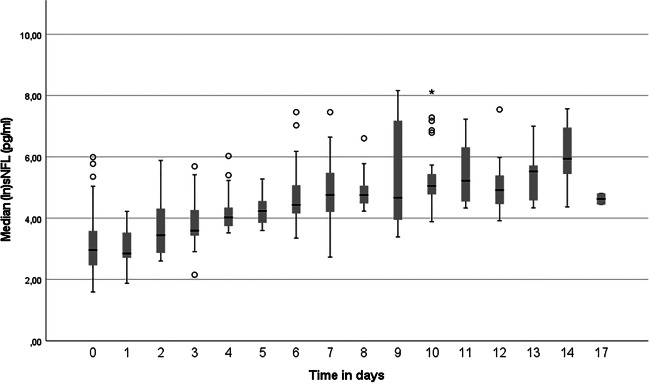
Conclusion: Levels of NFL in serum and CSF are correlated. Early serum NFL levels seem to reflect initial tissue damage and serum NFL levels in the late phase may reflect secondary events such as vasospasm or delayed cerebral ischemia. Serum NFL may be used as a prognostic marker of clinical outcome in SAH.
Keywords: Cerebral vasospasm; Glasgow Outcome Scale; Neurofilament protein l; Subarachnoid haemorrhage.
© 2023. The Author(s).
Conflict of interest statement
A.G. is employed by UmanDiagnostics® which has UmanDiagnostics NF-Light™ as a market product.
Figures
References
-
- Gendron TF, Badi MK, Heckman MG, Jansen-West KR, Vilanilam GK, Johnson PW, Burch AR, Walton RL, Ross OA, Brott TG, Miller TM, Berry JD, Nicholson KA, Wszolek ZK, Oskarsson BE, Sheth KN, Sansing LH, Falcone GJ, Cucchiara BL, Meschia JF, Petrucelli L. Plasma neurofilament light predicts mortality in patients with stroke. Sci Transl Med. 2020;12(569):eaay1913. doi: 10.1126/scitranslmed.aay1913. - DOI - PMC - PubMed
Publication types
MeSH terms
Substances
LinkOut - more resources
Full Text Sources
