Review
. 2023 Jul;23(4):403-408.
doi: 10.7861/clinmed.2022-0556. Epub 2023 Jun 23.

Recent treatment advances and practical management of hepatitis D virus

Affiliations
Review

Recent treatment advances and practical management of hepatitis D virus

Kathryn Olsen et al. Clin Med (Lond). 2023 Jul.

Abstract

Hepatitis D virus (HDV), also referred to as hepatitis delta virus, is the smallest virus capable of causing human disease. It is unable to replicate on its own and can only propagate in the presence of hepatitis B virus (HBV). Infection with both HBV and HDV frequently results in more severe disease than HBV alone, with higher instances of cirrhosis, liver failure and hepatocellular carcinoma (HCC). Thus, there is a need for effective treatment for HDV; however, currently approved treatment options are very limited both in terms of their efficacy and availability. This makes the management of HDV a challenge for physicians. In this review, we look at the background, diagnosis and treatment of HDV, informed by our hospital data, to set out the optimal management of HDV; we also explore novel treatment options for this disease.

Keywords: Hepatitis D virus; bulevirtide; lonafarnib; nucleic acid polymer REP 2139; pegylated interferon.


Figures

Fig 1.
Fig 1.
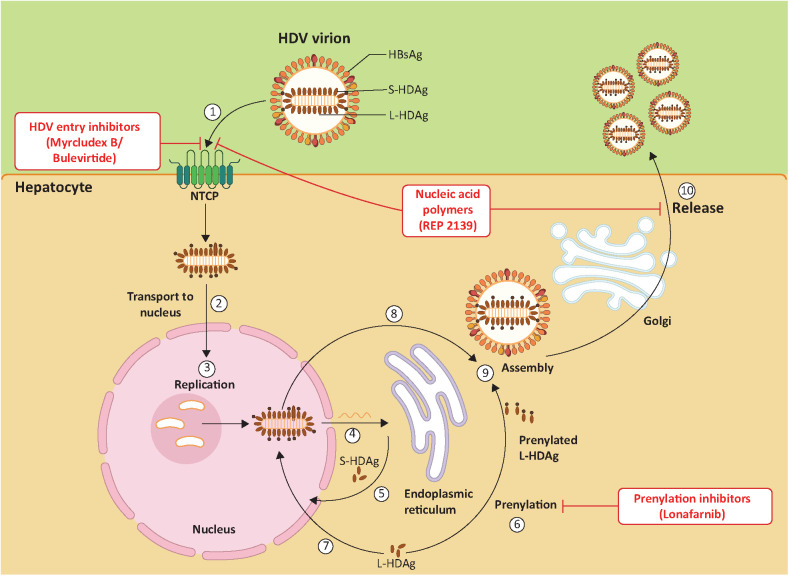
Hepatitis D viral life cycle and sites of potential therapies. (1) Hepatitis D virus (HDV) attaches to hepatocytes via interactions between hepatitis D surface antigen protein and sodium taurocholate cotransporting polypeptide (NTCP). (2) HDV ribonucleoprotein (RNP) is translocated to the nucleus by the hepatitis D antigen (HDAg) and (3) HDV replication occurs. (4) The HDV antigenome is transported to the endoplasmic reticulum (ER), where (5) it is translated into small HDAg (S-HDAg) and large HDAg (L-HDAg). (6) L-HDAg is prenylated before assembly. (7) S-HDAg supports HDV replication and is recycled into the nucleus. (8) New RNPs via new HDAg molecules are formed and exported into the cytoplasm. (9) New HDV RNP associates with hepatitis B virus (HBV) envelope proteins and is assembled into HDV virions. (10) HDV virions are released from the hepatocyte via the Golgi apparatus. Figure created with BioRender (biorender.com).

References

    1. Abbas Z, Afzal R. Life cycle and pathogenesis of hepatitis D virus: a review. World J Hepatol 2013;5:666–75. - PMC - PubMed
    1. Urban S, Neumann-Haefelin C, Lampertico P. Hepatitis D virus in 2021: virology, immunology and new treatment approaches for a difficult-to-treat disease. Gut 2021;70:1782–94. - PMC - PubMed
    1. Stockdale AJ, Kreuels B, Henrion MYR, et al. The global prevalence of hepatitis D virus infection: systematic review and meta-analysis. J Hepatol 2020;73:523–32. - PMC - PubMed
    1. Farci P, Niro GA. Clinical features of hepatitis D. Semin Liver Dis 2012;32:228–36. - PubMed
    1. Sandmann L, Cornberg M. Experimental drugs for the treatment of hepatitis D. J Exp Pharmacol 2021;13:461–8. - PMC - PubMed

Substances