


A systematic review of fear of falling and related constructs after hip fracture: prevalence, measurement, associations with physical function, and interventions
- PMID: 37353752
- PMCID: PMC10288814
- DOI: 10.1186/s12877-023-03855-9
A systematic review of fear of falling and related constructs after hip fracture: prevalence, measurement, associations with physical function, and interventions
Abstract
Background: Hip fracture is a common and debilitating injury amongst older adults. Fear of falling (FoF) and related constructs (balance confidence and falls efficacy) may impede rehabilitation after hip fracture. An updated systematic review to synthesize existing literature on FoF after hip fracture is needed. This review focussed on four research questions: In the hip fracture population: (1) What is the prevalence of FoF?; (2) What FoF assessment tools are validated? (3) What is the relationship between FoF and physical function?; (4) What interventions are effective for reducing FoF?
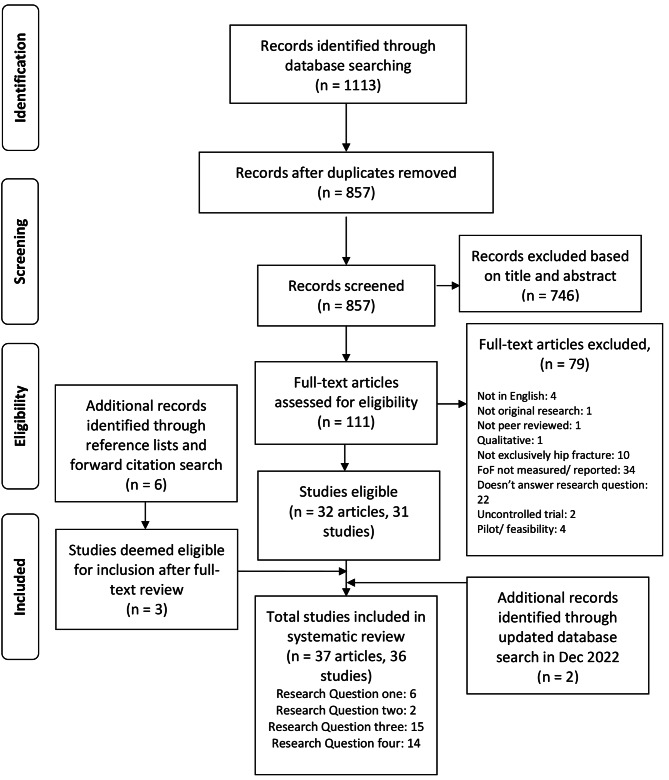
Methods: A systematic search was undertaken in EBSCO Health, Scopus and PsychINFO in January 2021 (and updated December 2022) for articles on FoF after hip fracture. Data in relation to each research question was extracted and analysed. The quality of the studies was appraised using the 'Risk of Bias Tool for Prevalence Studies', 'COSMIN Risk of Bias checklist for Patient-reported outcome measures', modified version of the 'Appraisal Tool for Cross-sectional studies', and the 'Cochrane Risk of Bias 2' tools for each research question, respectively.
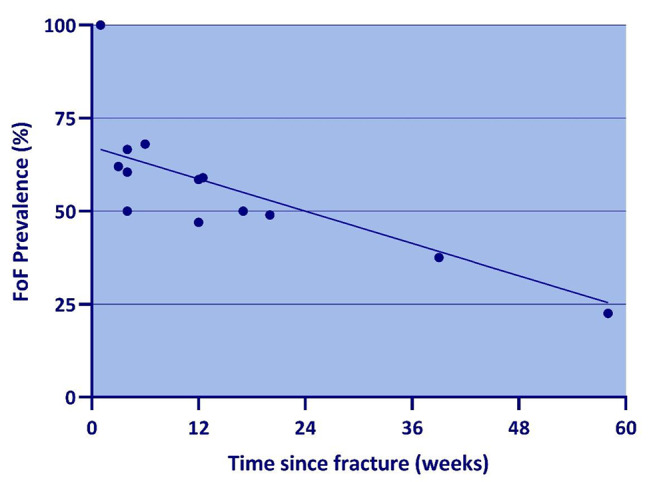
Results: 36 studies (37 articles) with 5099 participants were included (mean age 80.2 years and average 78% female). Prevalence rates for FoF after hip fracture ranged between 22.5% and 100%, and prevalence tended to decrease as time progressed post hip fracture. The 'Falls Efficacy Scale - International' (FES-I) and 'Fear of Falling Questionnaire - Revised' (FFQ-R) were found to be reliable, internally consistent, and valid tools in hip fracture patients. FoF after hip fracture was consistently associated with measures of physical function including balance, gait speed, composite physical performance measures and self-reported function. Ten of 14 intervention studies were considered high risk of bias. Exercise-based interventions with or without a psychological component were not effective in reducing FoF after hip fracture compared to a control condition.
Conclusion: FoF is prevalent after hip fracture and is consistently associated with poorer physical function. Only two instruments (FES-I and FFQ-R) have been validated for measuring FoF in the hip fracture population. However, there remains a need for larger, higher quality randomised controlled trials targeting FoF after hip fracture in order to guide clinical practice.
Trial registration: PROSPERO registration: CRD42020221836.
Keywords: Balance confidence; Falls efficacy; Fear of falling; Hip fracture; Neck of femur fracture OR nof; Older adults; Rehabilitation.
© 2023. The Author(s).
Conflict of interest statement
The authors declare that they have no competing interests.
Figures
References
-
- ANZHFR. ANZHFR Annual report of hip fracture care 2019. Aust New Zeal Hip Fract Regist. 2019
Publication types
MeSH terms
LinkOut - more resources
Full Text Sources
Medical
Miscellaneous
