. 2023 Jun 23;24(1):263.
doi: 10.1186/s12859-023-05389-8.

Fast and accurate genome-wide predictions and structural modeling of protein-protein interactions using Galaxy

Affiliations

Fast and accurate genome-wide predictions and structural modeling of protein-protein interactions using Galaxy

Aysam Guerler et al. BMC Bioinformatics. .

Abstract

Background: Protein-protein interactions play a crucial role in almost all cellular processes. Identifying interacting proteins reveals insight into living organisms and yields novel drug targets for disease treatment. Here, we present a publicly available, automated pipeline to predict genome-wide protein-protein interactions and produce high-quality multimeric structural models.

Results: Application of our method to the Human and Yeast genomes yield protein-protein interaction networks similar in quality to common experimental methods. We identified and modeled Human proteins likely to interact with the papain-like protease of SARS-CoV2's non-structural protein 3. We also produced models of SARS-CoV2's spike protein (S) interacting with myelin-oligodendrocyte glycoprotein receptor and dipeptidyl peptidase-4.

Conclusions: The presented method is capable of confidently identifying interactions while providing high-quality multimeric structural models for experimental validation. The interactome modeling pipeline is available at usegalaxy.org and usegalaxy.eu.

Keywords: Galaxy workflow; Protein–protein interactions; Structural modeling.


Conflict of interest statement

A.G., D.B., N.C. and A.N. are founders of and hold equity in GalaxyWorks, LLC. The results of the study discussed in this publication could affect the value of GalaxyWorks, LLC.

Figures
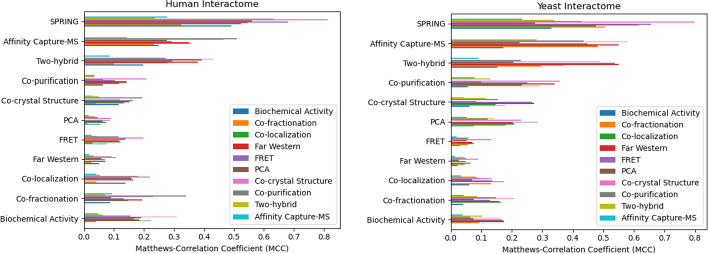
Fig. 1
Fig. 1
Human (left) and Yeast (right) protein–protein prediction results and comparison. Showing Matthew’s correlation coefficients (MCCs) as produced by comparing SPRING predictions with different protein–protein interaction experiments available in the BioGRID database. Each experimental method serves as a positive validation set for every other method
Fig. 2
Fig. 2
Putative ubiquitin-like substrates (colored) of SARS-CoV2 papain-like protease (green)
Fig. 3
Fig. 3
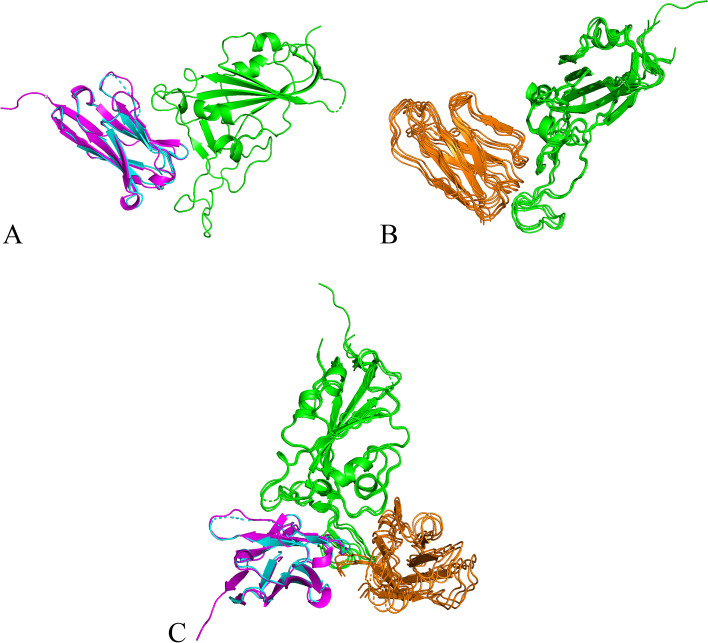
Putative binding modes of SARS-CoV2 receptor-binding domain (green) and A the top-ranking model of myelin-oligodendrocyte glycoprotein (cyan) with the homologue template of PDB entry 7C8V (pink) and B a cluster of secondary models (orange). C Display of both binding modes in complex with SARS-CoV2 receptor-binding domain
Fig. 4
Fig. 4
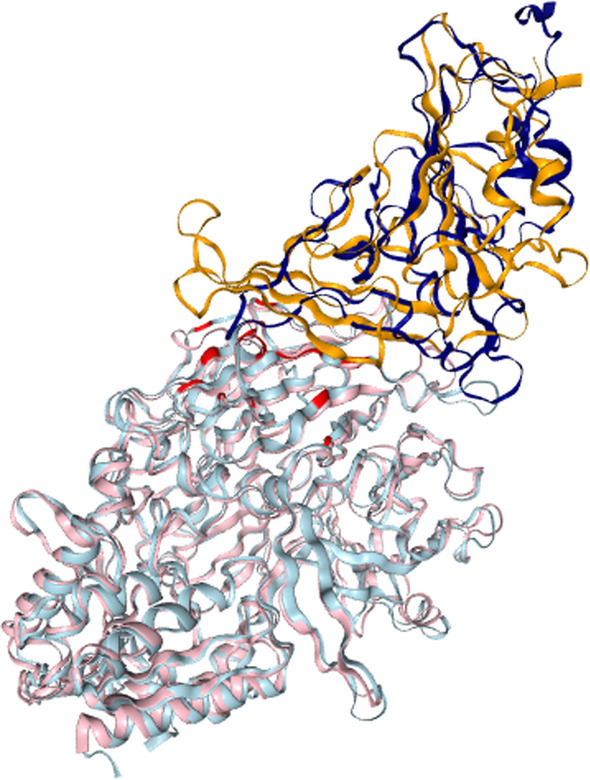
Putative binding mode between SARS-CoV2 (S) receptor-binding domain (RBD) (navy) and dipeptidyl peptidase-4 (DPP4) (cyan) with known MERS-CoV and DPP4 critical binding sites highlighted (red). The multimeric template framework is PDB entry 4L72 (pink), with the MERS-CoV receptor-binding domain (RBD) (orange)
Fig. 5
Fig. 5
Schematic overview of the presented pipeline, illustrating the main input data sets, tools and outputs

References

    1. Afgan E, et al. The galaxy platform for accessible, reproducible and collaborative biomedical analyses: 2018 update. Nucleic Acids Res. 2018 doi: 10.1093/nar/gky379. - DOI - PMC - PubMed
    1. Altschul S. Gapped BLAST and PSI-BLAST: a new generation of protein database search programs. Nucleic Acids Res. 1997;25(17):3389–3402. doi: 10.1093/nar/25.17.3389. - DOI - PMC - PubMed
    1. Baek M, et al. Accurate prediction of protein structures and interactions using a three-track neural network. Science. 2021;373(6557):871–876. doi: 10.1126/science.abj8754. - DOI - PMC - PubMed
    1. Benson DA, et al. GenBank. Nucleic Acids Res. 2014 doi: 10.1093/nar/gku1216. - DOI - PMC - PubMed
    1. Berman HM. The protein data bank. Nucleic Acids Res. 2000;28(1):235–242. doi: 10.1093/nar/28.1.235. - DOI - PMC - PubMed