


Machine learning to predict poor school performance in paediatric survivors of intensive care: a population-based cohort study
- PMID: 37354231
- PMCID: PMC10354166
- DOI: 10.1007/s00134-023-07137-1
Machine learning to predict poor school performance in paediatric survivors of intensive care: a population-based cohort study
Abstract
Purpose: Whilst survival in paediatric critical care has improved, clinicians lack tools capable of predicting long-term outcomes. We developed a machine learning model to predict poor school outcomes in children surviving intensive care unit (ICU).
Methods: Population-based study of children < 16 years requiring ICU admission in Queensland, Australia, between 1997 and 2019. Failure to meet the National Minimum Standard (NMS) in the National Assessment Program-Literacy and Numeracy (NAPLAN) assessment during primary and secondary school was the primary outcome. Routine ICU information was used to train machine learning classifiers. Models were trained, validated and tested using stratified nested cross-validation.
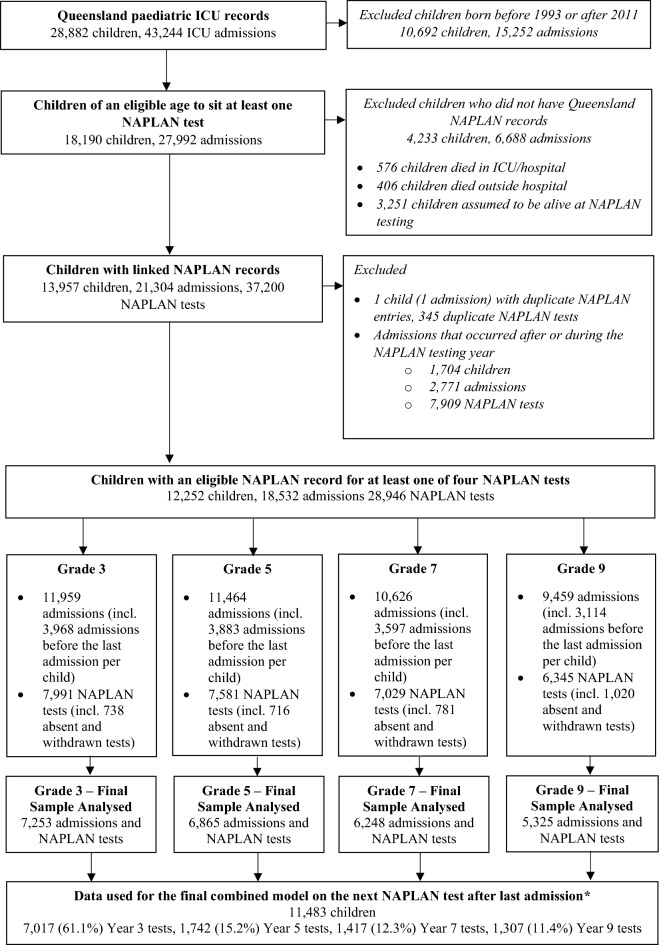
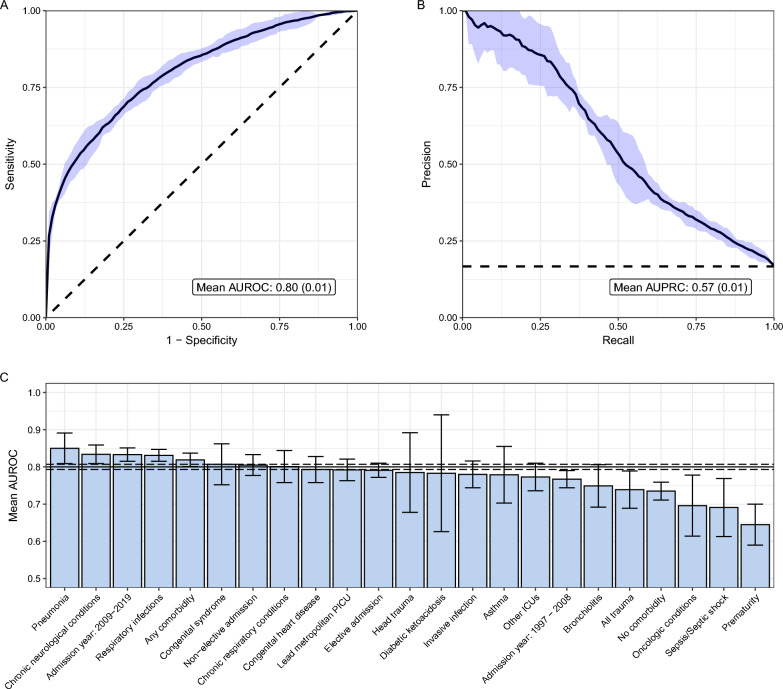
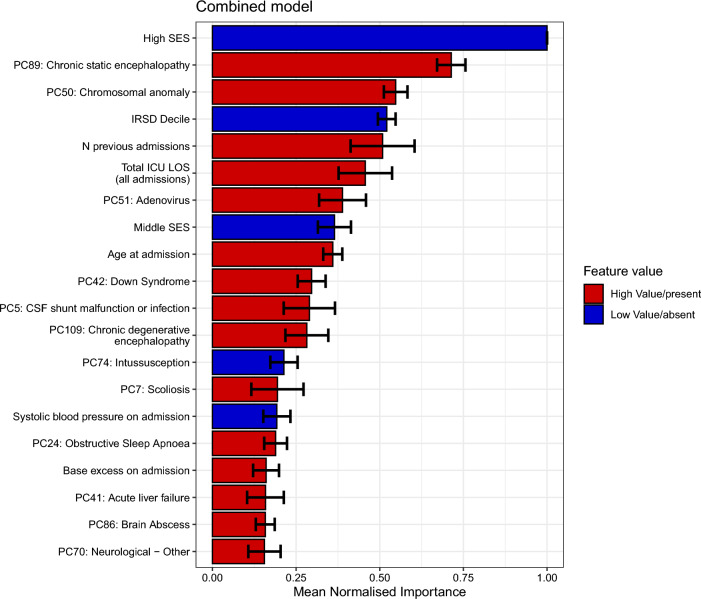
Results: 13,957 childhood ICU survivors with 37,200 corresponding NAPLAN tests after a median follow-up duration of 6 years were included. 14.7%, 17%, 15.6% and 16.6% failed to meet NMS in school grades 3, 5, 7 and 9. The model demonstrated an Area Under the Receiver Operating Characteristic curve (AUROC) of 0.8 (standard deviation SD, 0.01), with 51% specificity to reach 85% sensitivity [relative Area Under the Precision Recall Curve (rel-AUPRC) 3.42, SD 0.06]. Socio-economic status, illness severity, and neurological, congenital, and genetic disorders contributed most to the predictions. In children with no comorbidities admitted between 2009 and 2019, the model achieved a AUROC of 0.77 (SD 0.03) and a rel-AUPRC of 3.31 (SD 0.42).
Conclusions: A machine learning model using data available at time of ICU discharge predicted failure to meet minimum educational requirements at school age. Implementation of this prediction tool could assist in prioritizing patients for follow-up and targeting of rehabilitative measures.
Keywords: Child; Intensive care; Machine learning; Neurodevelopment; School.
© 2023. The Author(s).
Conflict of interest statement
None declared. The funding bodies had no role in study design, conduct, analyses and reporting.
Figures
References
-
- Moynihan KM, Alexander PMA, Schlapbach LJ, Millar J, Jacobe S, Ravindranathan H, Croston EJ, Staffa SJ, Burns JP, Gelbart B, Australian, New Zealand Intensive Care Society Pediatric Study G, the ACfO, Resource E Epidemiology of childhood death in Australian and New Zealand intensive care units. Intensive Care Med. 2019;45:1262–1271. - PubMed
-
- Schlapbach LJ, Straney L, Alexander J, MacLaren G, Festa M, Schibler A, Slater A, Group APS Mortality related to invasive infections, sepsis, and septic shock in critically ill children in Australia and New Zealand, 2002–13: a multicentre retrospective cohort study. Lancet Infect Dis. 2015;15:46–54. - PubMed
-
- Schlapbach LJ, Gibbons KS, Horton SB, Johnson K, Long DA, Buckley DHF, Erickson S, Festa M, d'Udekem Y, Alphonso N, Winlaw DS, Delzoppo C, van Loon K, Jones M, Young PJ, Butt W, Schibler A, Nitric Study Group tA, New Zealand Intensive Care Society Clinical Trials G, the APSG Effect of nitric oxide via cardiopulmonary bypass on ventilator-free days in young children undergoing congenital heart disease surgery: the NITRIC Randomized Clinical Trial. JAMA. 2022;328:38–47. - PMC - PubMed
-
- Carlton EF, Pinto N, Smith M, Fink EL, Watson RS, Hoehn KS, Marupudi N, Dervan LA, Lackey M, Ringwood M, Maddux AB, Network tP-PIotP, Health tEKSNIoC, Network HDCPCCR Overall health following pediatric critical illness: a scoping review of instruments and methodology. Pediatr Crit Care Med. 2021;22:1061–1071. - PMC - PubMed
-
- Fink EL, Jarvis JM, Maddux AB, Pinto N, Galyean P, Olson LM, Zickmund S, Ringwood M, Sorenson S, Dean JM, Carcillo JA, Berg RA, Zuppa A, Pollack MM, Meert KL, Hall MW, Sapru A, McQuillen PS, Mourani PM, Watson RS, Pediatric Acute Lung I, Sepsis Investigators Long-term Outcomes Subgroup Investigators a, Eunice Kennedy Shriver National Institute of Child H, Human Development Collaborative Pediatric Critical Care Research N Development of a core outcome set for pediatric critical care outcomes research. Contemp Clin Trials. 2020;91:105968. - PMC - PubMed
MeSH terms
Grants and funding
LinkOut - more resources
Full Text Sources
Medical
