


The impact of national and international travel on spatio-temporal transmission of SARS-CoV-2 in Belgium in 2021
- PMID: 37355572
- PMCID: PMC10290350
- DOI: 10.1186/s12879-023-08368-9
The impact of national and international travel on spatio-temporal transmission of SARS-CoV-2 in Belgium in 2021
Abstract
Background: The Severe Acute Respiratory Syndrome Coronavirus 2 (SARS-CoV-2) has rapidly spread over the world and caused tremendous impacts on global health. Understanding the mechanism responsible for the spread of this pathogen and the impact of specific factors, such as human mobility, will help authorities to tailor interventions for future SARS-CoV-2 waves or newly emerging airborne infections. In this study, we aim to analyze the spatio-temporal transmission of SARS-CoV-2 in Belgium at municipality level between January and December 2021 and explore the effect of different levels of human travel on disease incidence through the use of counterfactual scenarios.
Methods: We applied the endemic-epidemic modelling framework, in which the disease incidence decomposes into endemic, autoregressive and neighbourhood components. The spatial dependencies among areas are adjusted based on actual connectivity through mobile network data. We also took into account other important factors such as international mobility, vaccination coverage, population size and the stringency of restriction measures.
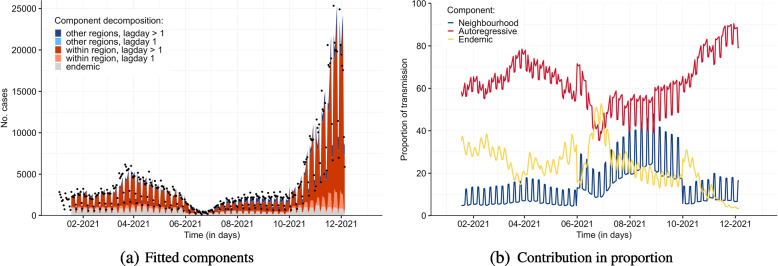
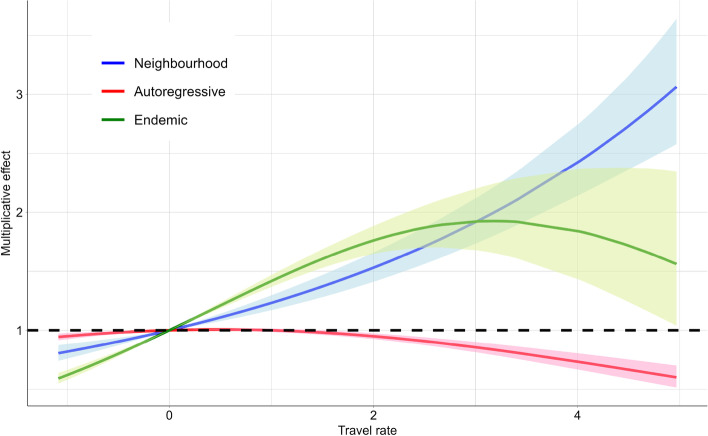
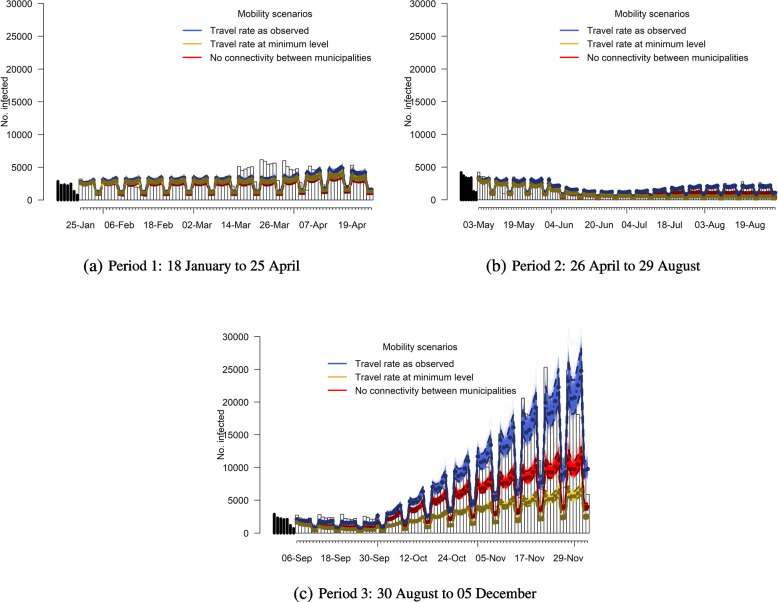
Results: The results demonstrate the aggravating effect of international travel on the incidence, and simulated counterfactual scenarios further stress the alleviating impact of a reduction in national and international travel on epidemic growth. It is also clear that local transmission contributed the most during 2021, and municipalities with a larger population tended to attract a higher number of cases from neighboring areas.
Conclusions: Although transmission between municipalities was observed, local transmission was dominant. We highlight the positive association between the mobility data and the infection spread over time. Our study provides insight to assist health authorities in decision-making, particularly when the disease is airborne and therefore likely influenced by human movement.
Keywords: COVID-19; Human mobility; International travel; Spatio-temporal model.
© 2023. The Author(s).
Conflict of interest statement
The authors declare no competing interests.
Figures
References
-
- Pullano G, Valdano E, Scarpa N, Rubrichi S, Colizza V. Evaluating the effect of demographic factors, socioe conomic factors, and risk aversion on mobility during the COVID-19 epidemic in France under lockdown: A population-based study. Lancet Digit Health. 2020;2(12):e638–49. doi: 10.1016/S2589-7500(20)30243-0. - DOI - PMC - PubMed
MeSH terms
LinkOut - more resources
Full Text Sources
Medical
Miscellaneous
