Association of a Medicare Advantage Posthospitalization Home Meal Delivery Benefit With Rehospitalization and Death
- PMID: 37355995
- PMCID: PMC10291360
- DOI: 10.1001/jamahealthforum.2023.1678
Association of a Medicare Advantage Posthospitalization Home Meal Delivery Benefit With Rehospitalization and Death
Abstract
Importance: The 2018 Chronic Care Act allowed Medicare Advantage plans to have greater flexibility in offering supplemental benefits, such as meals and services, to address unmet needs of beneficiaries with certain chronic conditions. Based on earlier studies of community-based nutritional support, such programs may result in reduced use.
Objective: To evaluate the association of a 4-week posthospitalization home-delivered meals benefit with 30-day all-cause rehospitalization and mortality in patients admitted for heart failure (HF) and other acute medical conditions (non-HF).
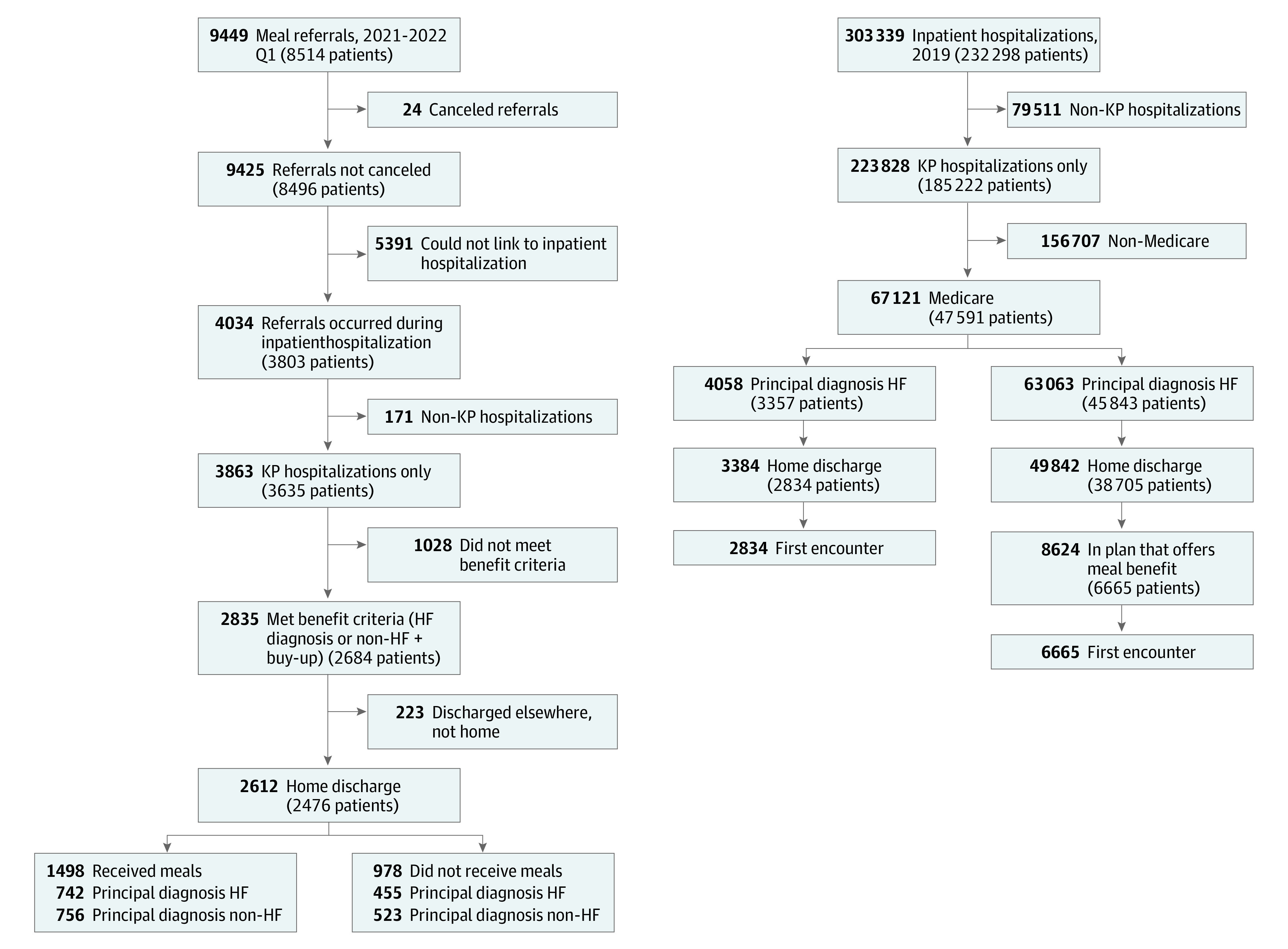
Design, setting, and participants: In this cohort study, patients who received meals (the meals group) were compared with 2 controls: (1) no meals in the 2019 historical cohort who would have been eligible for the benefit (the no meals-2019 group) and (2) no meals in the 2021 and 2022 concurrent cohort who were referred but did not receive the meals due to unsuccessful contacts and active declines (the no meals-2021/2022 group). This study took place in a large integrated health care system in southern California among Medicare Advantage members with a hospitalization for HF or other acute medical conditions at 15 Kaiser Permanente hospitals discharged to home.
Exposure: The exposure was receipt of at least 1 and up to 4 shipments of home-delivered meals (total of 56 to 84 meals) after hospital discharge.
Main outcomes and measures: The main outcomes were 30-day all-cause composite rehospitalization and death.
Results: A total of 4032 adults with admission to the hospital for HF (mean [SD] age, 79 [9] years; 1951 [48%] White; 2001 [50%] female) and 7944 with non-HF admissions (mean [SD] age, 78 [8] years; 3890 [49%] White; 4149 [52%] female) were included in the analyses. Unadjusted rates of 30-day death and rehospitalization for the meals, no meals-2019, and no meals-2021/2022 cohorts were as follows: HF: 23.3%, 30.1%, and 38.5%; non-HF: 16.5%, 22.4%, and 32.9%, respectively. For HF, exposure to meals was significantly associated with lower odds of 30-day death and rehospitalization compared with the no meals-2021/2022 cohort (OR, 0.55; 95% CI, 0.43-0.71; P < .001) but was not significant compared with the no meals-2019 cohort (OR, 0.86; 95% CI, 0.72-1.04; P = .12). For non-HF, exposure to meals was associated with significantly lower odds of 30-day death and rehospitalization when compared with the no meals-2019 (OR, 0.64; 95% CI, 0.52-0.79; P < .001) and the no meals-2021/2022 (OR, 0.48; 95% CI, 0.37-0.62; P < .001) cohorts.
Conclusions and relevance: In this cohort study, exposure to posthospitalization home-delivered meals was associated with lower 30-day rehospitalization and mortality; randomized clinical trials are needed to confirm these findings.
Conflict of interest statement
Figures
References
-
- Freed M, Biniek J, Damico A, Neuman T. Medicare Advantage in 2022: premiums, out-of-pocket limits, cost sharing, supplemental benefits, prior authorization, and star ratings. Kaiser Family Foundation. 2022. Accessed December 28, 2022. https://www.kff.org/medicare/issue-brief/medicare-advantage-in-2022-prem...
-
- Gilbert T, Neuburger J, Kraindler J, et al. . Development and validation of a Hospital Frailty Risk Score focusing on older people in acute care settings using electronic hospital records: an observational study. Lancet. 2018;391(10132):1775-1782. doi:10.1016/S0140-6736(18)30668-8 - DOI - PMC - PubMed
Publication types
MeSH terms
LinkOut - more resources
Full Text Sources
Medical
Research Materials
Miscellaneous