


Predicting response to chemoradiotherapy in rectal cancer via visual morphologic assessment and staging on baseline MRI: a multicenter and multireader study
- PMID: 37358604
- PMCID: PMC10480283
- DOI: 10.1007/s00261-023-03961-7
Predicting response to chemoradiotherapy in rectal cancer via visual morphologic assessment and staging on baseline MRI: a multicenter and multireader study
Abstract
Purpose: Pre-treatment knowledge of the anticipated response of rectal tumors to neoadjuvant chemoradiotherapy (CRT) could help to further optimize the treatment. Van Griethuysen et al. proposed a visual 5-point confidence score to predict the likelihood of response on baseline MRI. Aim was to evaluate this score in a multicenter and multireader study setting and compare it to two simplified (4-point and 2-point) adaptations in terms of diagnostic performance, interobserver agreement (IOA), and reader preference.
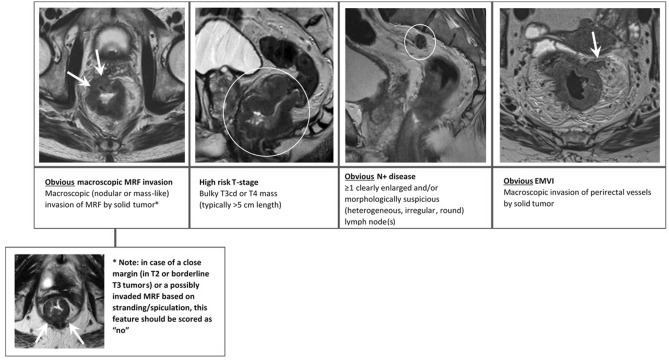
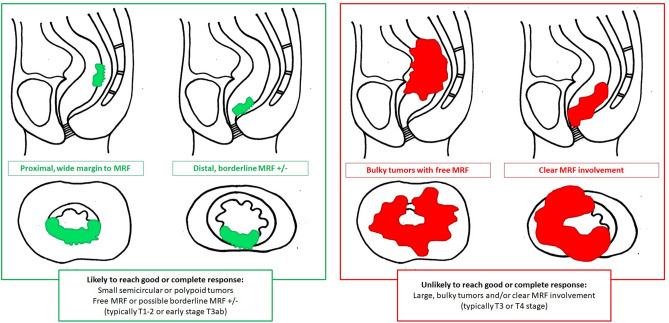
Methods: Twenty-two radiologists from 14 countries (5 MRI-experts,17 general/abdominal radiologists) retrospectively reviewed 90 baseline MRIs to estimate if patients would likely achieve a (near-)complete response (nCR); first using the 5-point score by van Griethuysen (1=highly unlikely to 5=highly likely to achieve nCR), second using a 4-point adaptation (with 1-point each for high-risk T-stage, obvious mesorectal fascia invasion, nodal involvement, and extramural vascular invasion), and third using a 2-point score (unlikely/likely to achieve nCR). Diagnostic performance was calculated using ROC curves and IOA using Krippendorf's alpha (α).
Results: Areas under the ROC curve to predict the likelihood of a nCR were similar for the three methods (0.71-0.74). IOA was higher for the 5- and 4-point scores (α=0.55 and 0.57 versus 0.46 for the 2-point score) with best results for the MRI-experts (α=0.64-0.65). Most readers (55%) favored the 4-point score.
Conclusions: Visual morphologic assessment and staging methods can predict neoadjuvant treatment response with moderate-good performance. Compared to a previously published confidence-based scoring system, study readers preferred a simplified 4-point risk score based on high-risk T-stage, MRF involvement, nodal involvement, and EMVI.
Keywords: Chemoradiotherapy; Magnetic resonance imaging; Rectal cancer; Response.
© 2023. The Author(s).
Conflict of interest statement
The authors have nothing to declare.
Figures
References
-
- van der Valk MJM, Hilling DE, Bastiaannet E, et al. Long-term outcomes of clinical complete responders after neoadjuvant treatment for rectal cancer in the International Watch & Wait Database (IWWD): an international multicentre registry study. Lancet. 2018;391(10139):2537–2545. doi: 10.1016/S0140-6736(18)31078-X. - DOI - PubMed
-
- Bach SP, STAR-TREC Collaborative Can we Save the rectum by watchful waiting or TransAnal surgery following (chemo)Radiotherapy versus Total mesorectal excision for early REctal Cancer (STAR-TREC)? Protocol for the international, multicentre, rolling phase II/III partially randomized patient preference trial evaluating long-course concurrent chemoradiotherapy versus short-course radiotherapy organ preservation approaches. Colorectal Dis. 2022;24(5):639–651. doi: 10.1111/codi.16056. - DOI - PMC - PubMed
Publication types
MeSH terms
LinkOut - more resources
Full Text Sources
Research Materials
Miscellaneous
