


Genetic risk factors of Alzheimer's Disease disrupt resting-state functional connectivity in cognitively intact young individuals
- PMID: 37358635
- PMCID: PMC10511575
- DOI: 10.1007/s00415-023-11809-9
Genetic risk factors of Alzheimer's Disease disrupt resting-state functional connectivity in cognitively intact young individuals
Abstract
Background: Past evidence shows that changes in functional brain connectivity in multiple resting-state networks occur in cognitively healthy individuals who have non-modifiable risk factors for Alzheimer's Disease. Here, we aimed to investigate how those changes differ in early adulthood and how they might relate to cognition.
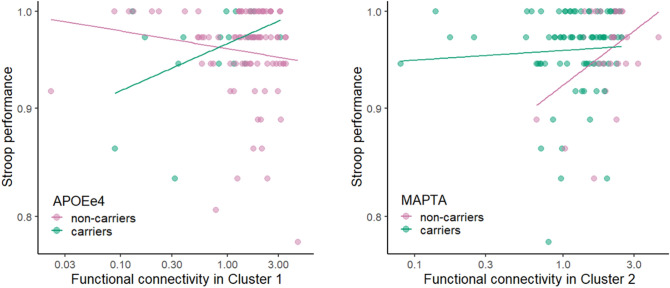
Methods: We investigated the effects of genetic risk factors of AD, namely APOEe4 and MAPTA alleles, on resting-state functional connectivity in a cohort of 129 cognitively intact young adults (aged 17-22 years). We used Independent Component Analysis to identify networks of interest, and Gaussian Random Field Theory to compare connectivity between groups. Seed-based analysis was used to quantify inter-regional connectivity strength from the clusters that exhibited significant between-group differences. To investigate the relationship with cognition, we correlated the connectivity and the performance on the Stroop task.
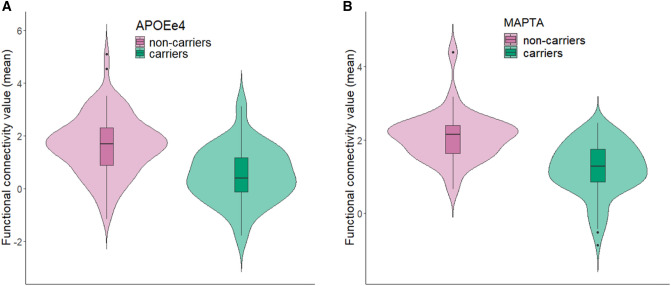
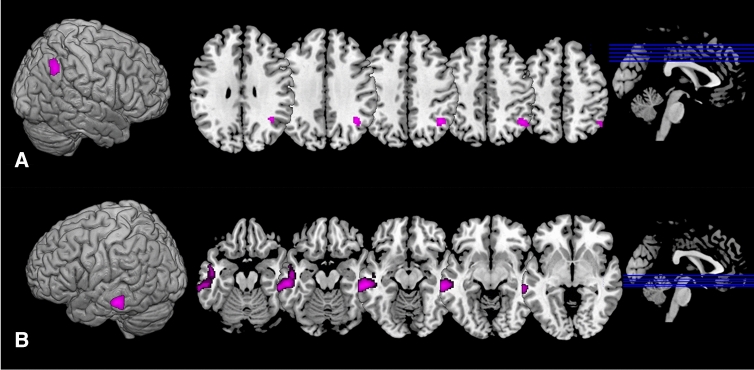
Results: The analysis revealed a decrease in functional connectivity in the Default Mode Network (DMN) in both APOEe4 carriers and MAPTA carriers in comparison with non-carriers. APOEe4 carriers showed decreased connectivity in the right angular gyrus (size = 246, p-FDR = 0.0079), which was correlated with poorer performance on the Stroop task. MAPTA carriers showed decreased connectivity in the left middle temporal gyrus (size = 546, p-FDR = 0.0001). In addition, we found that only MAPTA carriers had a decreased connectivity between the DMN and multiple other brain regions.
Conclusions: Our findings indicate that APOEe4 and MAPTA alleles modulate brain functional connectivity in the brain regions within the DMN in cognitively intact young adults. APOEe4 carriers also showed a link between connectivity and cognition.
Keywords: Alzheimer’s disease; Cognition; Functional connectivity; Functional neuroimaging; Large-scale networks; Risk factors.
© 2023. The Author(s).
Conflict of interest statement
LK is a recipient of the University of Sheffield Flagship Scholarship. LS’s participation is funded by Alzheimer's Research UK Senior Research Fellowship (ARUK-SRF2017B-1), NIHR Sheffield Biomedical Research Centre. JZ, CMN, GMT, and WH have no financial conflicts of interests to disclose. JOB has acted as a consultant for TauRx, Novo Nordisk, Biogen, Roche, Lilly and GE Healthcare and received grant or academic support from Avid/ Lilly, Merck and Alliance Medical. CR is the founder of Scottish Brain Sciences, and acted as a consultant for Biogen, Eisai, MSD, Actinogen, Roche, and Eli Lilly, and received payment or honoraria from Roche and Eisai in the past. SG acted as a consultant for Scottish Brain Sciences.
Figures


References
MeSH terms
Grants and funding
LinkOut - more resources
Full Text Sources
Medical
Miscellaneous
