Review
. 2023 Apr 17:1-15.
doi: 10.1038/s44222-023-00052-6. Online ahead of print.

Engineering synthetic biomolecular condensates

Affiliations
Review

Engineering synthetic biomolecular condensates

Yifan Dai et al. Nat Rev Bioeng. .

Abstract

The concept of phase-separation-mediated formation of biomolecular condensates provides a new framework to understand cellular organization and cooperativity-dependent cellular functions. With growing understanding of how biological systems drive phase separation and how cellular functions are encoded by biomolecular condensates, opportunities have emerged for cellular control through engineering of synthetic biomolecular condensates. In this Review, we discuss how to construct synthetic biomolecular condensates and how they can regulate cellular functions. We first describe the fundamental principles by which biomolecular components can drive phase separation. Next, we discuss the relationship between the properties of condensates and their cellular functions, which informs the design of components to create programmable synthetic condensates. Finally, we describe recent applications of synthetic biomolecular condensates for cellular control and discuss some of the design considerations and prospective applications.

Keywords: Biotechnology; Intrinsically disordered proteins; Soft materials; Synthetic biology.


Conflict of interest statement

Competing interestsThe authors declare no competing interests.

Figures
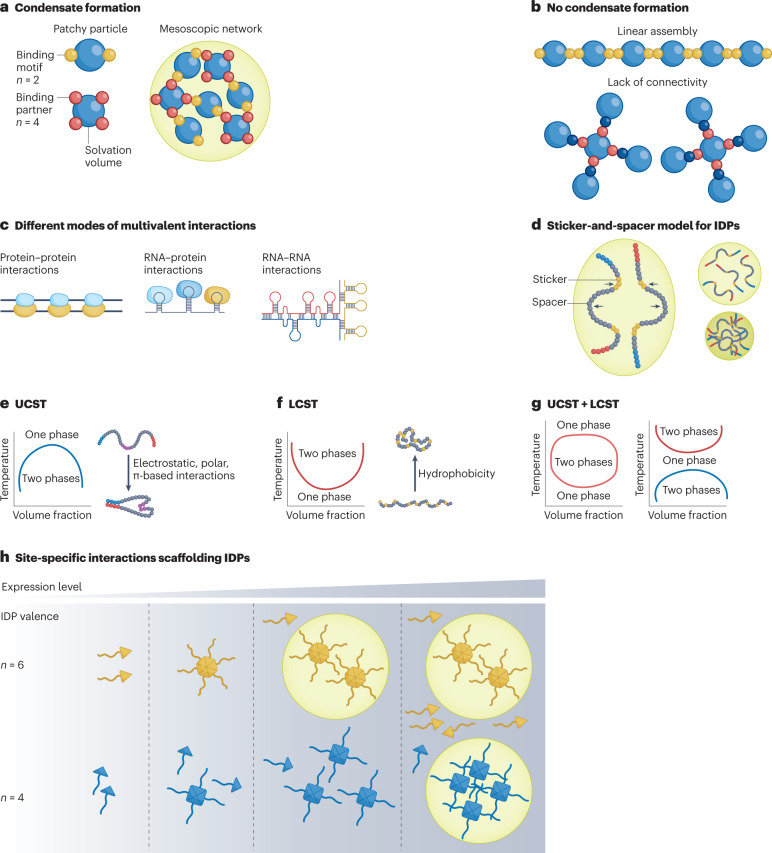
Fig. 1
Fig. 1. Principles of condensate formation.
a, Patchy particle model that explains the principle of multivalency mediated phase separation. b, Network formation is determined by the valency and the connectivity within the network. c, Different modes of multivalent interactions between different types of biomolecules. d, Sticker-and-spacer model represents how intrinsically disordered proteins (IDPs) undergo solvent-mediated phase transition. e, Phase diagram for upper-critical-solution-temperature (UCST) phase behaviour, in which a decrease in the system temperature results in strong intermolecular interactions and drives phase separation. f, Phase diagram for lower-critical-solution-temperature (LCST) phase behaviour, in which an increase in temperature increases the entropic penalty of water solvating the protein backbone and drives phase separation. g, Different double phase behaviours (UCST + LCST) are dictated by the differences in the transition temperatures of UCST and LCST systems. h, Effect of modulating the valency of site-specific interactions in an IDP-containing domain on its phase boundary.
Fig. 2
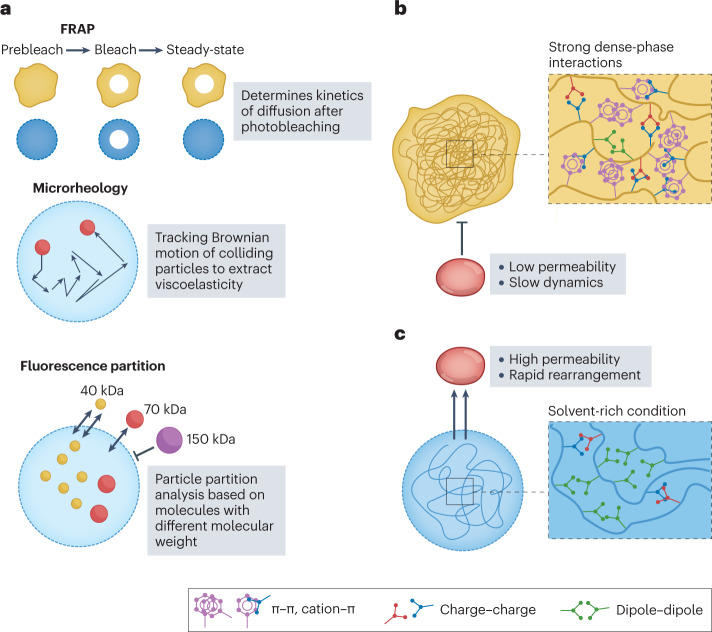
Fig. 2. Condensate material properties are a key determinant of condensate function.
a, Different experimental techniques to quantify the material properties of condensates. b, Condensates with strong dense-phase interactions result in low permeability and slow dynamics of the components in the condensate. c, Condensates with a solvent-rich dense phase result in high permeability and rapid rearrangement of molecules within that phase. FRAP, fluorescence recovery after photobleaching.
Fig. 3
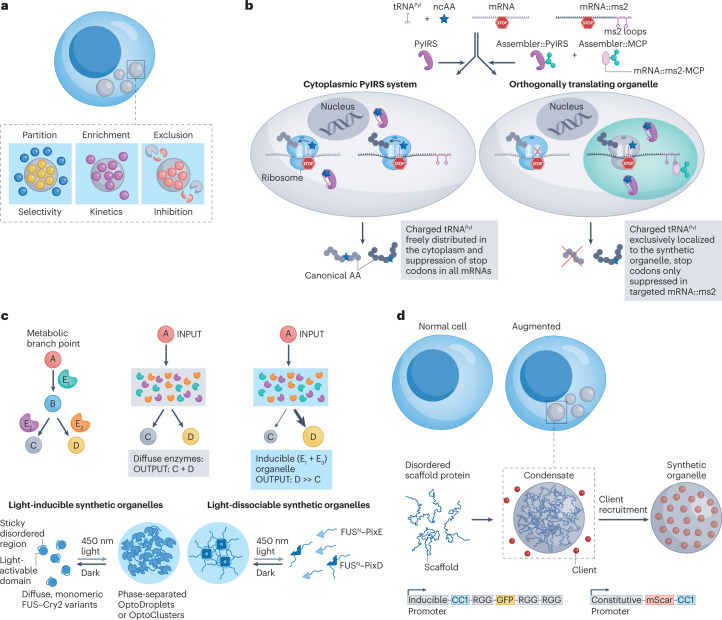
Fig. 3. Applications of synthetic biomolecular condensates for cellular control.
a, The mechanisms by which synthetic condensates can modulate cellular functions. b, Intrinsically disordered protein (IDP)-mediated synthetic condensates recruit specific transfer RNA (tRNA) synthetase and target mRNA, creating an orthogonal translational organelle. c, Light-controlled assembly of synthetic condensates enriches enzymes of interest, improves product yields and minimizes production of side-products. d, A synthetic condensate formed by an IDP disrupts cellular pathways by sequestering endogenous proteins of interest. FUS, fused in sarcoma protein; GFP, green fluorescent protein; MCP, MS2 coat protein; ncAA, non-natural amino acid; PN, N peptide; PyIRS, pyrrolsyl tRNA synthetase. Panel b from Reinkemeier, C. D., Girona, G. E. & Lemke, E. A. Designer membraneless organelles enable codon reassignment of selected mRNAs in eukaryotes. Science 363, eaaw2644 (2019). Reprinted with permission from AAAS ref. , AAAS. Panel c reprinted from ref. , Springer Nature Limited. Panel d reprinted from ref. , Springer Nature Limited.
Fig. 4
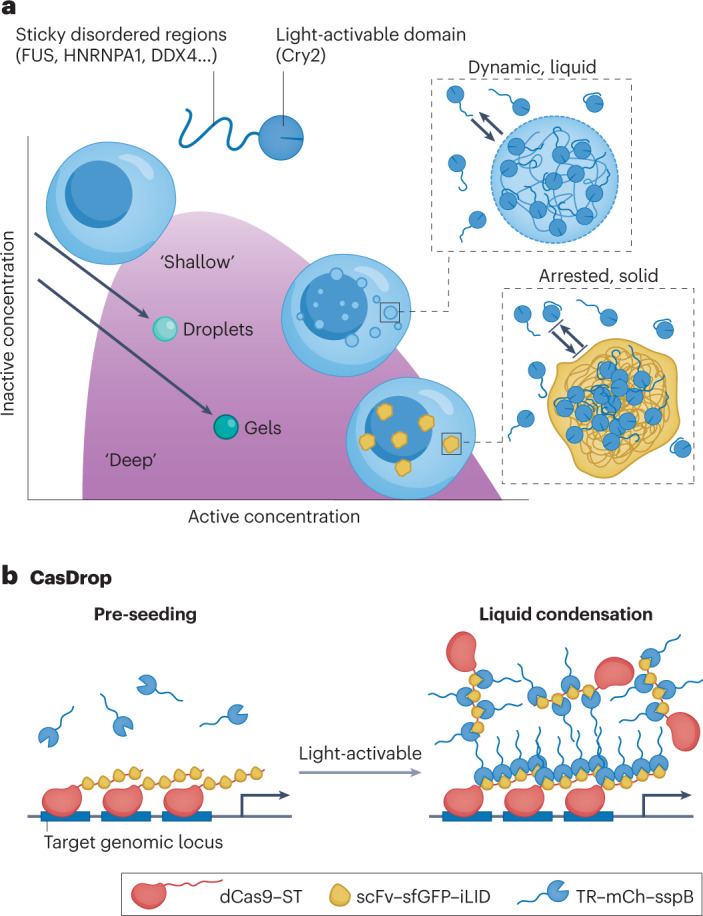
Fig. 4. Optogenetics-based synthetic phase-separation systems allow investigation of intracellular phase behaviours.
a, The OptoDroplet system consists of a light-activated Cry2 domain fused to an IDP. Activation of light intensity tunes the intermolecular interaction strength. b, The CasDrop system mechanically restructures the genome by light-activated condensate formation on a targeted genomic locus. Cry2, cryptochrome 2; dCAS9, enzymatically dead Cas9; iLID, improved light-induced dimer; mCh, mCherry; scFV, single-chain variable fragment; sfGFP, superfolder green fluorescence protein; sspB, stringent starvation protein B; ST, SunTag; TR, transcriptional regulator. Part a reprinted with permission from ref. , CellPress, Elsevier. Part b reprinted with permission from ref. , CellPress, Elsevier.
Fig. 5
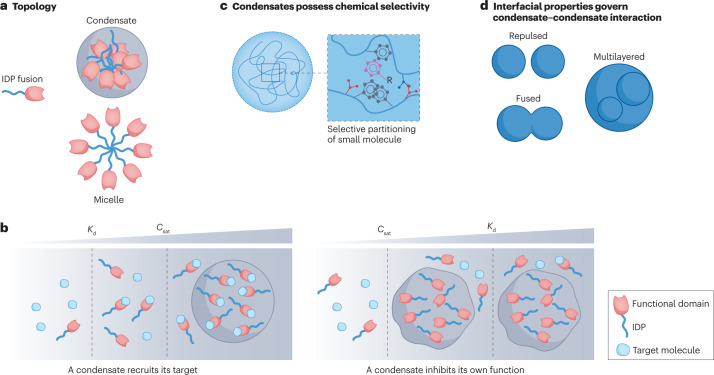
Fig. 5. Design considerations for synthetic condensates.
a, Phase separation of intrinsically disordered protein (IDP) fusion can result in macromolecular complexes with different topology. b, The relationship between binding affinity Kd of a functional domain for a target molecule and the saturation concentration Csat of the IDP dictates whether the condensate can recruit the target molecule. c, Condensates formed by different molecular components possess distinct chemical environments. A condensate with a hydrophobic environment can attract hydrophobic-type interactions. d, Condensate–condensate interactions can be modulated by interfacial properties, which can be regulated by the molecular components within the condensate, solvent environment and biomolecular surfactants.
Fig. 6
Fig. 6. Prospects of cellular functions modulated by synthetic condensates.
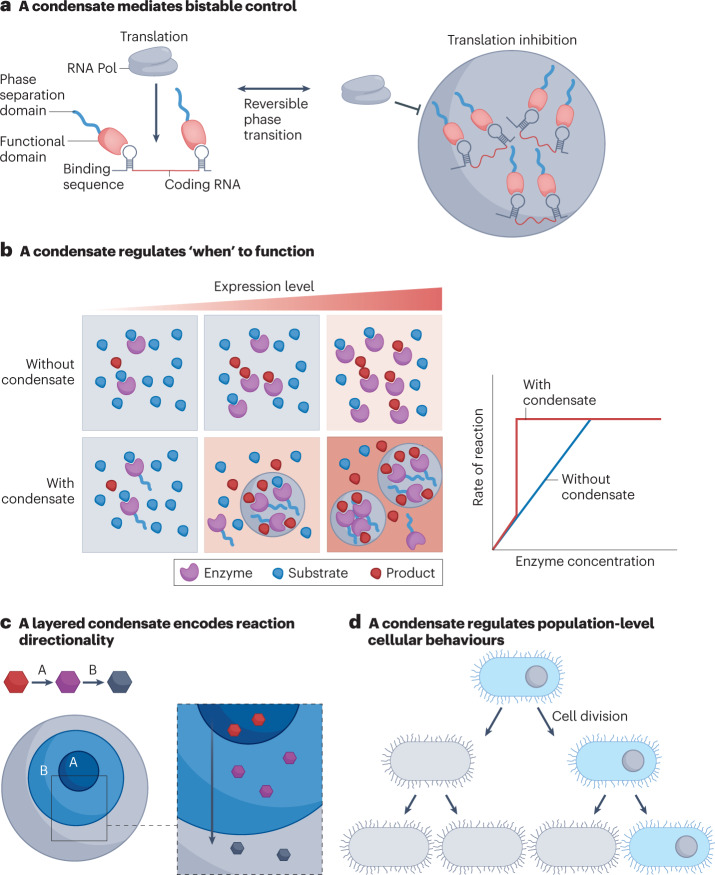
a, Reversible formation and dissolution of synthetic condensates can mediate bistable cellular functions. b, Phase separation is a concentration-dependent (and hence time-dependent) process to initiate cellular function, thereby regulating the ‘timing’ of and the efficiency of the synthetic function. c, A multilayered condensate can modulate reaction directionality. d, Control of the spatial location of a condensate in a cell can regulate the function of cells at the population level. RNA Pol, RNA polymerase.

References

    1. Alberts, B. Molecular Biology of the Cell (Norton, 2017).
    1. Shin Y, Brangwynne CP. Liquid phase condensation in cell physiology and disease. Science. 2017;357:eaaf4382. doi: 10.1126/science.aaf4382. - DOI - PubMed
    1. Choi J-M, Holehouse AS, Pappu RV. Physical principles underlying the complex biology of intracellular phase transitions. Annu. Rev. Biophys. 2020;49:107–133. doi: 10.1146/annurev-biophys-121219-081629. - DOI - PMC - PubMed
    1. Sabari BR, et al. Coactivator condensation at super-enhancers links phase separation and gene control. Science. 2018;361:eaar3958. doi: 10.1126/science.aar3958. - DOI - PMC - PubMed
    1. Lyon AS, Peeples WB, Rosen MK. A framework for understanding the functions of biomolecular condensates across scales. Nat. Rev. Mol. Cell Biol. 2021;22:215–235. doi: 10.1038/s41580-020-00303-z. - DOI - PMC - PubMed

LinkOut - more resources