


Reduced regional cerebral oxygen saturation increases risk for emergence delirium in pediatric patients
- PMID: 37360360
- PMCID: PMC10285695
- DOI: 10.3389/fped.2023.1117455
Reduced regional cerebral oxygen saturation increases risk for emergence delirium in pediatric patients
Abstract
Objectives: To assess whether decreased regional cerebral oxygen saturation (rScO2) is associated with the emergence delirium (ED) following general anesthesia in the pediatric population.
Methods: A retrospective observational cohort study was conducted on 113 children (ASA I-III) aged 2-14 years who underwent selective surgery under general anesthesia between 2022-01 and 2022-04. Intraoperatively, the rScO2 was monitored using a cerebral oximeter. The Pediatric Anesthesia Emergence Delirium (PAED) score was used to evaluate the patients for ED.
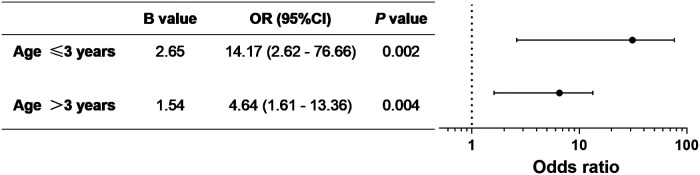
Results: The incidence of ED was 31%. Low rScO2 was reported in 41.6% of patients, who had a higher incidence of ED (P < 0.001) than those who did not experience desaturation. Logistic regression analysis revealed that decreased rScO2 was significantly associated with incident ED events [odds ratio (OR), 10.77; 95% confidence interval, 3.31-35.05]. Children under 3 years of age had a higher incidence of ED after rScO2 desaturation during anesthesia compared to older children (OR, 14.17 vs. 4.64).
Conclusion: Intraoperative rScO2 desaturation significantly increased the incidence of ED following general anesthesia. Monitoring should be enhanced to improve the oxygen balance in vital organs to improve the quality and safety of anesthesia.
Keywords: children; desaturation; emergence delirium; general anesthesia; regional cerebral oxygen saturation.
© 2023 Li, Gao, Zhang, Zhang, Wang, Wang and Li.
Conflict of interest statement
The authors declare that the research was conducted in the absence of any commercial or financial relationships that could be construed as a potential conflict of interest. The reviewer CW declared a shared parent affiliation with the author(s) to the handling editor at time of review.
Figures
References
-
- Gooden R, Tennant I, James B, Augier R, Crawford-Sykes A, Ehikhametalor K, et al. The incidence of emergence delirium and risk factors following sevoflurane use in pediatric patients for day case surgery, Kingston, Jamaica. Rev Bras Anestesiol. (2014) 64(6):413–8. 10.1016/j.bjan.2013.09.011 - DOI - PubMed
-
- Chandler JR, Myers D, Mehta D, Whyte E, Groberman MK, Montgomery CJ, et al. Emergence delirium in children: a randomized trial to compare total intravenous anesthesia with propofol and remifentanil to inhalational sevoflurane anesthesia. Paediatr Anaesth. (2013) 23(4):309–15. 10.1111/pan.12090 - DOI - PubMed
-
- Tsiotou AG, Malisiova A, Kouptsova E, Mavri M, Anagnostopoulou M, Kalliardou E. Dexmedetomidine for the reduction of emergence delirium in children undergoing tonsillectomy with propofol anesthesia: a double-blind, randomized study. Paediatr Anaesth. (2018) 28(7):632–8. 10.1111/pan.13397 - DOI - PubMed
LinkOut - more resources
Full Text Sources
