Review
. 2023 Jun 20:14:20406223231178273.
doi: 10.1177/20406223231178273. eCollection 2023.

Clinical scenarios-based guide for tofacitinib in rheumatoid arthritis

Affiliations
Review

Clinical scenarios-based guide for tofacitinib in rheumatoid arthritis

Mahta Mortezavi et al. Ther Adv Chronic Dis. .

Abstract

Tofacitinib was the first Janus kinase inhibitor to be approved for the treatment of rheumatoid arthritis (RA), and there is a large body of data to inform the efficacy and safety of this drug for patients at different places in their treatment journeys and with diverse demographics and characteristics. Here, we summarize tofacitinib clinical efficacy and safety data from some clinical trials, post hoc analyses, and real-world studies, which provide evidence of the efficacy of tofacitinib in treating patients with RA at various stages of their treatment journeys, and with differentiating baseline characteristics, such as age, gender, race, and body mass index. In addition, we review the safety data available from different patient subpopulations in the tofacitinib clinical development program, real-world data, and findings from the ORAL Surveillance post-marketing safety study that included patients aged ⩾50 years with pre-existing cardiovascular risk factors. The available efficacy and safety data in these subpopulations can enable better discussions between clinicians and patients to guide informed decision-making and individualized patient care.

Keywords: Janus kinase inhibitors; rheumatoid arthritis; tofacitinib.


Conflict of interest statement

The authors declared the following potential conflicts of interest with respect to the research, authorship, and/or publication of this article: MM is an employee and shareholder of Pfizer Inc. EFM is a speaker or advisor to AbbVie, Amgen, AstraZeneca, Bristol Myers Squibb, Glaxo SmithKline, Janssen, Lilly, Novartis, Pfizer Inc, Roche, and Sanofi.

Figures
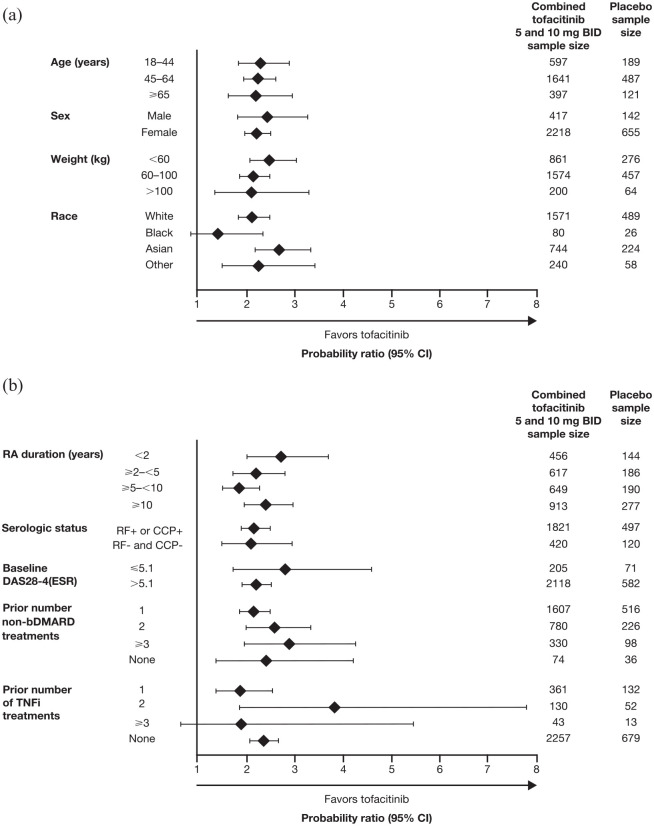
Figure 1.
Figure 1.
Probability ratios for achieving ACR20 response with tofacitinib plus MTX versus MTX alone in subpopulations of patients with RA stratified by (a) demographics and (b) disease characteristics. ACR20, American College of Rheumatology >20% response criteria; bDMARD, biologic disease-modifying antirheumatic drug; BID, twice daily; CCP, cyclic citrullinated peptide; CI, confidence interval; DAS28-4(ESR), Disease Activity Score in 28 joints, erythrocyte sedimentation rate; MTX, methotrexate; RA, rheumatoid arthritis; RF, rheumatoid factor; TNFi, tumor necrosis factor inhibitor. Pooled analysis of data for tofacitinib 5 and 10 mg BID or placebo in phase II/III trials of ⩾3 months’ duration (NCT00550446, NCT00687193, NCT00814307, NCT00413660, NCT00603512, NCT00960440, NCT00847613, NCT00856544, and NCT00853385).
Figure 2.
Figure 2.
Proportion of patients achieving (a) CDAI LDAa and (b) CDAI remissionb, and change from baseline in (c) DAS28-4(CRP)c and (d) HAQ-DId over time in ORAL Surveillance. BID, twice daily; BL, baseline; CDAI, Clinical Disease Activity Index; DAS28-4(CRP), Disease Activity Score in 28 joints, C-reactive protein; HAQ-DI, Health Assessment Questionnaire-Disability Index; LDA, low disease activity; LSM, least squares mean; MMRM, mixed model for repeated measures; N, number of patients with observations at visit; SE, standard error; TNFi, tumor necrosis factor inhibitor. Binary outcomes were analyzed using normal approximation of the difference in binomial proportions. Last Observation Carried Forward mixed components were applied to the missing data. On-treatment time included data on or prior to the study treatment end date. Only visits with >50 patients for each treatment group were included. For continuous outcomes, data were derived from an MMRM with fixed effects for treatment, visit, treatment group by visit interaction, baseline value, and baseline value by visit interaction, without imputation for missing values. A common heterogeneous compound symmetry covariance matrix was used. On-treatment time includes data on or prior to the study treatment end date. Only visits with >50 patients for each treatment group were included. aDefined as CDAI ⩽ 10. bDefined as CDAI ⩽ 2.8. cScores range from 0 to 9.4, with higher scores indicative of worse disease activity. dScores range from 0 to 3, with increasing scores indicative of worse functioning (0 indicating no functional impairment and 3 indicating complete impairment). eFor patients randomized to the tofacitinib 10 mg BID group who had their dose of tofacitinib reduced to 5 mg BID, the data collected after patients were switched to tofacitinib 5 mg BID were counted in the tofacitinib 10 mg BID group.
Figure 3.
Figure 3.
Effects of tofacitinib monotherapy on RA (a) disease activity, (b) patient-reported outcomes, and (c) radiographic progression at Month 6 in ORAL Start, a phase III study of MTX-naïve patients., ACR70, American College of Rheumatology >70% response criteria; BID, twice daily; DAS28-4(ESR), Disease Activity Score in 28 joints, erythrocyte sedimentation rate; FACIT-F, Functional Assessment of Chronic Illness Therapy-Fatigue; HAQ-DI, Health Assessment Questionnaire-Disability Index; LDA, low disease activity; MCID, minimal clinically important difference; mTSS, modified Total Sharp Score; MTX, methotrexate; N, number of patients randomized and treated; RA, rheumatoid arthritis; SE, standard error; VAS, visual analog scale. aLDA defined as DAS28-4(ESR) score ⩽ 3.2. bRemission defined as DAS28-4(ESR) score < 2.6. c⩾0.22-point decrease from baseline in HAQ-DI. d⩾10 mm decrease from baseline in pain VAS score. e⩾4-point increase from baseline in FACIT-F total score. fNo radiographic progression defined as change from baseline in the mTSS ⩽ 0.5. *p ⩽ 0.05;**p < 0.001 versus MTX.
Figure 4.
Figure 4.
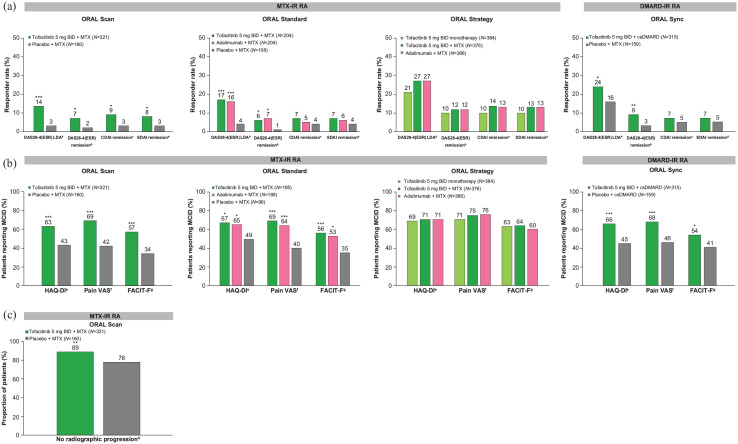
Effects of tofacitinib as monotherapy or in combination with csDMARD on (a) disease activity at Month 6, (b) patient-reported outcomes at Month 3, and (c) radiographic progression at Month 6 in phase III and IIIb/IV studies of patients with DMARD-IR.–,,–,, BID, twice daily; CDAI, Clinical Disease Activity Index; csDMARD, conventional synthetic disease-modifying antirheumatic drug; DAS28-4(ESR), Disease Activity Score in 28 joints, erythrocyte sedimentation rate; FACIT-F, Functional Assessment of Chronic Illness Therapy-Fatigue; HAQ-DI, Health Assessment Questionnaire-Disability Index; IR, inadequate response; LDA, low disease activity; MCID, minimal clinically important difference; mTSS, modified Total Sharp Score; MTX, methotrexate; N, number of patients randomized and treated (N may vary by outcome); RA, rheumatoid arthritis; SDAI, Simplified Disease Activity Index; VAS, visual analog scale. aDAS28-4(ESR) LDA defined as ⩽3.2 or <3.2 (ORAL Strategy). bDAS28-4(ESR) remission defined as <2.6. cCDAI remission defined as ⩽2.8. dSDAI remission defined as ⩽3.3. e⩾0.22-point decrease from baseline in HAQ-DI. f⩾10 mm decrease from baseline in pain VAS score. g⩾4-point increase from baseline in FACIT-F total score. hNo radiographic progression defined as change from baseline in the mTSS ⩽ 0.5. *p ⩽ 0.05; **p < 0.01; ***p < 0.001 versus MTX or csDMARD plus placebo.
Figure 5.
Figure 5.
Effects of tofacitinib in combination with csDMARD on (a) disease activity and (b) patient-reported outcomes at Month 3 in a phase III study of patients with TNFi-IR RA,, and change from baseline in (c) DAS28-4(ESR) and (d) HAQ-DI at Month 3 in phase II/III trials of bDMARD-naïve and bDMARD-IR patients (adapted by permission from BMJ publishing Group Limited [Charles-Schoeman C, et al. Ann Rheum Dis 2016]). bDMARD, biologic disease-modifying antirheumatic drug; BID, twice daily; CDAI, Clinical Disease Activity Index; CI, confidence interval; csDMARD, conventional synthetic disease-modifying antirheumatic drug; DAS28-4(ESR), Disease Activity Score in 28 joints, erythrocyte sedimentation rate; HAQ-DI, Health Assessment Questionnaire-Disability Index; IR, inadequate response; LDA, low disease activity; LSM, least squares mean; MCID, minimal clinically important difference; MTX, methotrexate; N, number of patients randomized and treated; RA, rheumatoid arthritis; SDAI, Simplified Disease Activity Index; TNFi, tumor necrosis factor inhibitor. aDAS28-4(ESR) LDA defined as ⩽3.2. bDAS28-4(ESR) remission defined as <2.6. cCDAI remission defined as ⩽2.8. dSDAI remission defined as ⩽3.3. e⩾0.22-point decrease from baseline in HAQ-DI. *p < 0.05 versus MTX plus placebo or placebo, ***p < 0.0001 versus MTX plus placebo or placebo.

References

    1. Smolen JS, Aletaha D, McInnes IB. Rheumatoid arthritis. Lancet 2016; 388: 2023–2038. - PubMed
    1. Taylor PC, Atzeni F, Balsa A, et al. The key comorbidities in patients with rheumatoid arthritis: a narrative review. J Clin Med 2021; 10: 509. - PMC - PubMed
    1. Smolen JS, Landewé RBM, Bijlsma JWJ, et al. EULAR recommendations for the management of rheumatoid arthritis with synthetic and biological disease-modifying antirheumatic drugs: 2019 update. Ann Rheum Dis 2020; 79: 685–699. - PubMed
    1. Fraenkel L, Bathon JM, England BR, et al. 2021 American College of Rheumatology guideline for the treatment of rheumatoid arthritis. Arthritis Rheumatol 2021; 73: 1108–1123. - PubMed
    1. Lee EB, Fleischmann R, Hall S, et al. Tofacitinib versus methotrexate in rheumatoid arthritis. N Engl J Med 2014; 370: 2377–2386. - PubMed

LinkOut - more resources