Mercuric Chloride Induced Nephrotoxicity: Ameliorative Effect of Carica papaya Leaves Confirmed by Histopathology, Immunohistochemistry, and Gene Expression Studies
- PMID: 37360438
- PMCID: PMC10286259
- DOI: 10.1021/acsomega.3c01045
Mercuric Chloride Induced Nephrotoxicity: Ameliorative Effect of Carica papaya Leaves Confirmed by Histopathology, Immunohistochemistry, and Gene Expression Studies
Retraction in
-
Retraction of "Mercuric Chloride Induced Nephrotoxicity: Ameliorative Effect of Carica papaya Leaves Confirmed by Histopathology, Immunohistochemistry, and Gene Expression Studies".ACS Omega. 2025 Feb 28;10(9):9808. doi: 10.1021/acsomega.5c01751. eCollection 2025 Mar 11. ACS Omega. 2025. PMID: 40092779 Free PMC article.
Abstract
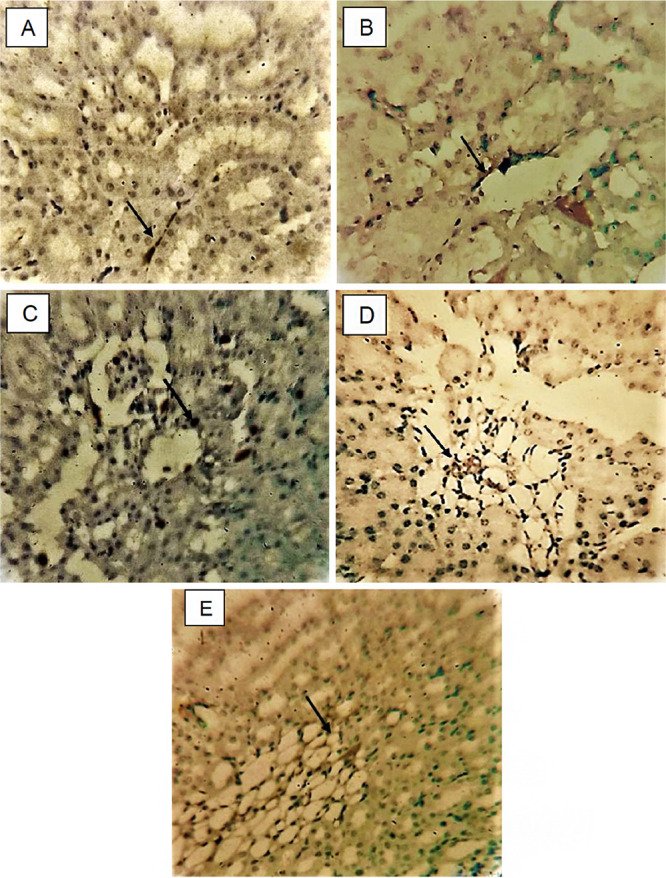
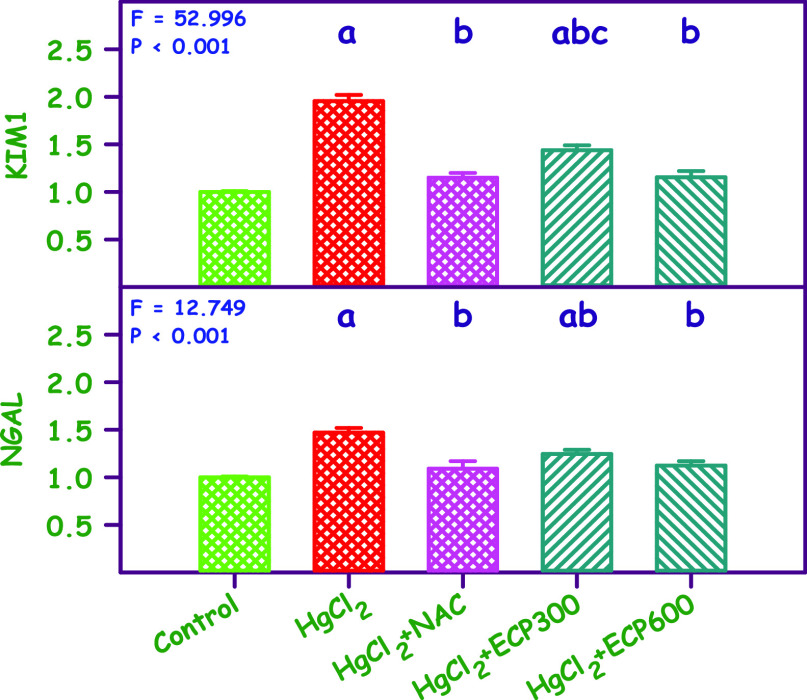
The present study analyzes the efficacy of the ethanolic extract of C. papaya leaves (ECP) against HgCl2-induced nephrotoxicity. The effects on the biochemical and percentage of body and organ weight against HgCl2-induced nephrotoxicity in female Wistar rats were studied. Wistar rats were divided into five groups with six animals in each group: control, HgCl2 (2.5 mg/kg b.w.), N-acetylcysteine (NAC 180 mg/kg) + HgCl2, ECP (300 mg/kg b.w.) + HgCl2, and ECP (600 mg/kg) + HgCl2 groups. After 28 days of study, animals were sacrificed on the 29th day to harvest the blood and kidneys for further analysis. The effect ECP was analyzed by immunohistochemistry (NGAL) and real-time PCR (KIM-1 and NGAL mRNA) in HgCl2-induced nephrotoxicity. The results revealed that the HgCl2 group showed prominent damage in the proximal tubules and glomerulus of nephrons and enormous expression of NGAL in immunohistochemistry and KIM-1 and NGAL in real-time PCR compared to the control group. The simultaneous pretreatment with NAC (180 mg/kg) and ECP (600 and 300 mg/kg) reduced renal damage and expression of NGAL in immunohistochemistry and KIM-1 and NGAL gene in real-time PCR. This study attests to the nephroprotective effect of ECP against HgCl2-induced toxicity.
© 2023 The Authors. Published by American Chemical Society.
Conflict of interest statement
The authors declare no competing financial interest.
Figures
References
-
- Li P.-K.; Garcia G.; Lui S.-F.; Andreoli S.; Fung W.-W.; Hradsky A.; Kumaraswami L.; Liakopoulos V.; Rakhimova Z.; Saadi G.; Strani L.; Ulasi I.; Kalantar Z.-K. Kidney health for everyone everywhere - from prevention to detection and equitable access to care. Clin. Nephrol. 2020, 93, 111–122. 10.5414/CNWKDEditorial. - DOI - PubMed
-
- Bello A.-K.; Levin A.; Tonelli M.; Okpechi I.-G.; Feehally J.; Harris D.; Jindal K.; Salako B. L.; Rateb A.; Osman M. A.; Qarni B.; Saad S.; Lunney M.; Wiebe N.; Ye F.; Johnson D. W. Assessment of Global Kidney Health Care Status. JAMA. 2017, 317, 1864–1881. 10.1001/jama.2017.4046. - DOI - PMC - PubMed
-
- Vaidya V.-S.; Ozer J.-S.; Dieterle F.; Collings F.-B.; Ramirez V.; Troth S.; Muniappa N.; Thudium D.; Gerhold D.; Holder D.-J.; Bobadilla N.-A.; Marrer E.; Perentes E.; Cordier A.; Vonderscher J.; Maurer G.; Goering P.-L.; Sistare F.-D.; Bonventre J.-V. Kidney injury molecule-1 outperforms traditional biomarkers of kidney injury in preclinical biomarker qualification studies. Nat. Biotechnol. 2010, 28, 478–485. 10.1038/nbt.1623. - DOI - PMC - PubMed
Publication types
LinkOut - more resources
Full Text Sources
Miscellaneous