Review
. 2023 May 9:1-31.
doi: 10.1007/s10311-023-01604-3. Online ahead of print.

Artificial intelligence for waste management in smart cities: a review

Affiliations
Review

Artificial intelligence for waste management in smart cities: a review

Bingbing Fang et al. Environ Chem Lett. .

Abstract

The rising amount of waste generated worldwide is inducing issues of pollution, waste management, and recycling, calling for new strategies to improve the waste ecosystem, such as the use of artificial intelligence. Here, we review the application of artificial intelligence in waste-to-energy, smart bins, waste-sorting robots, waste generation models, waste monitoring and tracking, plastic pyrolysis, distinguishing fossil and modern materials, logistics, disposal, illegal dumping, resource recovery, smart cities, process efficiency, cost savings, and improving public health. Using artificial intelligence in waste logistics can reduce transportation distance by up to 36.8%, cost savings by up to 13.35%, and time savings by up to 28.22%. Artificial intelligence allows for identifying and sorting waste with an accuracy ranging from 72.8 to 99.95%. Artificial intelligence combined with chemical analysis improves waste pyrolysis, carbon emission estimation, and energy conversion. We also explain how efficiency can be increased and costs can be reduced by artificial intelligence in waste management systems for smart cities.

Keywords: Artificial intelligence; Chemical analysis; Cost efficiency; Optimization; Waste management.


Conflict of interest statement

Conflict of interestThe authors have not disclosed any competing interests.

Figures
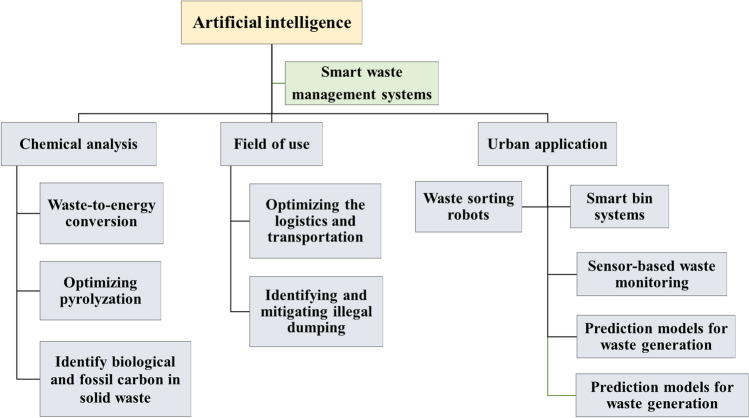
Fig. 1
Fig. 1
Application of artificial intelligence in waste management. The figure illustrates five key aspects: waste type and generation, the use of artificial intelligence in waste management, artificial intelligence-based optimization of waste transportation, the role of artificial intelligence in detecting and reducing illegal dumping and waste treatment practices, and the use of artificial intelligence to analyze the chemical composition of waste. This optimized representation provides a clear and concise overview of the main themes discussed in this review, highlighting the potential of artificial intelligence to revolutionize waste management practices
Fig. 2
Fig. 2
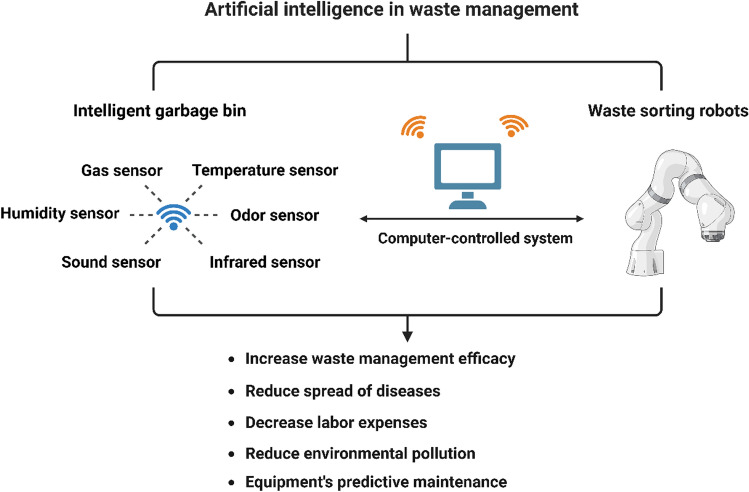
Uses of artificial intelligence in the garbage bin and waste robotic sorting. These include real-time garbage bin monitoring to optimize waste collection routes and prevent bin overflows. Additionally, intelligent garbage sorting can improve recycling efficiency and reduce contamination. In contrast, robotic waste sorting can utilize robotic arms to sort waste in recycling facilities, increasing the speed and accuracy of sorting while reducing the need for manual labor. Artificial intelligence can also be used for predictive maintenance to anticipate when waste-sorting equipment will require maintenance, reducing downtime and extending equipment lifespans. Lastly, waste management optimization using artificial intelligence can consider factors such as traffic, weather, and population density to enhance the efficiency of waste collection and processing
Fig. 3
Fig. 3
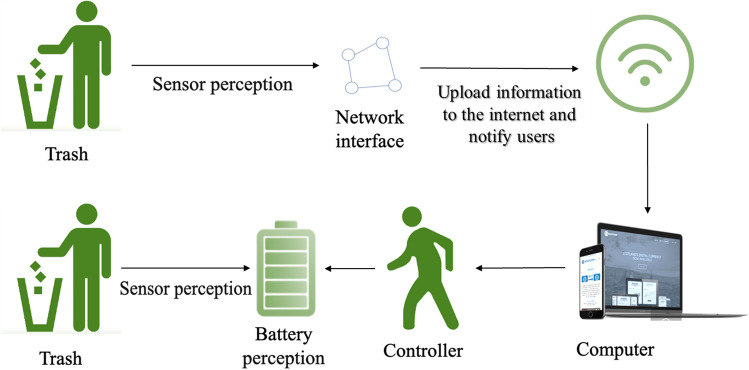
A typical wireless sensor network structure for a solid waste management system. A sensor is installed on the garbage bin. When garbage enters, the sensor can obtain information such as smell, weight, and humidity to classify the trash. At the same time, it can detect the environment of garbage bins and monitor the filling level of garbage bins. Users can monitor the status of garbage bins on the platform in real time as the information is uploaded through the internet
Fig. 4
Fig. 4
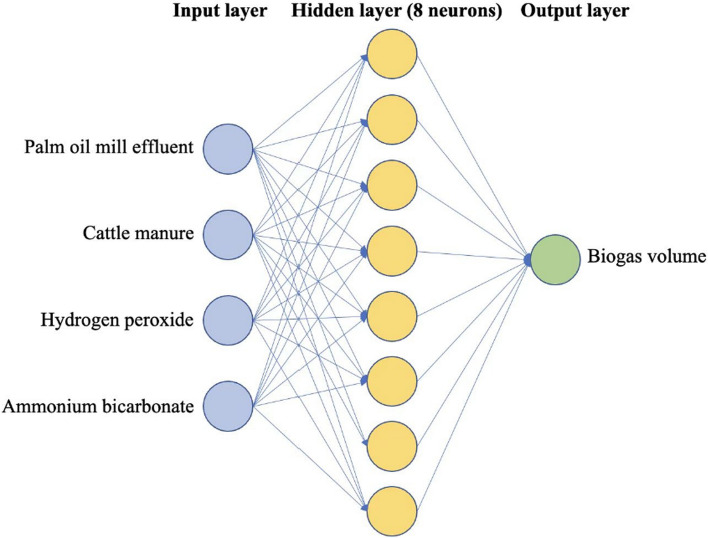
A neural network for predicting biogas volume using four input attributes. The diagram has eight hidden layers and one output layer to induce biogas prediction. It consists of three layers: input, hidden, and output
Fig. 5
Fig. 5
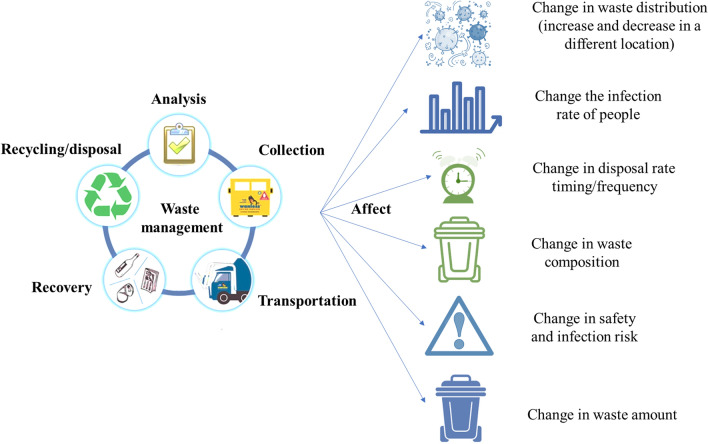
Impact of the coronavirus disease 2019 (COVID-19) on waste management. The COVID-19 pandemic has significantly affected the composition, timing, and frequency of waste disposal. It has also increased the risk of infection for the public due to the production of masks and medical waste that require manual handling. These changes in waste volumes have complex and interrelated impacts on municipal waste management, as depicted in the chart
Fig. 6
Fig. 6
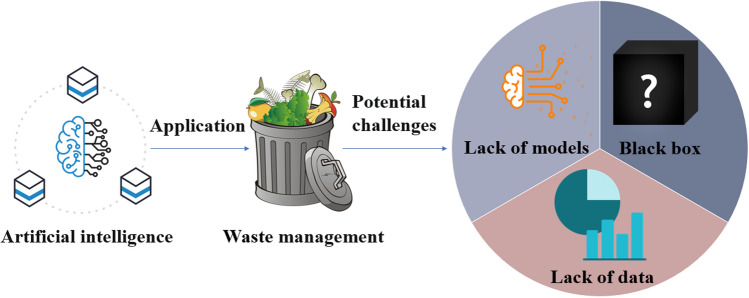
Three challenges of artificial intelligence in waste management. Implementing artificial intelligence in waste management can be summarized as black box problems, a lack of data, and a shortage of suitable models. Black boxes refer to the complexity of artificial intelligence models, which makes it difficult for researchers to understand their mechanisms. Lack of data refers to the scarcity and unreliability of data in the waste management industry, making it challenging to train artificial intelligence models. Finally, the lack of suitable models means that most existing applications of artificial intelligence in waste management rely on preexisting models rather than custom models explicitly developed for waste management

References

    1. Abbasi M, El Hanandeh A. Forecasting municipal solid waste generation using artificial intelligence modelling approaches. Waste Manag. 2016;56:13–22. doi: 10.1016/j.wasman.2016.05.018. - DOI - PubMed
    1. Abdallah M, Abu Talib M, Feroz S, Nasir Q, Abdalla H, Mahfood B. Artificial intelligence applications in solid waste management: a systematic research review. Waste Manag. 2020;109:231–246. doi: 10.1016/j.wasman.2020.04.057. - DOI - PubMed
    1. Abou Baker N, Szabo-Müller P, Handmann U. Transfer learning-based method for automated e-waste recycling in smart cities. EAI Endorsed Trans Smart Cities. 2021;5:e1–e1. doi: 10.4108/eai.16-4-2021.169337. - DOI
    1. Abunama T, Othman F, Ansari M, El-Shafie A. Leachate generation rate modeling using artificial intelligence algorithms aided by input optimization method for an msw landfill. Environ Sci Pollut Res. 2019;26:3368–3381. doi: 10.1007/s11356-018-3749-5. - DOI - PubMed
    1. Adnan RM, Yuan X, Kisi O, Yuan Y. Streamflow forecasting using artificial neural network and support vector machine models. Am Sci Res J Eng, Technol, Sci (ASRJETS) 2017;29:286–294.

LinkOut - more resources