


Contract Cheating and Student Stress: Insights from a Canadian Community College
- PMID: 37362770
- PMCID: PMC10161988
- DOI: 10.1007/s10805-023-09476-6
Contract Cheating and Student Stress: Insights from a Canadian Community College
Abstract
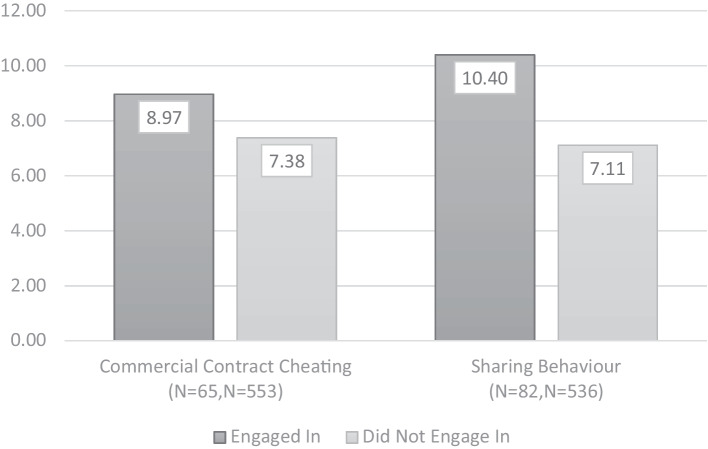
This article presents results from a self-report survey of misconduct behaviours and the stress students (n = 916) experienced at one Canadian community college. Results showed that students engaged in a variety of contract cheating behaviours, and experienced a myriad of stressors both in and outside the college context, including traumatic life events. Those who engaged in commercial contract cheating and inappropriate sharing behaviours experienced significantly higher levels of stress. This result differed by type of stress suggesting that not all stress may lead to violation behaviour. Results also suggest that some students are exposed to more stress than others, which could put them at higher risk for engaging in contract cheating. Understanding contract cheating using the stress process framework draws our attention to how a student's location in the social institutions of work, family, and school, how their positions of advantage or disadvantage, and their involvement in social relationships may produce stress which we have found to be associated with contract cheating. Seeing stress in this way allows post-secondary institutions to address the structural conditions which lead to stress through the development of policy, procedure, and supports for students as they navigate academic integrity throughout their programs.
Keywords: Academic dishonesty; Academic integrity; Academic misconduct; Canada; Community college; Contract cheating; Stress; Stress process model; Survey.
© The Author(s), under exclusive licence to Springer Nature B.V. 2023, Springer Nature or its licensor (e.g. a society or other partner) holds exclusive rights to this article under a publishing agreement with the author(s) or other rightsholder(s); author self-archiving of the accepted manuscript version of this article is solely governed by the terms of such publishing agreement and applicable law.
Conflict of interest statement
Conflict of InterestThe authors have no conflicts of interest/competing interests to declare that are relevant to the content of this report. Ideas and opinions represented in this research report are those of the researchers.
Figures

References
-
- Eaton, S. E. (2022a). Contract cheating in Canada: A comprehensive overview. In S. E. Eaton & J. Christensen Hughes (Eds.), Academic integrity in Canada: An enduring and essential challenge (pp. 165-187). Springer. 10.1007/978-3-030-83255-1
-
- Eaton, S. E. (2020b). Understanding academic integrity from a teaching and learning perspective: Engaging with the 4M framework. Calgary: University of Calgary. https://hdl.handle.net/1880/112435
-
- Eaton, S. E. (2021). Plagiarism in higher education: Tackling tough topics in academic integrity. ABC Clio.
-
- Eaton, S. E., Chibry, N., Toye, M. A., & Rossi, S. (2019). Interinstitutional perspectives on contract cheating: A qualitative narrative exploration from Canada. International Journal for Educational Integrity, 15(9). 10.1007/s40979-019-0046-0
-
- Eaton, S. E., Pethrick, H., & Turner, K. L. (2023). Academic integrity and student mental well-being: a rapid review. Canadian Perspectives on Academic Integrity, 5(2). 10.11575/cpai.v5i2.73748
LinkOut - more resources
Full Text Sources