. 2023 Jul 4;12(13):e028921.
doi: 10.1161/JAHA.122.028921. Epub 2023 Jun 27.

Global, Regional, and National Advances Toward the Management of Rheumatic Heart Disease Based on the Global Burden of Disease Study 2019

Affiliations

Global, Regional, and National Advances Toward the Management of Rheumatic Heart Disease Based on the Global Burden of Disease Study 2019

Renjie Ruan et al. J Am Heart Assoc. .

Abstract

Background Population growth, aging, and major alterations in epidemiologic trends inadvertently modulate the status of rheumatic heart disease (RHD) epidemiology. This investigation predicted RHD burden pattern and temporal trends to provide epidemiologic evidence. Methods and Results Prevalence, mortality, and disability-adjusted life-years data for RHD were obtained from the GBD (Global Burden of Disease) study. We performed decomposition analysis and frontier analysis to assess variations and burden in RHD from 1990 to 2019. In 2019, there were >40.50 million RHD cases worldwide, along with nearly 0.31 million RHD-related deaths and 10.67 million years of healthy life lost to RHD. The RHD burden was commonly concentrated within lower sociodemographic index regions and countries. RHD primarily affects women (22.52 million cases in 2019), and the largest age-specific prevalence rate was at 25 to 29 years in women and 20 to 24 years in men. Multiple reports demonstrated prominent downregulation of RHD-related mortality and disability-adjusted life-years at the global, regional, and national levels. Decomposition analysis revealed that the observed improvements in RHD burden were primarily due to epidemiological alteration; however, it was negatively affected by population growth and aging. Frontier analysis revealed that the age-standardized prevalence rates were negatively linked to sociodemographic index, whereas Somalia and Burkina Faso, with lower sociodemographic index, showed the lowest overall difference from the frontier boundaries of mortality and disability-adjusted life-years. Conclusions RHD remains a major global public health issue. Countries such as Somalia and Burkina Faso are particularly successful in managing adverse outcomes from RHD and may serve as a template for other countries.

Keywords: Global Burden of Disease 2019; disability‐adjusted life‐years; mortality; prevalence; rheumatic heart disease.


Figures

Figure 1
Figure 1. Rheumatic heart disease–related prevalence for both sexes in 204 countries and territories.
A, The ASPR of rheumatic heart disease in 2019. B, The AAPC of rheumatic heart disease‐related prevalence between 1990 and 2019. AAPC indicates average annual percentage change; and ASPR, age‐standardized prevalence rate.
Figure 2
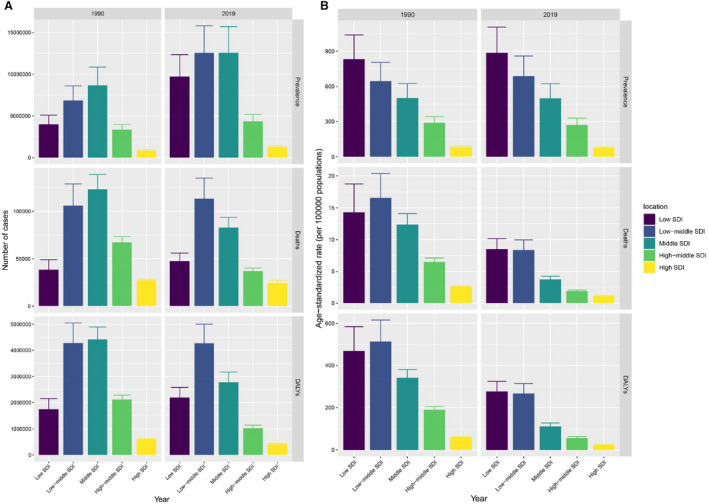
Figure 2. Progression of rheumatic heart disease burden between 1990 and 2019 by SDI quintile.
A, Prevalence, mortality, and DALYs case numbers between 1990 and 2019 in 5 SDI quintiles. B, ASPR, ASMR, and AMDR between 1990 and 2019 in 5 SDI quintiles. AMDR indicates age‐matched disability‐adjusted life–years rate; ASMR, age‐standardized mortality rate; ASPR, age‐standardized prevalence rate; DALYs, disability‐adjusted life‐years; and SDI, sociodemographic index.
Figure 3
Figure 3. The time trends of rheumatic heart disease burden from 1990 to 2019 by 19 age groups every 5 years in 5 SDI regions.
A, The time trends of rheumatic heart disease–related prevalence, mortality, and DALYs cases by age groups. B, The proportion change of rheumatic heart disease‐related prevalence, mortality, and DALYs cases in each age group. DALYs indicates disability‐adjusted life years; and SDI, sociodemographic index.
Figure 4
Figure 4. Alterations in rheumatic heart disease–related prevalence numbers based on the population‐level determinants of population growth, aging, and epidemiological alteration between 1990 and 2019 at the global level and by SDI quintile.
The black dot refers to the overall alteration induced by all 3 components. For individual components, the positive value magnitude represents a corresponding rise in prevalence numbers of rheumatic heart disease associated with the component. A negative value magnitude represents a matched reduction in prevalence numbers of rheumatic heart disease associated with the corresponding component. SDI indicates sociodemographic index.
Figure 5
Figure 5. Frontier analysis involving SDI and rheumatic heart disease burden in 2019.
A and B, Frontier analysis with ASPR. C and D, Frontier analysis with ASMR. E and F, Frontier analysis with AMDR. The frontier is marked using a solid black color, and countries and territories are presented as dots. The leading 15 countries with the most EF (the highest ASPR of rheumatic heart disease gap from frontier) are marked in black. Examples of frontier countries with low SDI (<0.5) and reduced EF are marked in blue, and those with high SDI (>0.85) and relatively elevated EF for their development are marked in red. Red dots represent a reduction in rheumatic heart disease burden between 1990 and 2019. Blue dots represent a rise in rheumatic heart disease burden during the same duration of time. AMDR indicates age‐matched disability‐adjusted life‐years rate; ASMR, age‐standardized mortality rate; ASPR, age‐standardized prevalence rate; EF, effective difference; and SDI, sociodemographic index.

References

    1. Marijon E, Mirabel M, Celermajer DS, Jouven X. Rheumatic heart disease. Lancet. 2012;379:953–964. doi: 10.1016/S0140-6736(11)61171-9 - DOI - PubMed
    1. Rothenbühler M, O'Sullivan CJ, Stortecky S, Stefanini GG, Spitzer E, Estill J, Shrestha NR, Keiser O, Jüni P, Pilgrim T. Active surveillance for rheumatic heart disease in endemic regions: a systematic review and meta‐analysis of prevalence among children and adolescents. Lancet Glob Health. 2014;2:e717–e726. doi: 10.1016/S2214-109X(14)70310-9 - DOI - PubMed
    1. Marijon E, Mocumbi A, Narayanan K, Jouven X, Celermajer DS. Persisting burden and challenges of rheumatic heart disease. Eur Heart J. 2021;42:3338–3348. doi: 10.1093/eurheartj/ehab407 - DOI - PubMed
    1. Remenyi B, Carapetis J, Wyber R, Taubert K, Mayosi BM. Position statement of the World Heart Federation on the prevention and control of rheumatic heart disease. Nat Rev Cardiol. 2013;10:284–292. doi: 10.1038/nrcardio.2013.34 - DOI - PubMed
    1. Okello E, Beaton A. Targeted investment needed to end rheumatic heart disease in Africa. Lancet Glob Health. 2021;9:e887–e888. doi: 10.1016/S2214-109X(21)00215-1 - DOI - PubMed

LinkOut - more resources