Review
. 2023 Jun 7;13(6):632.
doi: 10.3390/bios13060632.

Progress in the Optical Sensing of Cardiac Biomarkers

Affiliations
Review

Progress in the Optical Sensing of Cardiac Biomarkers

Cristina Polonschii et al. Biosensors (Basel). .

Abstract

Biomarkers play key roles in the diagnosis, risk assessment, treatment and supervision of cardiovascular diseases (CVD). Optical biosensors and assays are valuable analytical tools answering the need for fast and reliable measurements of biomarker levels. This review presents a survey of recent literature with a focus on the past 5 years. The data indicate continuing trends towards multiplexed, simpler, cheaper, faster and innovative sensing while newer tendencies concern minimizing the sample volume or using alternative sampling matrices such as saliva for less invasive assays. Utilizing the enzyme-mimicking activity of nanomaterials gained ground in comparison to their more traditional roles as signaling probes, immobilization supports for biomolecules and for signal amplification. The growing use of aptamers as replacements for antibodies prompted emerging applications of DNA amplification and editing techniques. Optical biosensors and assays were tested with larger sets of clinical samples and compared with the current standard methods. The ambitious goals on the horizon for CVD testing include the discovery and determination of relevant biomarkers with the help of artificial intelligence, more stable specific recognition elements for biomarkers and fast, cheap readers and disposable tests to facilitate rapid testing at home. As the field is progressing at an impressive pace, the opportunities for biosensors in the optical sensing of CVD biomarkers remain significant.

Keywords: biosensors; cardiovascular diseases; optical assay.


Conflict of interest statement

The authors declare no conflict of interest.

Figures
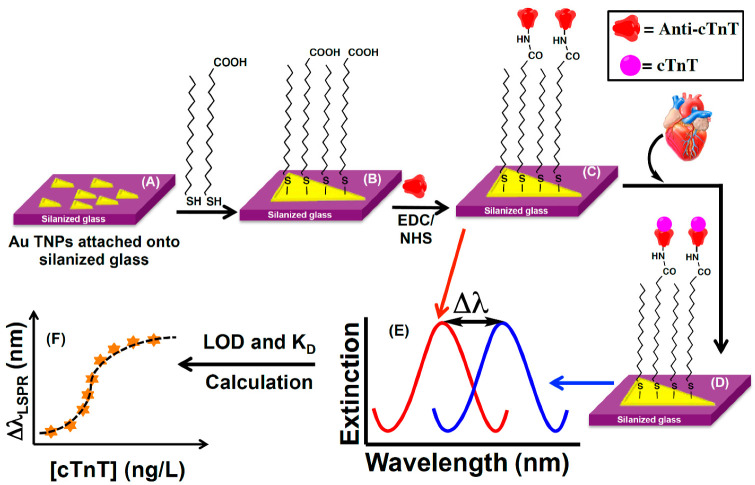
Figure 1
Figure 1
Design of a chip-based format LSPR cTnT biosensor. (A) Au TNPs attached to silanized glass, (B) after being functionalized with a 1:1 mole ratio of 1-dodecanethiol and 16-mercaptohexadecanoic acid, (C) further functionalization with anti-cTnT through EDC/NHS amide coupling to complete the nanosensor, (D) detection of cTnT upon binding to anti-cTnT on sensor surface, (E) representation of nanosensor absorption maxima (λLSPR) peak shift before and after binding of cTnT, and (F) relationship between ∆λLSPR and cTnT concentration to calculate the LOD and KD. For simplicity, only one Au TNP is shown in the functionalization steps. Reproduced from [44] with permission from The Royal Society of Chemistry.
Figure 2
Figure 2
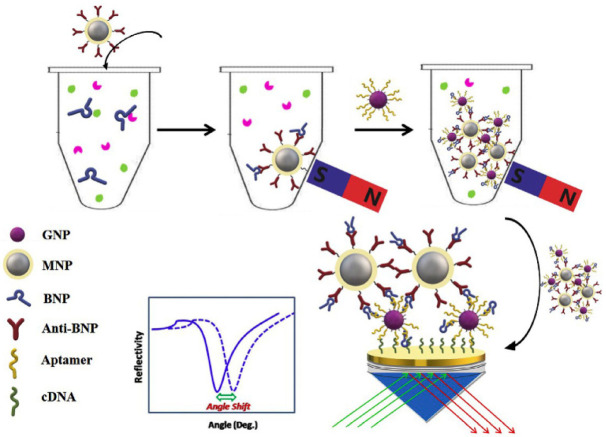
Schematic of the BNP SPR sensing strategy via magnetoplasmonic nanocomposites for signal amplification. The change in refractive index at the gold sensor’s surface is translated into a shift in the resonance angle. More details are given in the text. Reproduced from [47] with permission from Elsevier.
Figure 3
Figure 3
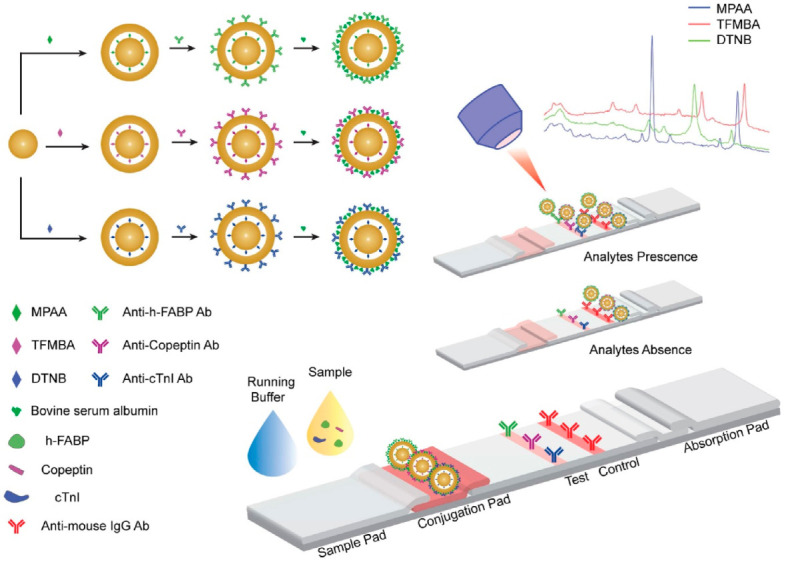
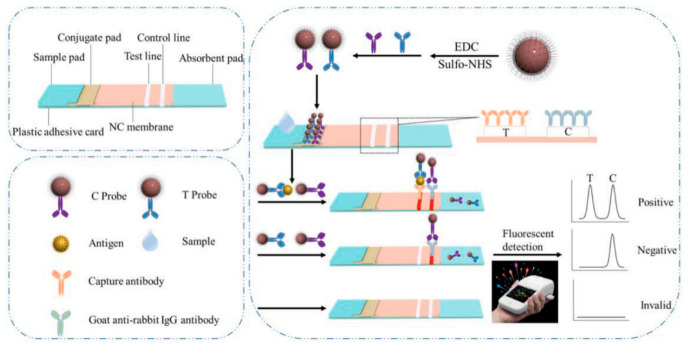
Schematic illustration of the process to prepare antibody conjugated gap-enhanced nanoparticle, and the lateral flow strip for a multiplex detection of the biomarker panel for myocardial infarction. Reprinted with permission from [66]. Copyright (2022) Elsevier.
Figure 4
Figure 4
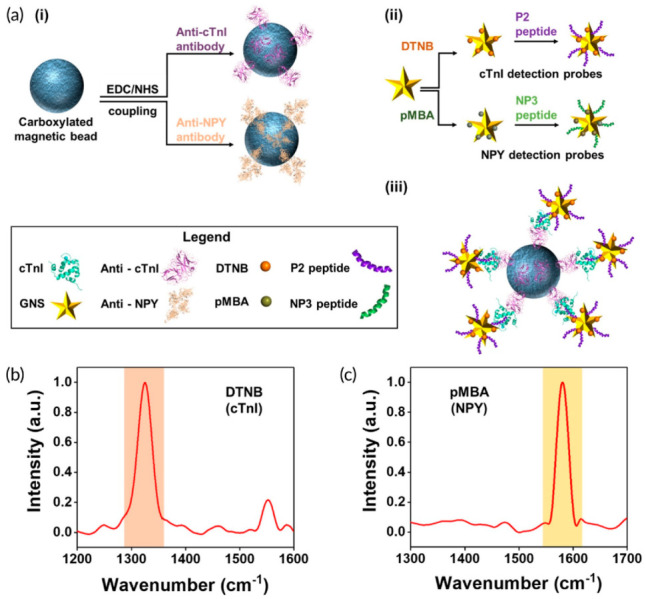
Fabrication of PRADA. (a) Schematic of the synthesis of capture and detection probes. (i) Magnetic beads functionalized with pAbs as capture probes. (ii) GNSs conjugated with SERS barcodes and peptide BREs as detection probes. (iii) The representative complete immunocomplex formed by capture probes, target antigens, and detection probes. (b,c) Normalized Raman spectra of GNSs functionalized with DTNB (1325 cm−1) and pMBA (1580 cm−1) for cTnI and NPY detection, respectively; the signature peaks are highlighted. BREs, biorecognition elements; GNSs, gold nanostars; pAbs, polyclonal antibodies; PRADA, portable reusable accurate diagnostics with nanostar antennas; SERS, surface-enhanced Raman spectroscopy. Reprinted with permission from [73]. Copyright (2020) John Wiley & Son.
Figure 5
Figure 5
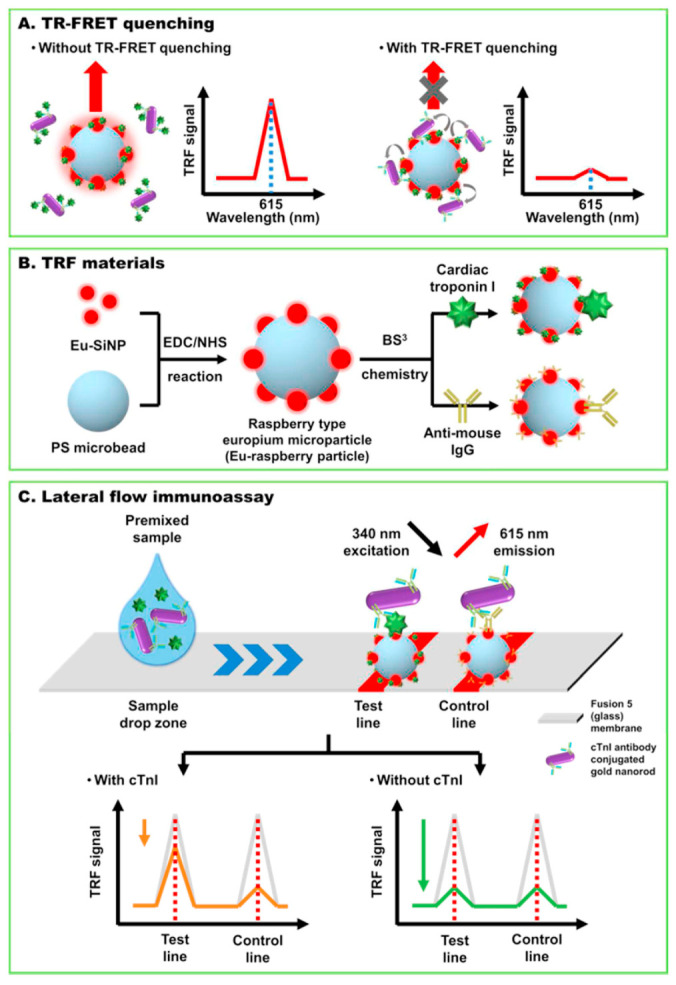
Principle of the TR-FRET LFIA for cTnI. (A): Fluorescence quenching mechanism by TR-FRET using Eu-SiNP and GNR. (B): The synthesis of the donor raspberry-type Eu-SiNP. (C): The competitive assay used in the LFIA: cTnI in the sample competes with cTnI anchored on the Eu-SiNPs at the test line for binding to the cTnI Ab-GNR conjugates. Thus, in the presence of cTnI, the fluorescence at the test line is high. In the absence of the biomarker, the binding of the cTnI Ab-GNR conjugates to the cTni/Eu-SiNPs, drastically quenching the signal at the test line. Reproduced from [83] with permission from Elsevier.
Figure 6
Figure 6
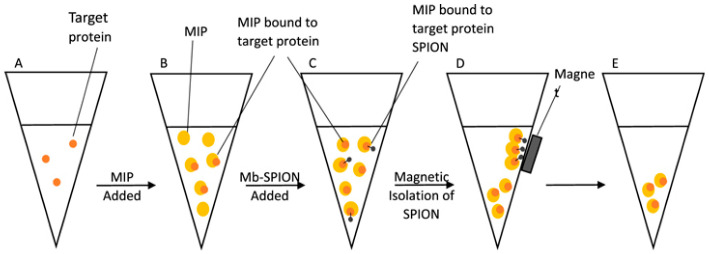
Principle of the MIP-based fluorimetric homogeneous assay for myoglobin. The sample containing myoglobin (A) is incubated with fluorescein-tagged MIP (B) which binds myoglobin. Next, myoglobin-functionalised SPION particles (“Mb-SPION”) are added to bind the excess MIP (C). The SPION particles and conjugates with MIPs are removed via a magnet (D). The fluorescence due to the remaining MIP particles (E) is finally measured and correlated with the concentration of myoglobin in the sample. Reproduced from [86] with permission from the authors.
Figure 7
Figure 7
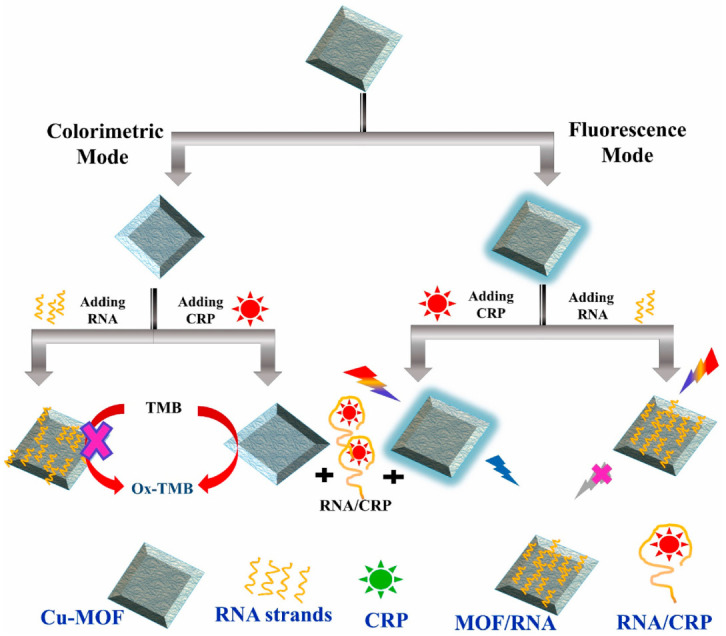
Principle of the detection of CRP by the dual colorimetry-fluorescence method relying on Cu-MOF and RNA-aptamer. Details are given in the text. Reproduced from [84] with permission from Elsevier.
Figure 8
Figure 8
Principle of the QBs@SiO2-COOH-based LFIA and of the detection of cTnI. Details are given in the text. Reproduced from [81] with permission from Elsevier.
Figure 9
Figure 9
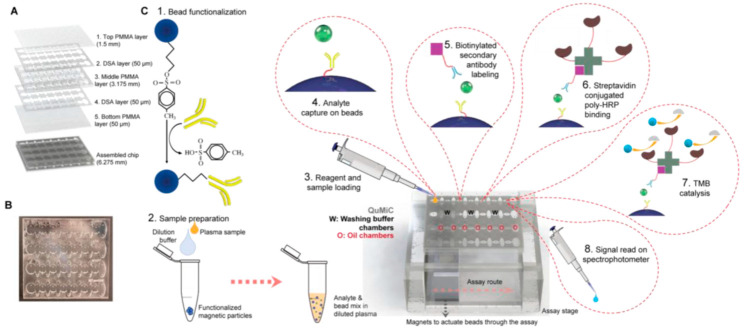
Construction and working principle of the Total Microfluidic chip for Multiplexed diagnostics (ToMMx). (A) Polymethyl methacrylate (PMMA) and double-sided adhesive (DSA) polyethylene terephthalate (PET) film layers of ToMMx design. (B) Laser-cut and assembled ToMMx. (C) Bead functionalization, sample preparation and assay steps of ToMMx. (1) Functionalization of tosyl-activated magnetic beads with analyte-specific primary antibodies. (2) Sample dilution buffer, plasma sample and functionalized beads mixed in tube as sample preparation. (3) Assay reagents, buffers and sample loading on ToMMx. (4) Analyte in the sample captured on antibody-functionalized beads. (5) Analyte–antibody complex labeled with biotinylated secondary antibody. (6) Streptavidin conjugated poly-HRP binding to antibody–antigen–antibody sandwich complex. (7) TMB substrate catalysis by poly-HRP in the complex. (8) Evaluation of analyte concentration via color change in the sample after transferring the colored liquid to a 96-well plate, mixing with stop solution and reading in with a spectrophotometer. Reproduced from [102] with permission from Elsevier).
Figure 10
Figure 10
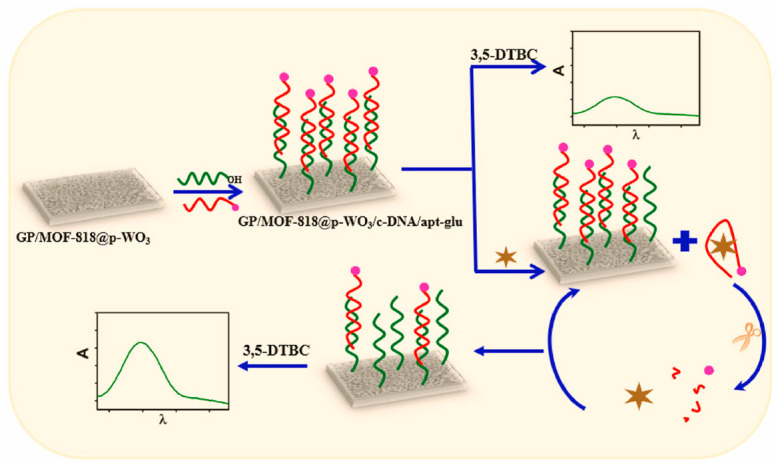
The assembly and working principle of the GP/MOF-818@p-WO3/c-DNA/apt-glu aptasensor for the analysis of cTnI. The glutathione label, cTnI and Exo I are depicted by a pink ball, star and scissor like symbols, respectively. The absorbance (A) at λ = 425 nm of a solution of 3,5-DTBC incubated with the sensor is quantitatively correlated with the amount of cTnI in the sample. Details are given in the text. Reproduced from [109] with permission from Elsevier.

References

    1. Sharma A., Jang J. Flexible electrical aptasensor using dielectrophoretic assembly of graphene oxide and its subsequent reduction for cardiac biomarker detection. Sci. Rep. 2019;9:5970. doi: 10.1038/s41598-019-42506-1. - DOI - PMC - PubMed
    1. World Health Organisation Cardiovascular Diseases. [(accessed on 8 May 2023)]; Available online: https://www.who.int/health-topics/cardiovascular-diseases#tab=tab_1.
    1. World Health Organisation Cardiovascular Diseases (CVDs) [(accessed on 8 May 2023)]; Available online: https://www.who.int/news-room/fact-sheets/detail/cardiovascular-diseases...
    1. Knuuti J., Wijns W., Saraste A., Capodanno D., Barbato E., Funck-Brentano C., Prescott E., Storey R.F., Deaton C., Cuisset T., et al. 2019 ESC Guidelines for the diagnosis and management of chronic coronary syndromes: The Task Force for the diagnosis and management of chronic coronary syndromes of the European Society of Cardiology (ESC) Eur. Heart J. 2020;41:407–477. doi: 10.1093/eurheartj/ehz425. - DOI - PubMed
    1. McDonagh T.A., Metra M., Adamo M., Gardner R.S., Baumbach A., Böhm M., Burri H., Butler J., Čelutkienė J., Chioncel O., et al. 2021 ESC Guidelines for the diagnosis and treatment of acute and chronic heart failure: Developed by the Task Force for the diagnosis and treatment of acute and chronic heart failure of the European Society of Cardiology (ESC) with the special contribution of the Heart Failure Association (HFA) of the ESC. Eur. Heart J. 2021;42:3599–3726. doi: 10.1093/eurheartj/ehab368. - DOI - PubMed