


Tricuspid Valve Endocarditis Due to Methicillin-Resistant Staphylococcus aureus in a Previously Healthy Young Patient without a Drug Abuse History: A Case Report and a Review of the Literature
- PMID: 37367192
- PMCID: PMC10298630
- DOI: 10.3390/idr15030033
Tricuspid Valve Endocarditis Due to Methicillin-Resistant Staphylococcus aureus in a Previously Healthy Young Patient without a Drug Abuse History: A Case Report and a Review of the Literature
Abstract
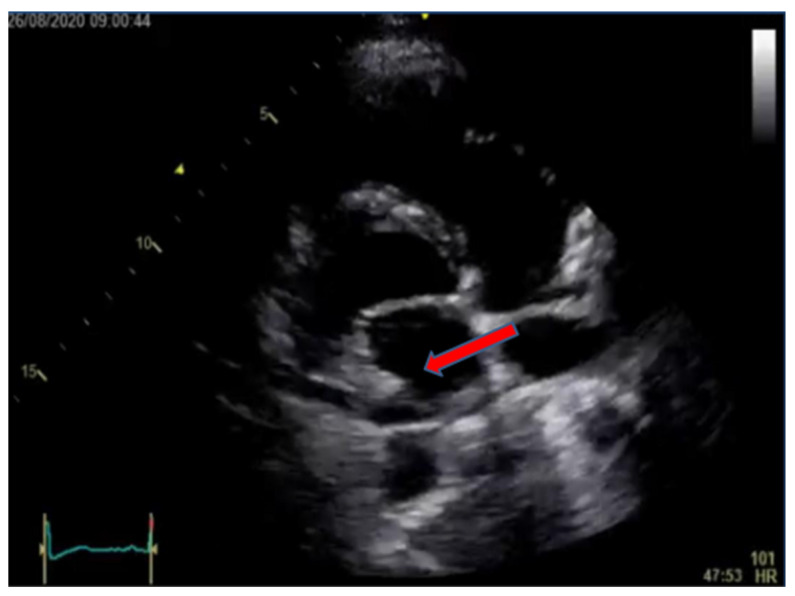
Right-sided infective endocarditis due to methicillin-resistant Staphylococcus aureus (MRSA) is strongly associated with intravenous drug abuse, congenital heart disease, or previous medical treatment and is rare in healthy patients without a history of drug abuse. Here, we present a case of an 18-year-old male with no drug abuse history and no medical burden who was diagnosed with MRSA tricuspid valve endocarditis. Due to initial symptoms which indicated community-acquired pneumonia and radiological finding of interstitial lesions, empiric therapy with ceftriaxone and azithromycin was started. After the detection of Gram-positive cocci in clusters in several blood culture sets, endocarditis was suspected, and flucloxacillin was added to the initial therapy. As soon as methicillin resistance was detected, the treatment was switched to vancomycin. Transesophageal echocardiography established the diagnosis of right-sided infective endocarditis. A toxicological analysis of hair was carried out, and no presence of narcotic drugs was found. After six weeks of therapy, the patient was fully recovered. Exceptionally, tricuspid valve endocarditis can be diagnosed in previously healthy people who are not drug addicts. As the clinical presentation commonly resembles a respiratory infection, a misdiagnosis is possible. Although MRSA rarely causes community-acquired infections in Europe, clinicians should be aware of this possibility.
Keywords: MRSA; methicillin-resistant Staphylococcus aureus; no medical burden; non-intravenous drug abusers; right-sided infective endocarditis (RSIE).
Conflict of interest statement
The authors declare no conflict of interest.
Figures
References
-
- Habib G., Erba P.A., Iung B., Donal E., Cosyns B., Laroche C., Popescu B.A., Prendergast B., Tornos P., Sadeghpour A., et al. Clinical presentation, aetiology and outcome of infective endocarditis. Results of the ESC-EORP EURO-ENDO (European infective endocarditis) registry: A prospective cohort study. Eur. Heart J. 2019;40:3222–3232. doi: 10.1093/eurheartj/ehz620. - DOI - PubMed
-
- Baddour L.M., Wilson W.R., Bayer A.S., Fowler V.G., Tleyjeh I.M., Rybak M.J., Barsic B., Lockhart P.B., Gewitz M.H., Levison M.E., et al. Infective Endocarditis in Adults: Diagnosis, Antimicrobial Therapy, and Management of Complications. Circulation. 2015;32:1435–1486. doi: 10.1161/CIR.0000000000000296. - DOI - PubMed
Publication types
LinkOut - more resources
Full Text Sources
Research Materials
