


Are Appearances Deceiving? Morpho-Genetic Complexity of the Eumerus tricolor Group (Diptera: Syrphidae) in Europe, with a Focus on the Iberian Peninsula
- PMID: 37367358
- PMCID: PMC10299051
- DOI: 10.3390/insects14060541
Are Appearances Deceiving? Morpho-Genetic Complexity of the Eumerus tricolor Group (Diptera: Syrphidae) in Europe, with a Focus on the Iberian Peninsula
Abstract
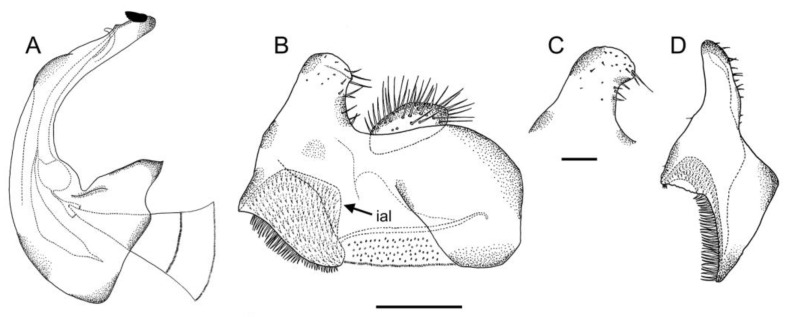
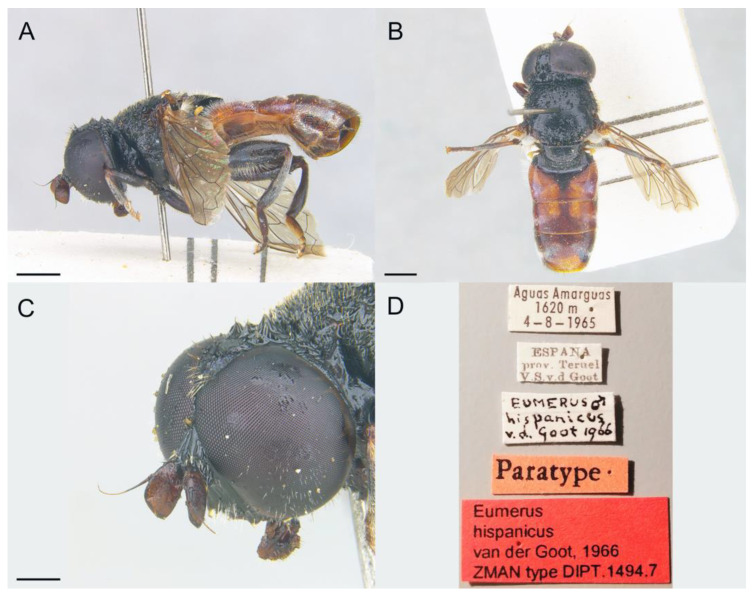
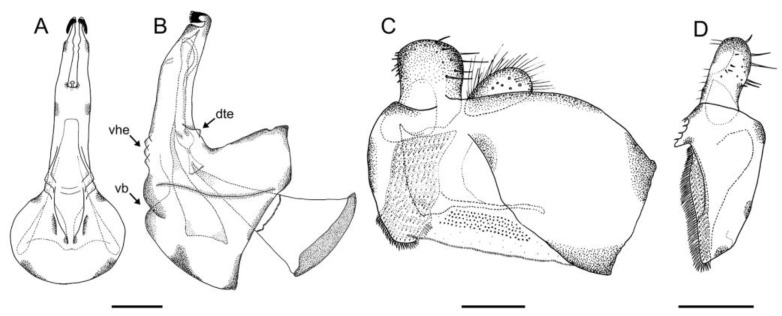
Eumerus Meigen, 1822 is one of the largest Syrphidae genera in the Palaearctic Region, with the highest levels of taxonomic diversity found in the Eumerus tricolor species group. Despite its high diversity, the interspecific levels of morphological variability can be low. Additionally, some species may show certain levels of intraspecific variability. Hence, species delimitation may become challenging. In this work, we assessed the diversity of the E. tricolor group in the Iberian Peninsula through an integrative analysis of nomenclature, morphology and the 5' (COI-5') and 3' (COI-3') end regions of the Cytochrome c oxidase subunit I gene. Two new species, Eumerus ancylostylus Aguado-Aranda & Ricarte sp. n. and Eumerus petrarum Aguado-Aranda, Nedeljković & Ricarte sp. n., were described, and their intra- and interspecific variations discussed. In addition, the first barcodes of Iberian members of the E. tricolor group were obtained, and the distribution ranges of all species were mapped within the study area. The systematic position of the new species is discussed based on the resulting COI-based trees. The male genitalia of Eumerus hispanicus van der Goot, 1966 and Eumerus bayardi Séguy, 1961 were studied and illustrated. A lectotype was designated for Eumerus lateralis (Zetterstedt, 1819). An updated dichotomous key for all known European species of the E. tricolor group is provided. The egg of E. petrarum sp. n. is also described.
Keywords: COI; Merodontini; hoverfly; male genitalia; phenotypic diversity; systematics.
Conflict of interest statement
The authors declare no conflict of interest. The funders had no role in the design of the study; in the collection, analyses, or interpretation of data; in the writing of the manuscript, or in the decision to publish the results.
Figures





References
-
- Marshall S.A. Flies: The Natural History and Diversity of Diptera. Firefly Books Ltd.; Richmond Hill, ON, Canada: 2012. pp. 1–616.
-
- Ballester-Torres I., Ricarte A., Nedeljković Z., Marcos-García M.Á. High phenotypic diversity does not always hide taxonomic diversity: A study case with Cheilosia soror (Zetterstedt, 1843) (Diptera: Syrphidae) in the Iberian Peninsula. J. Zool. Syst. Evol. Res. 2022;2022:8378483. doi: 10.1155/2022/8378483. - DOI
-
- Struck T.H., Cerca J. Cryptic species and their evolutionary significance. Encycl. Life Sci. 2019;2019:1–9.
Grants and funding
LinkOut - more resources
Full Text Sources
