


Applying Satyrization to Insect Pest Control: The Case of the Spotted Wing Drosophila, Drosophila suzukii Matsumura
- PMID: 37367385
- PMCID: PMC10298948
- DOI: 10.3390/insects14060569
Applying Satyrization to Insect Pest Control: The Case of the Spotted Wing Drosophila, Drosophila suzukii Matsumura
Abstract
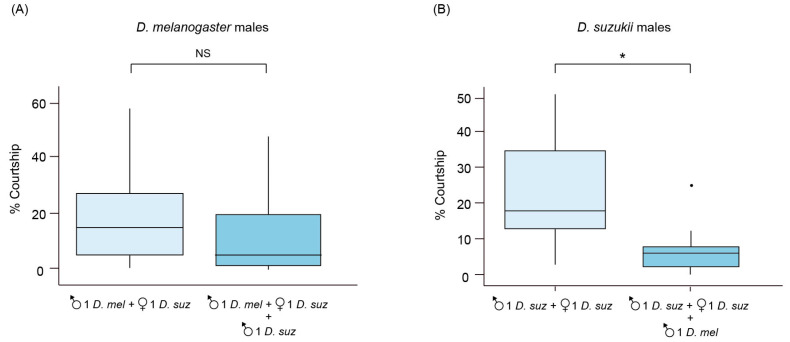
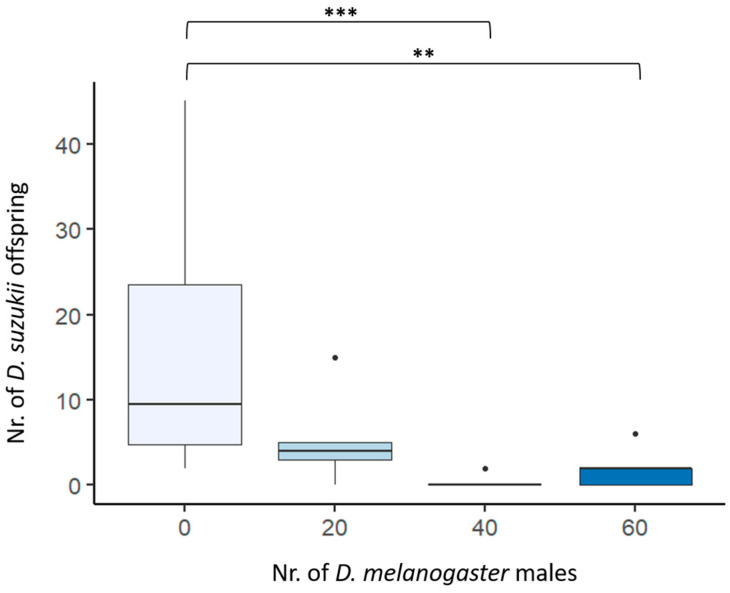
Drosophila suzukii represents one of the major agricultural pests worldwide. The identification of safety and long-lasting tools to suppress its populations is therefore crucial to mitigate the environmental and economic damages due to its occurrence. Here, we explore the possibility of using satyrization as a tool to control the abundance of D. suzukii. By using males of D. melanogaster, we realized courtship tests, spermathecae analysis, and multiple-choice experiments to assess the occurrence and extent of pre- and post-zygotic isolation between the two species, as well as the occurrence of fitness costs in D. suzukii females due to satyrization. Our results showed that: (i) D. melanogaster males successfully courted D. suzukii females; (ii) D. melanogaster males significantly affected the total courtship time of D. suzukii males, which reduced from 22.6% to 6.4%; (iii) D. melanogaster males were able to inseminate D. suzukii and reduce their offspring, inducing a high fitness cost. Reproductive interference occurs at different steps between D. melanogaster and D. suzukii, both alone and in combination with other area-wide control approaches.
Keywords: asymmetric fitness cost; biological control; fruit fly; insect pests; interspecific interactions; reproductive interference.
Conflict of interest statement
The authors declare no conflict of interest.
Figures
References
-
- Shuker D.M., Burdfield-Steel E.R. Reproductive interference in insects: Reproductive interference in insects. Ecol. Entomol. 2017;42:65–75. doi: 10.1111/een.12450. - DOI
-
- Kyogoku D. When does reproductive interference occur? Predictions and data. Popul. Ecol. 2020;62:196–206. doi: 10.1002/1438-390X.12041. - DOI
Grants and funding
- MISSIONE 4 COMPONENTE 2, INVESTIMENTO 1.4 - D.D. 1032 17/06/2022, CN00000022/This study was carried out within the Agritech National Research Center and received funding from the European Union Next-GenerationEU (PIANO NAZIONALE DI RIPRESA E RESILIENZA (PNRR) - MISSIONE 4 COMPONENTE 2, INVESTIMENTO 1.4 - D.D. 1032 17/06/2022, CN00
- PON "RICERCA E INNOVAZIONE" 2014-2020", AZIONE IV.5 "DOTTORATI SU TEMATICHE GREEN, D.M. 1061 10/08/2021./F.C. was funded by PON "RICERCA E INNOVAZIONE" 2014-2020", AZIONE IV.5 "DOTTORATI SU TEMATICHE GREEN, D.M. 1061 10/08/2021.
LinkOut - more resources
Full Text Sources
Molecular Biology Databases
