Multicenter Study
. 2023 Jun;307(5):e222855.
doi: 10.1148/radiol.222855.

A Multicenter Assessment of Interreader Reliability of LI-RADS Version 2018 for MRI and CT

Affiliations
Multicenter Study

A Multicenter Assessment of Interreader Reliability of LI-RADS Version 2018 for MRI and CT

Cheng William Hong et al. Radiology. 2023 Jun.

Erratum in

  • Erratum for: A Multicenter Assessment of Interreader Reliability of LI-RADS Version 2018 for MRI and CT.
    Hong CW, Chernyak V, Choi JY, Lee S, Potu C, Delgado T, Wolfson T, Gamst A, Birnbaum J, Kampalath R, Lall C, Lee JT, Owen JW, Aguirre DA, Mendiratta-Lala M, Davenport MS, Masch W, Roudenko A, Lewis SC, Kierans AS, Hecht EM, Bashir MR, Brancatelli G, Douek ML, Ohliger MA, Tang A, Cerny M, Fung A, Costa EA, Corwin MT, McGahan JP, Kalb B, Elsayes KM, Surabhi VR, Blair K, Marks RM, Horvat N, Best S, Ash R, Ganesan K, Kagay CR, Kambadakone A, Wang J, Cruite I, Bijan B, Goodwin M, Cunha GM, Tamayo-Murillo D, Fowler KJ, Sirlin CB. Hong CW, et al. Radiology. 2023 Jul;308(1):e239018. doi: 10.1148/radiol.239018. Radiology. 2023. PMID: 37489994 Free PMC article. No abstract available.

Abstract

Background Various limitations have impacted research evaluating reader agreement for Liver Imaging Reporting and Data System (LI-RADS). Purpose To assess reader agreement of LI-RADS in an international multicenter multireader setting using scrollable images. Materials and Methods This retrospective study used deidentified clinical multiphase CT and MRI and reports with at least one untreated observation from six institutions and three countries; only qualifying examinations were submitted. Examination dates were October 2017 to August 2018 at the coordinating center. One untreated observation per examination was randomly selected using observation identifiers, and its clinically assigned features were extracted from the report. The corresponding LI-RADS version 2018 category was computed as a rescored clinical read. Each examination was randomly assigned to two of 43 research readers who independently scored the observation. Agreement for an ordinal modified four-category LI-RADS scale (LR-1, definitely benign; LR-2, probably benign; LR-3, intermediate probability of malignancy; LR-4, probably hepatocellular carcinoma [HCC]; LR-5, definitely HCC; LR-M, probably malignant but not HCC specific; and LR-TIV, tumor in vein) was computed using intraclass correlation coefficients (ICCs). Agreement was also computed for dichotomized malignancy (LR-4, LR-5, LR-M, and LR-TIV), LR-5, and LR-M. Agreement was compared between research-versus-research reads and research-versus-clinical reads. Results The study population consisted of 484 patients (mean age, 62 years ± 10 [SD]; 156 women; 93 CT examinations, 391 MRI examinations). ICCs for ordinal LI-RADS, dichotomized malignancy, LR-5, and LR-M were 0.68 (95% CI: 0.61, 0.73), 0.63 (95% CI: 0.55, 0.70), 0.58 (95% CI: 0.50, 0.66), and 0.46 (95% CI: 0.31, 0.61) respectively. Research-versus-research reader agreement was higher than research-versus-clinical agreement for modified four-category LI-RADS (ICC, 0.68 vs 0.62, respectively; P = .03) and for dichotomized malignancy (ICC, 0.63 vs 0.53, respectively; P = .005), but not for LR-5 (P = .14) or LR-M (P = .94). Conclusion There was moderate agreement for LI-RADS version 2018 overall. For some comparisons, research-versus-research reader agreement was higher than research-versus-clinical reader agreement, indicating differences between the clinical and research environments that warrant further study. © RSNA, 2023 Supplemental material is available for this article. See also the editorials by Johnson and Galgano and Smith in this issue.


Conflict of interest statement

Disclosures of conflicts of interest: C.W.H. No relevant relationships. V.C. Consulting fees from Bayer. J.Y.C. No relevant relationships. S.L. No relevant relationships. C.P. No relevant relationships. T.D. No relevant relationships. T.W. No relevant relationships. A.G. No relevant relationships. J.B. No relevant relationships. R.K. No relevant relationships. C.L. No relevant relationships. J.T.L. No relevant relationships. J.W.O. LI-RADS Rad-Path Workgroup Co-chair. D.A.A. No relevant relationships. M.M.L. No relevant relationships. M.S.D. Royalties from Wolters-Kluwer, UpToDate.com; treasurer on Board of Directors for Society of Advanced Body Imaging; member of Radiology editorial board. W.M. No relevant relationships. A.R. No relevant relationships. S.C.L. No relevant relationships. A.S.K. No relevant relationships. E.M.H. No relevant relationships. M.R.B. Grant funding to author institution from NCI, Siemens Healthineers, Madrigal Pharmaceuticals, NGM Biopharmaceuticals, Carmot Therapeutics, Corcept Therapeutics.; member of Radiology editorial board G.B. Consulting fees from Bayer; payment for lectures from Bayer, Guerbet, Bracco, AstraZeneca; support for meeting attendance from Bayer, AstraZeneca. M.L.D. No relevant relationships. M.A.O. No relevant relationships. A.T. Grants from Institut de Valorisation des Donnees, Canadian Institutes of Health Research; consulting fees from Onco-Tech; LI-RADS steering committee member; LI-RADS International Working Group member; equipment loan from Siemens Healthcare for Onco-Tech and CIHR grants. M.C. No relevant relationships. A.F. LI-RADS Technique Working Group co-chair. E.A.C. No relevant relationships. M.T.C. No relevant relationships. J.P.M. No relevant relationships. B.K. No relevant relationships. K.M.E. No relevant relationships. V.R.S. No relevant relationships. K.B. No relevant relationships. R.M.M. No relevant relationships. N.H. Consulting fees from Guerbet; payment for lecture from Bayer. S.B. No relevant relationships. R.A. No relevant relationships. K.G. No relevant relationships. C.R.K. No relevant relationships. A.K. Research grants from GE Healthcare, Philips Healthcare, PanCAN, Bayer; advisory board membership, Bayer; honorarium from Texas Radiological Society. J.W. No relevant relationships. I.C. No relevant relationships. B.B. No relevant relationships. M.G. No relevant relationships. G.M.C. 2021 Bayer Healthcare/RSNA Research Fellow grant recipient. D.T.M. No relevant relationships. K.J.F. Grants from Bayer, Pfizer, Median; consulting fees from Epigenomics, Bayer; payment for lectures from CME Talks; payment for expert testimony; participant on DataSafety or Advisory Board, Bayer; member of the RSNA Editorial Board, ACR panel chair, ACR LI-RADS, SAR portfolio director; unpaid board member for Quantix Bio. C.B.S. Research grants from ACR, Bayer, Foundation of the NIH, GE, Gilead, Pfizer, Philips, Siemens; lab service agreements from Enanta, Gilead, ICON, Intercept, Nusirt, Shire, Synageva, Takeda; royalties from Medscape, Wolters-Kluwer; institutional consulting representative for AMRA, BMS, Exact Sciences, IBM-Watson, Pfizer; personal consulting for Blade, Boehringer, Epigenomics, Guerbet; honoraria for educational symposia from Japanese Society of Radiology, Stanford, M.D. Anderson; advisory board member for Quantix Bio; Chief Medical Officer for Livivos; stock options in Livivos; member of LI-RADS Steering Committee.

Figures

None
Graphical abstract
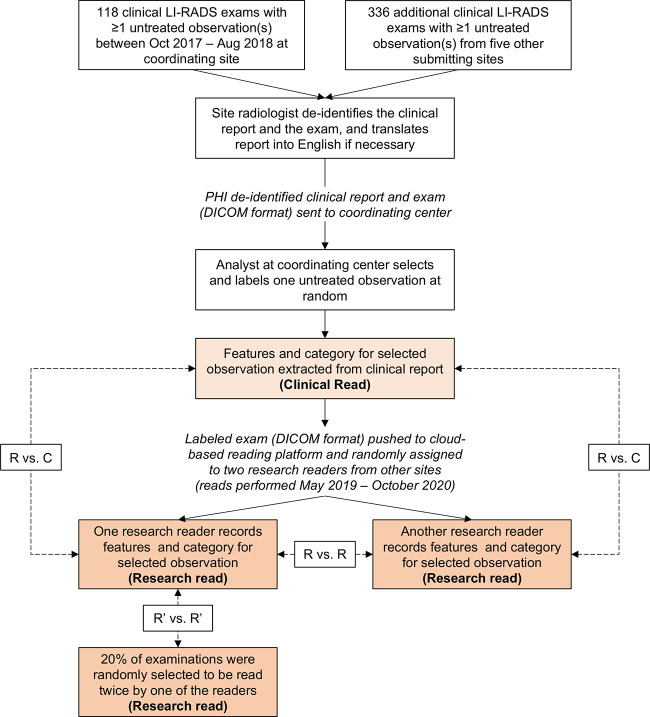
Schematic of the retrospective study design. Deidentified examinations
from the coordinating site and five other submitting sites were randomly
assigned to two of 43 research readers for research reads. Features and
categories were extracted from the clinical reports. This permitted the
computation of interreader agreement between the research readers (R vs R)
and between the research and clinical readers (R vs C). Twenty percent of
images were also read twice by one of the research readers to permit the
computation of intrareader agreement (R’ vs R’). DICOM =
Digital Imaging and Communications in Medicine, LI-RADS = Liver Imaging
Reporting and Data System, PHI = protected health information..
Figure 1:
Schematic of the retrospective study design. Deidentified examinations from the coordinating site and five other submitting sites were randomly assigned to two of 43 research readers for research reads. Features and categories were extracted from the clinical reports. This permitted the computation of interreader agreement between the research readers (R vs R) and between the research and clinical readers (R vs C). Twenty percent of images were also read twice by one of the research readers to permit the computation of intrareader agreement (R’ vs R’). DICOM = Digital Imaging and Communications in Medicine, LI-RADS = Liver Imaging Reporting and Data System, PHI = protected health information..
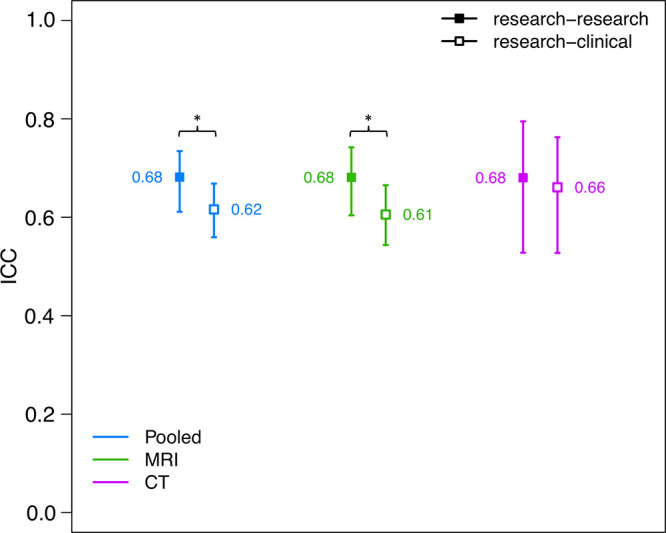
Plot shows intraclass correlation coefficient (ICC) reader agreement
for modified four-category Liver Imaging Reporting and Data System (LI-RADS)
version 2018 scale based on imaging modality. Agreement among research reads
only (research-research; ■) and between research and clinical reads
(research-clinical; □) are shown. Tails represent 95% CIs. * P
value < .05 by nonparametric bootstrap with per-case resampling.
Research-versus-research agreement pooled over both modalities and for MRI
only was better than research-versus-clinical agreement.
Figure 2:
Plot shows intraclass correlation coefficient (ICC) reader agreement for modified four-category Liver Imaging Reporting and Data System (LI-RADS) version 2018 scale based on imaging modality. Agreement among research reads only (research-research; ■) and between research and clinical reads (research-clinical; □) are shown. Tails represent 95% CIs. * P value < .05 by nonparametric bootstrap with per-case resampling. Research-versus-research agreement pooled over both modalities and for MRI only was better than research-versus-clinical agreement.
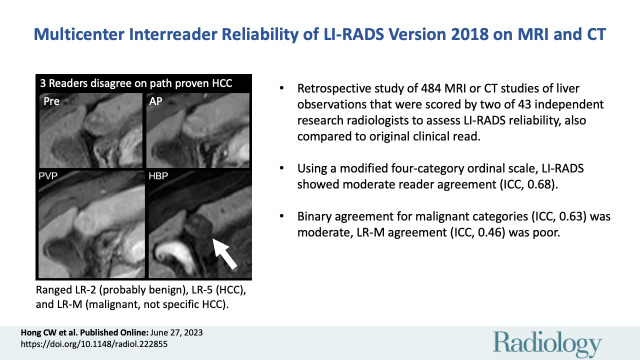
MRI scans show (A) reader disagreement and (B) reader agreement. (A)
Gadoxetic acid–enhanced MRI scans in a 56-year-old male patient with
cirrhosis secondary to hepatitis C. From left to right: contrast-unenhanced
(Pre), arterial phase (AP), portal venous phase (PVP), and hepatobiliary
phase (HBP) images. This 21-mm hepatobiliary phase hypointense observation
(arrow) was characterized on the clinical read as having nonrim arterial
phase hyperenhancement and washout appearance and was categorized as Liver
Imaging Reporting and Data System (LI-RADS) category LR-5 (definitely
hepatocellular carcinoma [HCC]). The first research reader characterized it
as having a targetoid appearance and categorized it as LR-M (probably or
definitely malignant, not specific for HCC). The second research reader
characterized it as having no major features and paralleling the blood pool
and categorized it as LR-2 (probably benign). It was subsequently resected
and found to be a well-differentiated HCC. (B) Extracellular
contrast–enhanced MRI scans in a 61-year-old female patient with
cirrhosis secondary to hepatitis C. From left to right: contrast-unenhanced,
arterial phase, portal venous phase, and delayed-phase (DP) images. This
31-mm observation (arrow) in the caudate lobe was characterized on the
clinical read as having arterial phase hyperenhancement, washout appearance,
and capsule appearance, and was categorized as LI-RADS category LR-5
(definitely HCC). Both research readers also categorized this observation as
LR-5. The patient died of intracranial hemorrhage a few months
later.
Figure 3:
MRI scans show (A) reader disagreement and (B) reader agreement. (A) Gadoxetic acid–enhanced MRI scans in a 56-year-old male patient with cirrhosis secondary to hepatitis C. From left to right: contrast-unenhanced (Pre), arterial phase (AP), portal venous phase (PVP), and hepatobiliary phase (HBP) images. This 21-mm hepatobiliary phase hypointense observation (arrow) was characterized on the clinical read as having nonrim arterial phase hyperenhancement and washout appearance and was categorized as Liver Imaging Reporting and Data System (LI-RADS) category LR-5 (definitely hepatocellular carcinoma [HCC]). The first research reader characterized it as having a targetoid appearance and categorized it as LR-M (probably or definitely malignant, not specific for HCC). The second research reader characterized it as having no major features and paralleling the blood pool and categorized it as LR-2 (probably benign). It was subsequently resected and found to be a well-differentiated HCC. (B) Extracellular contrast–enhanced MRI scans in a 61-year-old female patient with cirrhosis secondary to hepatitis C. From left to right: contrast-unenhanced, arterial phase, portal venous phase, and delayed-phase (DP) images. This 31-mm observation (arrow) in the caudate lobe was characterized on the clinical read as having arterial phase hyperenhancement, washout appearance, and capsule appearance, and was categorized as LI-RADS category LR-5 (definitely HCC). Both research readers also categorized this observation as LR-5. The patient died of intracranial hemorrhage a few months later.
Plot shows intraclass correlation coefficient (ICC) reader agreement
for dichotomized classification of Liver Imaging Reporting and Data System
(LI-RADS) version 2018 for the following dichotomized categories: probably
or definitely malignant versus other, LR-5 (definitely hepatocellular
carcinoma [HCC]) versus other, and LR-M (probably or definitely malignant,
not specific for HCC) versus other. Agreement among research reads only
(research-research; ■) and between research and clinical reads
(research-clinical; □) are shown. Tails represent 95% CIs. * P
< .05 by nonparametric bootstrap with per-case resampling.
Research-research agreement for malignant categories was better than
research-clinical agreement.
Figure 4:
Plot shows intraclass correlation coefficient (ICC) reader agreement for dichotomized classification of Liver Imaging Reporting and Data System (LI-RADS) version 2018 for the following dichotomized categories: probably or definitely malignant versus other, LR-5 (definitely hepatocellular carcinoma [HCC]) versus other, and LR-M (probably or definitely malignant, not specific for HCC) versus other. Agreement among research reads only (research-research; ■) and between research and clinical reads (research-clinical; □) are shown. Tails represent 95% CIs. * P < .05 by nonparametric bootstrap with per-case resampling. Research-research agreement for malignant categories was better than research-clinical agreement.
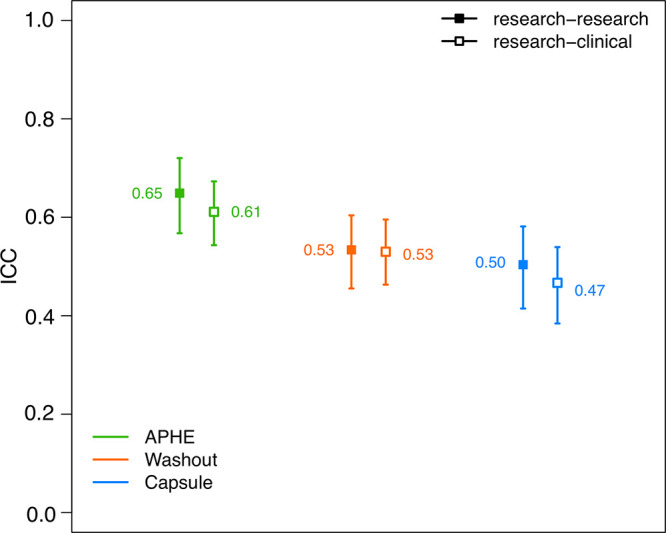
Plot shows intraclass correlation coefficient (ICC) reader agreement
for Liver Imaging Reporting and Data System (LI-RADS) version 2018 arterial
phase hyperenhancement (APHE), washout, and capsule for research reads only
(research-research; ■) and between research and clinical reads
(research-clinical; □). Tails represent 95% CIs. No differences in
ICCs between research-versus-research reads compared with
researcher-versus-clinical reads were observed.
Figure 5:
Plot shows intraclass correlation coefficient (ICC) reader agreement for Liver Imaging Reporting and Data System (LI-RADS) version 2018 arterial phase hyperenhancement (APHE), washout, and capsule for research reads only (research-research; ■) and between research and clinical reads (research-clinical; □). Tails represent 95% CIs. No differences in ICCs between research-versus-research reads compared with researcher-versus-clinical reads were observed.
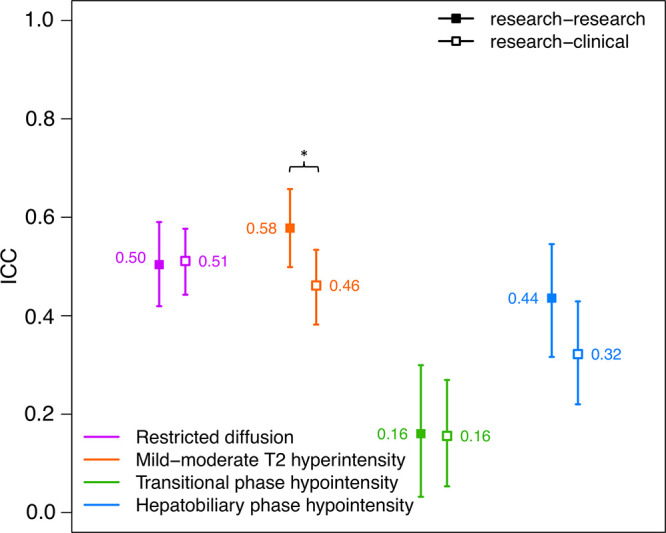
Plot shows intraclass correlation coefficient (ICC) reader agreement
for Liver Imaging Reporting and Data System (LI-RADS) version 2018 ancillary
features with sufficient frequency for analysis, which included restricted
diffusion, mild-moderate T2 hyperintensity, transitional phase
hypointensity, and hepatobiliary phase hypointensity. These four features
are only visible at MRI. Agreement among research reads only
(research-research; ■) and between research and clinical reads
(research-clinical; □) are shown. Tails represent 95% CIs. * P
< .05 by nonparametric bootstrap with per-case resampling.
Research-versus-research agreement for mild-moderate T2 hyperintensity was
better than research-versus-clinical agreement.
Figure 6:
Plot shows intraclass correlation coefficient (ICC) reader agreement for Liver Imaging Reporting and Data System (LI-RADS) version 2018 ancillary features with sufficient frequency for analysis, which included restricted diffusion, mild-moderate T2 hyperintensity, transitional phase hypointensity, and hepatobiliary phase hypointensity. These four features are only visible at MRI. Agreement among research reads only (research-research; ■) and between research and clinical reads (research-clinical; □) are shown. Tails represent 95% CIs. * P < .05 by nonparametric bootstrap with per-case resampling. Research-versus-research agreement for mild-moderate T2 hyperintensity was better than research-versus-clinical agreement.

Comment in

References

    1. Bruix J , Sherman M ; American Association for the Study of Liver Diseases. Management of hepatocellular carcinoma: an update . Hepatology 2011. ; 53 ( 3 ): 1020 – 1022 . - PMC - PubMed
    1. Elsayes KM , Kielar AZ , Agrons MM , et al . Liver Imaging Reporting and Data System: an expert consensus statement . J Hepatocell Carcinoma 2017. ; 4 : 29 – 39 . - PMC - PubMed
    1. Elsayes KM , Kielar AZ , Chernyak V , et al . LI-RADS: a conceptual and historical review from its beginning to its recent integration into AASLD clinical practice guidance . J Hepatocell Carcinoma 2019. ; 6 : 49 – 69 . - PMC - PubMed
    1. Chen N , Motosugi U , Morisaka H , et al . Added Value of a Gadoxetic Acid-enhanced Hepatocyte-phase Image to the LI-RADS System for Diagnosing Hepatocellular Carcinoma . Magn Reson Med Sci 2016. ; 15 ( 1 ): 49 – 59 . - PubMed
    1. Choi SH , Byun JH , Kim SY , et al . Liver Imaging Reporting and Data System v2014 With Gadoxetate Disodium-Enhanced Magnetic Resonance Imaging: Validation of LI-RADS Category 4 and 5 Criteria . Invest Radiol 2016. ; 51 ( 8 ): 483 – 490 . - PubMed

Publication types