


Subclinical Reactive Hypoglycemia with Low Glucose Effectiveness-Why We Cannot Stop Snacking despite Gaining Weight
- PMID: 37367911
- PMCID: PMC10304473
- DOI: 10.3390/metabo13060754
Subclinical Reactive Hypoglycemia with Low Glucose Effectiveness-Why We Cannot Stop Snacking despite Gaining Weight
Abstract
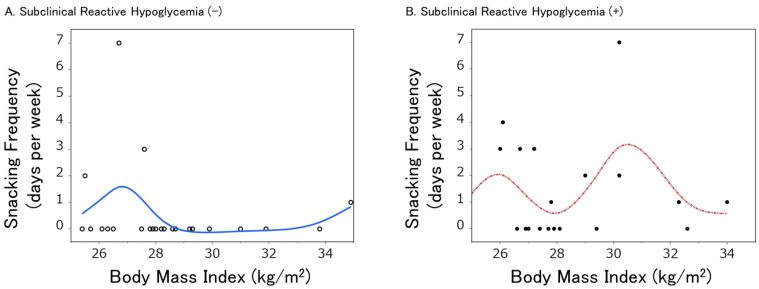
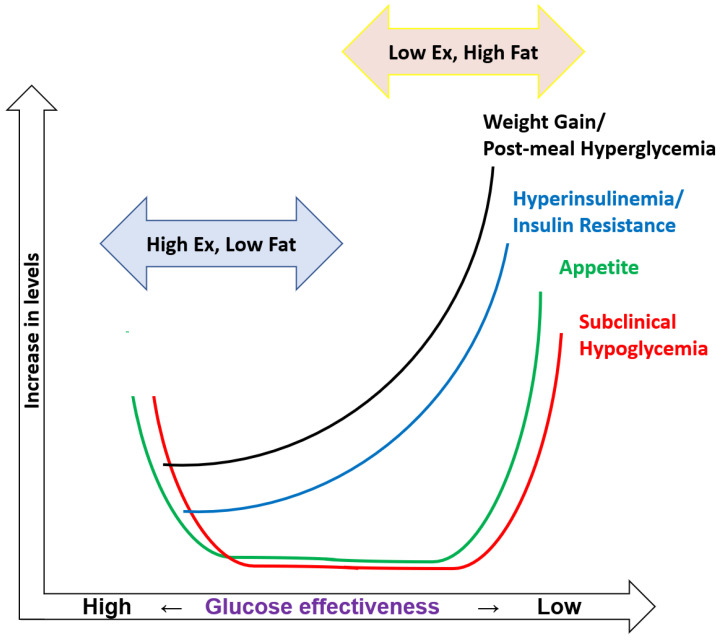
Obesity has grown worldwide owing to modern obesogenic lifestyles, including frequent snacking. Recently, we studied continuous glucose monitoring in obese/overweight men without diabetes and found that half of them exhibit glucose levels less than 70 mg/dL after a 75-g oral glucose load without notable hypoglycemic symptoms. Interestingly, people with "subclinical reactive hypoglycemia (SRH)" snack more frequently than those without it. Since the ingestion of sugary snacks or drinks could further induce SRH, a vicious cycle of "Snacking begets snacking via SRH" can be formed. Glucose effectiveness (Sg) is an insulin-independent mechanism that contributes to most of the whole-body glucose disposal after an oral glucose load in people without diabetes. Our recent data suggest that both higher and lower Sg are associated with SRH, while the latter but not the former is linked to snacking habits, obesity, and dysglycemia. The present review addresses the possible role of SRH in snacking habits in people with obesity/overweight, taking Sg into account. It is concluded that, for those with low Sg, SRH can be regarded as a link between snacking and obesity. Prevention of SRH by raising Sg might be key to controlling snacking habits and body weight.
Keywords: appetite; glucose effectiveness; obesity; overweight; snacking habits; subclinical reactive hypoglycemia.
Conflict of interest statement
The author declares no conflict of interest.
Figures
Similar articles
-
Lower Glucose Effectiveness Is Associated with Subclinical Reactive Hypoglycemia, Snacking Habits, and Obesity.Metabolites. 2023 Feb 6;13(2):238. doi: 10.3390/metabo13020238. Metabolites. 2023. PMID: 36837857 Free PMC article.
-
Impact of Lifestyle Behaviors on Postprandial Hyperglycemia during Continuous Glucose Monitoring in Adult Males with Overweight/Obesity but without Diabetes.Nutrients. 2021 Sep 2;13(9):3092. doi: 10.3390/nu13093092. Nutrients. 2021. PMID: 34578968 Free PMC article.
-
Nighttime snacking reduces whole body fat oxidation and increases LDL cholesterol in healthy young women.Am J Physiol Regul Integr Comp Physiol. 2013 Jan 15;304(2):R94-R101. doi: 10.1152/ajpregu.00115.2012. Epub 2012 Nov 21. Am J Physiol Regul Integr Comp Physiol. 2013. PMID: 23174861 Clinical Trial.
-
A review of snacking patterns among children and adolescents: what are the implications of snacking for weight status?Child Obes. 2013 Apr;9(2):104-15. doi: 10.1089/chi.2012.0108. Epub 2013 Mar 7. Child Obes. 2013. PMID: 23470091 Review.
-
Snacking: A cause for concern.Physiol Behav. 2018 Sep 1;193(Pt B):279-283. doi: 10.1016/j.physbeh.2018.02.010. Epub 2018 Feb 5. Physiol Behav. 2018. PMID: 29421590 Review.
Cited by
-
Soy-Based High-Protein Spheric Foods with the Appearance of Familiar Sugary Snacks.Foods. 2024 Apr 12;13(8):1176. doi: 10.3390/foods13081176. Foods. 2024. PMID: 38672850 Free PMC article.
-
Reactive Hypoglycemia: A Trigger for Nutrient-Induced Endocrine and Metabolic Responses in Polycystic Ovary Syndrome.J Clin Med. 2023 Nov 23;12(23):7252. doi: 10.3390/jcm12237252. J Clin Med. 2023. PMID: 38068304 Free PMC article.
-
Beyond the Metabolic Syndrome: Non-Obvious Complications of Obesity in Children.Children (Basel). 2023 Dec 9;10(12):1905. doi: 10.3390/children10121905. Children (Basel). 2023. PMID: 38136107 Free PMC article. Review.
References
-
- World Health Organization Obesity. [(accessed on 12 June 2023)]. Available online: https://www.who.int/health-topics/obesity/
Publication types
LinkOut - more resources
Full Text Sources
