Review
. 2023 Jun 12;13(12):1844.
doi: 10.3390/nano13121844.

Smart Radiotherapy Biomaterials for Image-Guided In Situ Cancer Vaccination

Affiliations
Review

Smart Radiotherapy Biomaterials for Image-Guided In Situ Cancer Vaccination

Victoria Ainsworth et al. Nanomaterials (Basel). .

Abstract

Recent studies have highlighted the potential of smart radiotherapy biomaterials (SRBs) for combining radiotherapy and immunotherapy. These SRBs include smart fiducial markers and smart nanoparticles made with high atomic number materials that can provide requisite image contrast during radiotherapy, increase tumor immunogenicity, and provide sustained local delivery of immunotherapy. Here, we review the state-of-the-art in this area of research, the challenges and opportunities, with a focus on in situ vaccination to expand the role of radiotherapy in the treatment of both local and metastatic disease. A roadmap for clinical translation is outlined with a focus on specific cancers where such an approach is readily translatable or will have the highest impact. The potential of FLASH radiotherapy to synergize with SRBs is discussed including prospects for using SRBs in place of currently used inert radiotherapy biomaterials such as fiducial markers, or spacers. While the bulk of this review focuses on the last decade, in some cases, relevant foundational work extends as far back as the last two and half decades.

Keywords: abscopal effect; cancer; image-guided radiotherapy; in situ vaccination; radio-immunotherapy; smart radiotherapy biomaterials.


Conflict of interest statement

W.N. NanoCan Therapeutics Corporation provided some funding for some of the work reported in this review. M.M. Consulted for Nanocan Therapeutics Corporation during the year of 2021–2022 in assisting with the smart radiotherapy biomaterials production protocols. P.O. is the Chief Scientific Officer of Nanocan. D.K. Genentech/Roche (consultancy < $5000/year). H.Q. Cofounder + CMO, Pistevo Decision, LLC; Consultant, Oncospace, LLC. R.H. RAPID, LLC (licensed IP), Vivos (consultant), Novartis (Advisory Board), Varian (Advisory Board).

Figures
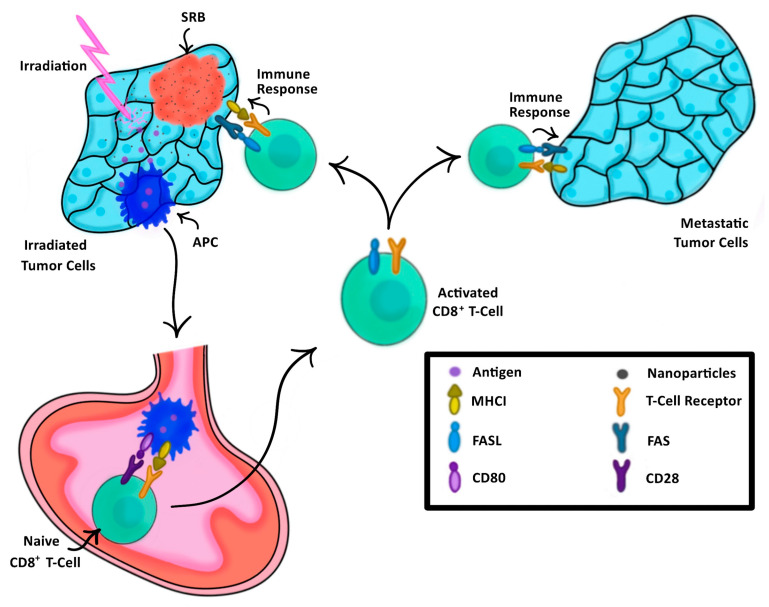
Figure 1
Figure 1
The process of SRB-assisted abscopal effect wherein an initial tumor (left) is treated with both radiation enhancing NPs and irradiation, triggering a cascade of antigen-presenting cells (APCs) to the lymph node (bottom) to activate naïve CD8+ T-Cells, thus triggering an immune response not only to the initially treated tumor, but also to the metastatic tumor (right).
Figure 2
Figure 2
Hollow degradable fiducial SRB loaded with drug payload and nanoparticles. (A) One formulation has the NPs within the hollow center, mixed with the drug payload. (B) Another formulation has the NPs incorporated within the polymer matrix in the annulus for a quicker release of NP while the drug payload is confined to the core, permitting a similar release rate as in case (A).
Figure 3
Figure 3
Process of the Liquid Immunogenic Fiducial Eluters (LIFE) Biomaterial loaded with nanoparticles and drug payload as it solidifies in situ. The LIFE biomaterial polymers (green) interact with the free calcium ions (Ca2+, blue) and solidify in the tumor.
Figure 4
Figure 4
(A) in vivo fluorescence imaging (FLI) comparing direct injection of fluorescence-tagged Anti-CD40 with seed-type SRB loaded with Anti-CD40 in mice. The images demonstrate superior sustained presence of antibody when administered with SRB versus direct injection, showing greater presence up to 13 days post-administration. (B) Scatter plots of percent volume change of treated and abscopal tumors when treated with IGRT of 5 Gy was given in combination with either direct injection of anti-CD40 or seed-type SRB loaded with the same [30]. (C) Bar graph of the average fluorescent intensity of immunofluorescence-stained prostate cancer tissue treated with mouse CD11b+ antibody administered intratumorally vs. via smart radiotherapy biomaterials (SRB) at posttreatment day 7 [31]. Bar graph showing the infiltration of APCs such as dendritic cells (CD11b+) to the treated tumors on day 7 post treatment for varying doses of RT with SRB loaded with mouse antibody versus control [28,32]. Graphs adapted from cited references.
Figure 5
Figure 5
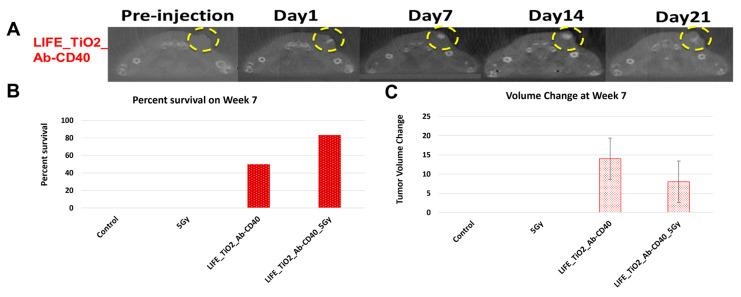
(A) CT images showing contrast from LIFE biomaterials injected in mice pancreatic tumors up to 21 days post injection (circled in yellow). Mice were monitored up to 10 weeks after treatment with combinations of RT and LIFE gel, loaded with titanium oxide and anti-CD40. The survival fraction (B) and overall change in tumor volume (C) for week 7 are shown in snapshot here demonstrating better tumor control when combining SRB LIFE gel with radiotherapy [28]. Graphs adapted from cited references.
Figure 6
Figure 6
Preliminary results validatinging the application of the aerosol dynamics computer code SAEROSA in a detailed lung model [36]. Simulation results are compared to published in vivo bulk deposition results for polystyrene nanoparticles [38]. Graph (A) shows good agreement between simulated versus experimental bulk deposition for polystyrene nanoparticles at 50, 75 and 100 nm. Concentrations, particle sizes and materials used in simulations reflected those used in vivo. Graph (B) demonstrates the first step towards therapeutic applications by comparing the deposition within the airway and alveoli separately for both polystyrene and gold nanoparticles, both with 50 nm and experimental concentrations. In-vivo data obtained from cited reference.
Figure 7
Figure 7
Geant4 Monte Carlo simulation of dose enhancement due to neutron-activated Gd emissions compared to absorbed dose from neutrons alone as a function of distance from the tumor centroid inside the tumor volume (red) and outside the tumor volume (black) [78]. Figure reproduced from conference proceedings with permission from author.

References

    1. The American Cancer Society Medical and Editorial Content Team Chemotherapy for Pancreatic Cancer. [(accessed on 28 May 2022)]. Available online: https://www.cancer.org/cancer/pancreatic-cancer/treating/chemotherapy.html.
    1. Quintela-Fandino M., Soberon N., Lluch A., Manso L., Calvo I., Cortes J., Moreno-Antón F., Gil-Gil M., Martinez-Jánez N., Gonzalez-Martin A., et al. Critically short telomeres and toxicity of chemotherapy in early breast cancer. Oncotarget. 2017;8:21472–21482. doi: 10.18632/oncotarget.15592. - DOI - PMC - PubMed
    1. Scheetz L., Park K.S., Li Q., Lowenstein P.R., Castro M.G., Schwendeman A., Moon J.J. Engineering patient-specific cancer immunotherapies. Nat. Biomed. Eng. 2019;3:768–782. doi: 10.1038/s41551-019-0436-x. - DOI - PMC - PubMed
    1. Frey B., Rubner Y., Kulzer L., Werthmöller N., Weiss E.M., Fietkau R., Gaipl U.S. Antitumor immune responses induced by ionizing irradiation and further immune stimulation. Cancer Immunol. Immunother. 2014;63:29–36. doi: 10.1007/s00262-013-1474-y. - DOI - PMC - PubMed
    1. Ngwa W., Irabor O.C., Schoenfeld J.D., Hesser J., Demaria S., Formenti S.C. Using immunotherapy to boost the abscopal effect. Nat. Rev. Cancer. 2018;18:313–322. doi: 10.1038/nrc.2018.6. - DOI - PMC - PubMed

LinkOut - more resources