. 2023 Nov 2;28(11):e1017-e1030.
doi: 10.1093/oncolo/oyad157.

Guideline Concordance of Treatment and Outcomes Among Adult Non-Hodgkin Lymphoma Patients in Sub-Saharan Africa: A Multinational, Population-Based Cohort

Affiliations

Guideline Concordance of Treatment and Outcomes Among Adult Non-Hodgkin Lymphoma Patients in Sub-Saharan Africa: A Multinational, Population-Based Cohort

Nikolaus Christian Simon Mezger et al. Oncologist. .

Abstract

Background: Although non-Hodgkin lymphoma (NHL) is the 6th most common malignancy in Sub-Saharan Africa (SSA), little is known about its management and outcome. Herein, we examined treatment patterns and survival among NHL patients.

Methods: We obtained a random sample of adult patients diagnosed between 2011 and 2015 from 11 population-based cancer registries in 10 SSA countries. Descriptive statistics for lymphoma-directed therapy (LDT) and degree of concordance with National Comprehensive Cancer Network (NCCN) guidelines were calculated, and survival rates were estimated.

Findings: Of 516 patients included in the study, sub-classification was available for 42.1% (121 high-grade and 64 low-grade B-cell lymphoma, 15 T-cell lymphoma and 17 otherwise sub-classified NHL), whilst the remaining 57.9% were unclassified. Any LDT was identified for 195 of all patients (37.8%). NCCN guideline-recommended treatment was initiated in 21 patients. This corresponds to 4.1% of all 516 patients, and to 11.7% of 180 patients with sub-classified B-cell lymphoma and NCCN guidelines available. Deviations from guideline-recommended treatment were initiated in another 49 (9.5% of 516, 27.2% of 180). By registry, the proportion of all patients receiving guideline-concordant LDT ranged from 30.8% in Namibia to 0% in Maputo and Bamako. Concordance with treatment recommendations was not assessable in 75.1% of patients (records not traced (43.2%), traced but no sub-classification identified (27.8%), traced but no guidelines available (4.1%)). By registry, diagnostic work-up was in part importantly limited, thus impeding guideline evaluation significantly. Overall 1-year survival was 61.2% (95%CI 55.3%-67.1%). Poor ECOG performance status, advanced stage, less than 5 cycles and absence of chemo (immuno-) therapy were associated with unfavorable survival, while HIV status, age, and gender did not impact survival. In diffuse large B-cell lymphoma, initiation of guideline-concordant treatment was associated with favorable survival.

Interpretation: This study shows that a majority of NHL patients in SSA are untreated or undertreated, resulting in unfavorable survival. Investments in enhanced diagnostic services, provision of chemo(immuno-)therapy and supportive care will likely improve outcomes in the region.


Conflict of interest statement

The authors indicated no conflict of interest.

Figures
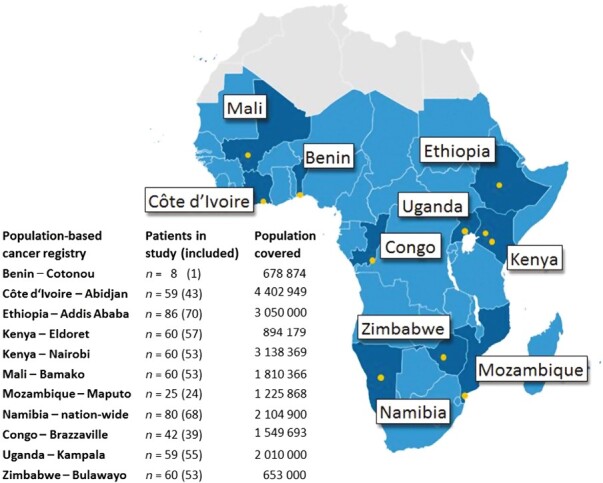
Figure 1.
Figure 1.
Map of Sub-Saharan Africa., Countries and cities of participating population-based cancer registries are highlighted. On the left, the numbers included in the random sample are shown along with the covered population in the registry area. For details see also Supplementary Table S2.
Figure 2.
Figure 2.
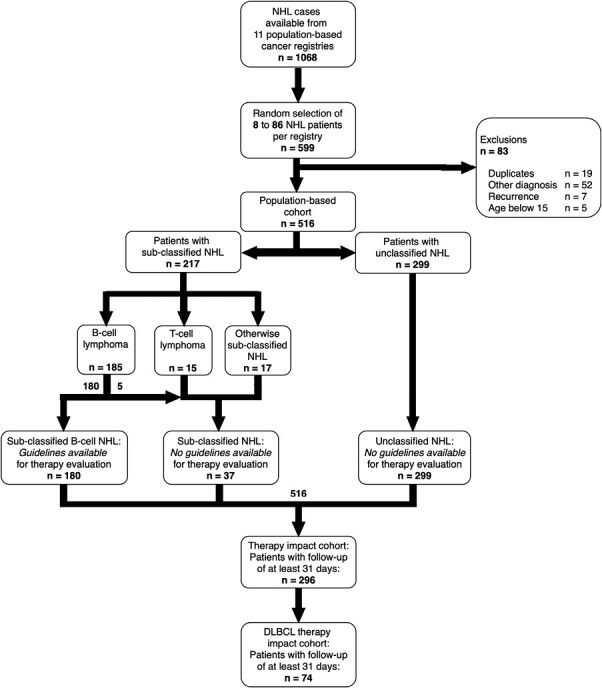
Flow chart of the study population. NHL, non-Hodgkin lymphoma; DLBCL, diffuse large B-cell lymphoma.
Figure 3.
Figure 3.
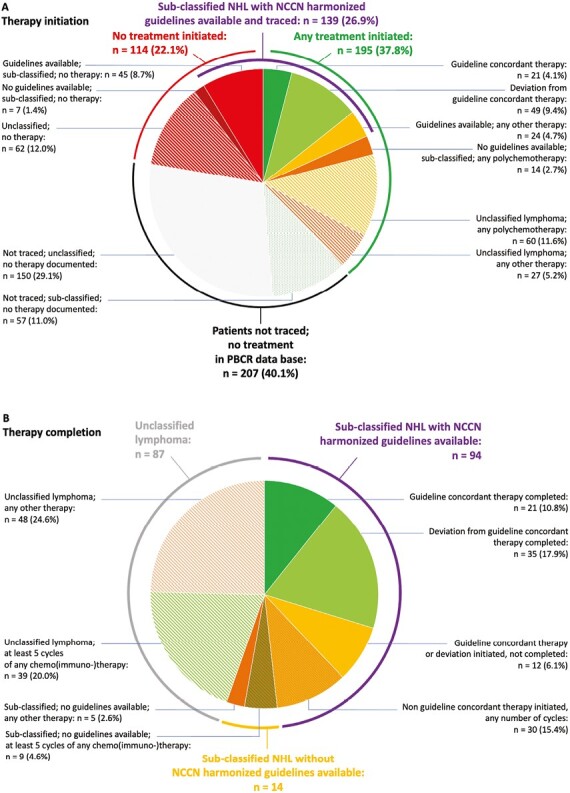
Evaluation of guideline concordance. (A) Depicts evaluation of therapy initiation in the population-based cohort (n = 516). Percentages refer to the proportion of all patients in cohort. (B) Depicts evaluation of therapy completion in all patients with any treatment documented (n = 195 (37.8% of total cohort)). The groups marked in green depict patients completing at least 5 cycles of chemo(immuno-)therapy. Percentages refer to proportion of all patients with any treatment documented. Evaluation refers to “therapy evaluation scheme” in Supplementary Table S1. PBCR, population-based cancer registry.
Figure 4.
Figure 4.
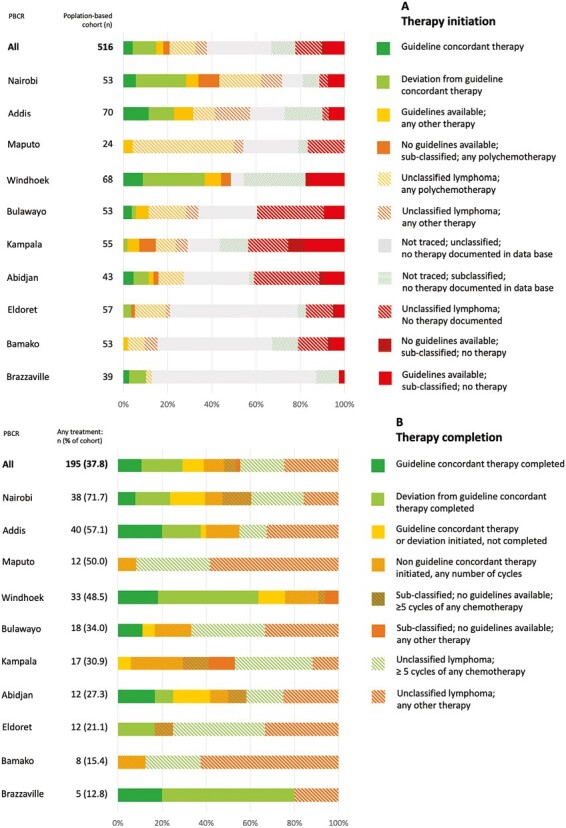
Stratification of evaluation of guideline concordance by population-based cancer registries. (A) Depicts evaluation of therapy initiation within the population-based cohort (n = 516). Percentages refer to proportion of all patients in respective population-based cancer registries. (B) Depicts evaluation of therapy completion among all patients with any treatment documented (n = 195 (37.8% of total cohort)). Percentages refer to proportion of all patients with any treatment documented in respective population-based cancer registries. Evaluation refers to “Therapy evaluation scheme” in Supplementary Table S1. Cotonou was excluded from figure due to small patient number (n = 1). PBCR, population-based cancer registry.
Figure 5.
Figure 5.
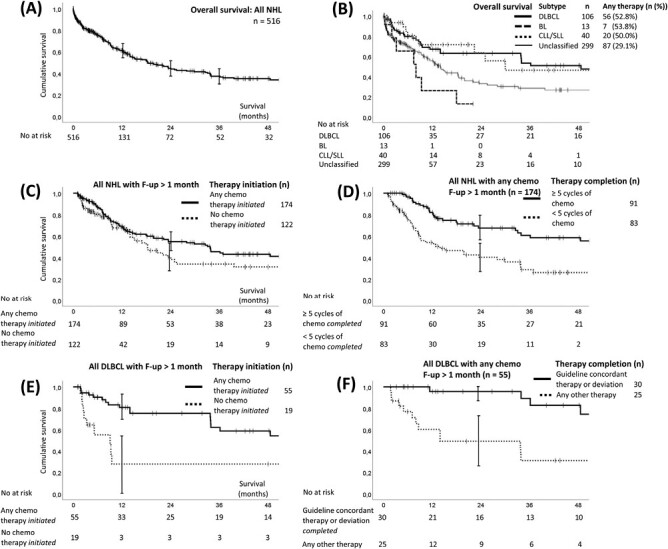
Survival by Kaplan-Meier estimates. (A) Overall survival of population-based cohort (n = 516); 95% CI indicated for 12, 24, and 36 months. (B) Overall survival of population-based cohort stratified by different subtypes and unclassified lymphoma. (C) Survival of population-based cohort with at least 1 month of survival (n = 296) with respect to therapy initiation and (D) those surviving at least 1 month that initiated any chemotherapy (n = 174), with respect to completion of chemo(immuno-)therapy cycles. (E) Survival of DLBCL with at least 1 month of survival (n = 74) with respect to therapy initiation and (F) DLBCL patients surviving at least 1 month that received any chemo(immuno-)therapy (n = 55) with respect to therapy completion concording with NCCN guidelines harmonized for Sub-Saharan Africa. No, Number; DLBCL, diffuse large B-cell lymphoma; BL, Burkitt lymphoma; CLL/SLL, chronic lymphocytic leukemia/small lymphocytic lymphoma; F-up, follow-up.
Figure 6.
Figure 6.
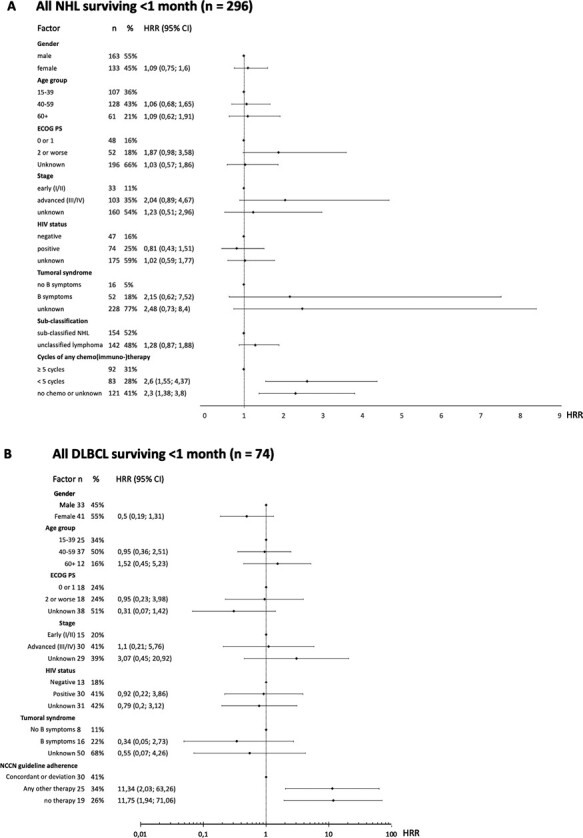
Results of multivariable Cox regression analysis for risk of early death. A: All NHL in the population-based cohort with at least 1 month of survival (n = 296). B: All DLBCL in the population-based cohort with at least 1 month of survival (n = 74). HRR, hazard rate ratio.

References

    1. Mafra A, Laversanne M, Gospodarowicz M, et al. Global patterns of non-Hodgkin lymphoma in 2020. Int J Cancer. 2022;151(9):1474-1481. - PubMed
    1. Bray F, Ferlay J, Soerjomataram I, et al. Global cancer statistics 2018: GLOBOCAN estimates of incidence and mortality worldwide for 36 cancers in 185 countries. CA Cancer J Clin. 2018;68(6):394-424. 10.3322/caac.21492. - DOI - PubMed
    1. Parkin DM, Nambooze S, Wabwire-Mangen F, Wabinga HR.. Changing cancer incidence in Kampala, Uganda, 1991-2006. Int J Cancer. 2010;126(5):1187-1195. 10.1002/ijc.24838. - DOI - PubMed
    1. Chokunonga E, Borok MZ, Chirenje ZM, Nyakabau AM, Parkin DM.. Trends in the incidence of cancer in the black population of Harare, Zimbabwe 1991-2010. Int J Cancer. 2013Published March 4, 2013;133(3):721-729. 10.1002/ijc.28063. - DOI - PubMed
    1. Ferlay J, Soerjomataram I, Dikshit R, et al. Cancer incidence and mortality worldwide: sources, methods and major patterns in GLOBOCAN 2012. Int J Cancer. 2014;136(5):E359-E386. 10.1002/ijc.29210. - DOI - PubMed

Publication types