Effect of an Artificial Intelligence-Based Self-Management App on Musculoskeletal Health in Patients With Neck and/or Low Back Pain Referred to Specialist Care: A Randomized Clinical Trial
- PMID: 37368401
- PMCID: PMC10300712
- DOI: 10.1001/jamanetworkopen.2023.20400
Effect of an Artificial Intelligence-Based Self-Management App on Musculoskeletal Health in Patients With Neck and/or Low Back Pain Referred to Specialist Care: A Randomized Clinical Trial
Abstract
Importance: Self-management is a key element in the care of persistent neck and low back pain. Individually tailored self-management support delivered via a smartphone app in a specialist care setting has not been tested.
Objective: To determine the effect of individually tailored self-management support delivered via an artificial intelligence-based app (SELFBACK) adjunct to usual care vs usual care alone or nontailored web-based self-management support (e-Help) on musculoskeletal health.
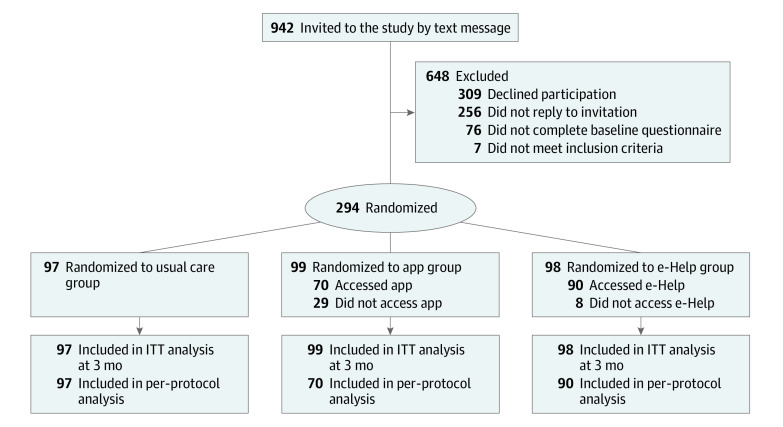
Design, setting, and participants: This randomized clinical trial recruited adults 18 years or older with neck and/or low back pain who had been referred to and accepted on a waiting list for specialist care at a multidisciplinary hospital outpatient clinic for back, neck, and shoulder rehabilitation. Participants were enrolled from July 9, 2020, to April 29, 2021. Of 377 patients assessed for eligibility, 76 did not complete the baseline questionnaire, and 7 did not meet the eligibility criteria (ie, did not own a smartphone, were unable to take part in exercise, or had language barriers); the remaining 294 patients were included in the study and randomized to 3 parallel groups, with follow-up of 6 months.
Interventions: Participants were randomly assigned to receive app-based individually tailored self-management support in addition to usual care (app group), web-based nontailored self-management support in addition to usual care (e-Help group), or usual care alone (usual care group).
Main outcomes and measures: The primary outcome was change in musculoskeletal health measured by the Musculoskeletal Health Questionnaire (MSK-HQ) at 3 months. Secondary outcomes included change in musculoskeletal health measured by the MSK-HQ at 6 weeks and 6 months and pain-related disability, pain intensity, pain-related cognition, and health-related quality of life at 6 weeks, 3 months, and 6 months.
Results: Among 294 participants (mean [SD] age, 50.6 [14.9] years; 173 women [58.8%]), 99 were randomized to the app group, 98 to the e-Help group, and 97 to the usual care group. At 3 months, 243 participants (82.7%) had complete data on the primary outcome. In the intention-to-treat analysis at 3 months, the adjusted mean difference in MSK-HQ score between the app and usual care groups was 0.62 points (95% CI, -1.66 to 2.90 points; P = .60). The adjusted mean difference between the app and e-Help groups was 1.08 points (95% CI, -1.24 to 3.41 points; P = .36).
Conclusions and relevance: In this randomized clinical trial, individually tailored self-management support delivered via an artificial intelligence-based app adjunct to usual care was not significantly more effective in improving musculoskeletal health than usual care alone or web-based nontailored self-management support in patients with neck and/or low back pain referred to specialist care. Further research is needed to investigate the utility of implementing digitally supported self-management interventions in the specialist care setting and to identify instruments that capture changes in self-management behavior.
Trial registration: ClinicalTrials.gov Identifier: NCT04463043.
Conflict of interest statement
Figures
References
-
- Andersson G, Watkins-Castillo SI. The burden of musculoskeletal diseases in the United States: spine: low back and neck pain. United States Bone and Joint Initiative; 2014. Accessed November 29, 2022. https://www.boneandjointburden.org/2014-report/ii0/spine-low-back-and-ne...
Publication types
MeSH terms
Associated data
LinkOut - more resources
Full Text Sources
Medical
Miscellaneous