


Trends in COVID-19 Vaccine Hesitancy and Uptake Among Persons Living With HIV in Washington, DC
- PMID: 37368934
- PMCID: PMC10529778
- DOI: 10.1097/QAI.0000000000003243
Trends in COVID-19 Vaccine Hesitancy and Uptake Among Persons Living With HIV in Washington, DC
Abstract
Objective: The COVID-19 pandemic has disproportionately affected older people, people with underlying health conditions, racial and ethnic minorities, socioeconomically disadvantaged, and people living with HIV (PWH). We sought to describe vaccine hesitancy and associated factors, reasons for vaccine hesitancy, and vaccine uptake over time in PWH in Washington, DC.
Methods: We conducted a cross-sectional survey between October 2020 and December 2021 among PWH enrolled in a prospective longitudinal cohort in DC. Survey data were linked to electronic health record data and descriptively analyzed. Multivariable logistic regression was performed to identify factors associated with vaccine hesitancy. The most common reasons for vaccine hesitancy and uptake were assessed.
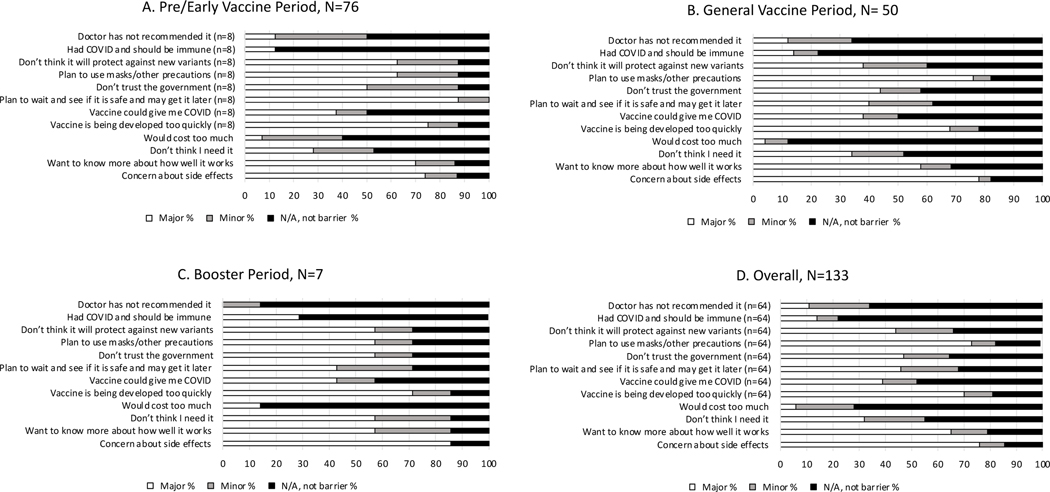
Results: Among 1029 participants (66% men, 74% Black, median age 54 years), 13% were vaccine hesitant and 9% refused. Women were 2.6-3.5 times, non-Hispanic Blacks were 2.2 times, Hispanics and those of other race/ethnicities were 3.5-8.8 times, and younger PWH were significantly more likely to express hesitancy or refusal than men, non-Hispanic Whites, and older PWH, respectively. The most reported reasons for vaccine hesitancy were side effect concerns (76%), plans to use other precautions/masks (73%), and speed of vaccine development (70%). Vaccine hesitancy and refusal declined over time (33% in October 2020 vs. 4% in December 2021, P < 0.0001).
Conclusions: This study is one of the largest analyses of vaccine hesitancy among PWH in a US urban area highly affected by HIV and COVID-19. Multilevel culturally appropriate approaches are needed to effectively address COVID-19 vaccine concerns raised among PWH.
Copyright © 2023 Wolters Kluwer Health, Inc. All rights reserved.
Conflict of interest statement
The authors have no conflicts of interest to disclose.
Figures

References
-
- Johns Hopkins University. The Center for Systems Science and Engineering. COVID-19 Dashboard; 2021. Available from: https://www.coronavirus.jhu.edu/map.html.
-
- Centers for Disease Control and Prevention. COVID-19: People with Certain Medical Conditions. 2021; Available from: https://www.cdc.gov/coronavirus/2019-ncov/need-extra-precautions/people-.... - PubMed
Publication types
MeSH terms
Substances
Grants and funding
LinkOut - more resources
Full Text Sources
Medical
