


Fibrin degradation products and survival in patients with chronic obstructive pulmonary disease: a protocolized prospective observational study
- PMID: 37370121
- PMCID: PMC10294503
- DOI: 10.1186/s12931-023-02472-9
Fibrin degradation products and survival in patients with chronic obstructive pulmonary disease: a protocolized prospective observational study
Abstract
Background: Patients with chronic obstructive pulmonary disease (COPD) have a high incidence of cardiovascular disease including thromboembolisms. Fibrin degradation products, like D-dimer, have been associated with death from all causes in healthy individuals and COPD patients. We aimed to determine the (i) association between D-dimer levels and all-cause mortality and time being alive and out of a hospital, (ii) possible modifying effect of anticoagulant treatment,, and (iii) distribution of D-dimer in patients with moderate to severe COPD.
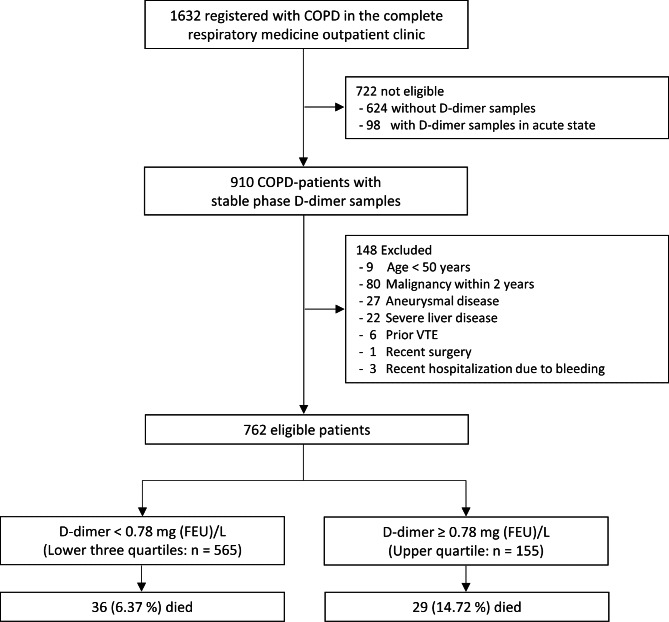
Methods: Results of routinely measured stable phase D-dimer samples from COPD-outpatients at Copenhagen University Hospital - Herlev and Gentofte, COPD-outpatient clinic were collected using the Danish registries. These were used to examine whether COPD-patients with a D-dimer level in the upper quartile, had a higher risk of death from all causes within 365 days.
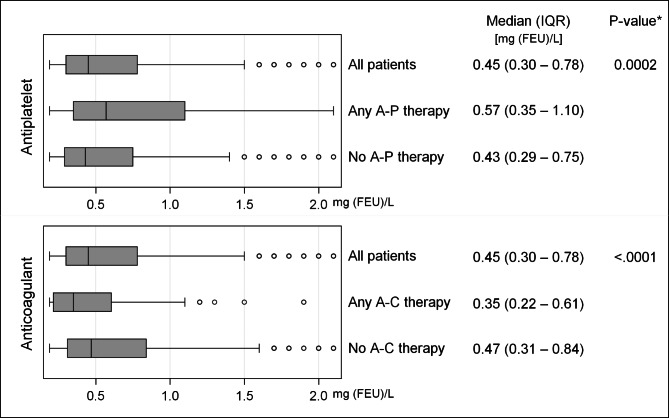
Results: In the unadjusted Cox proportional hazards regression we found an association between high D-dimer and all-cause mortality: Hazard ratio (HR): 2.3 (95% Confidence Interval (CI) 1.1-4.7). In the fully adjusted regression, the HR was 1.8 (CI 0.8-3.9). We did not find any interaction between D-dimer and anticoagulant or antiplatelet therapy. For the secondary outcome, proportion of days alive and out of hospital in 365 days (pDAOH), the unadjusted multiple linear regression had an association between high D-dimer level and pDAOH: -2.7% points (pp) (CI -3.9 pp - -1.5 pp), which was attenuated to -1,7pp (-2.9pp - -0.4pp) in the fully adjusted regression.
Conclusions: In patients with moderate to severe COPD, patients with a high level of D-dimer were more likely to die; however, the signal was not strong in the adjusted analyses and our results do not support unselected risk stratification with D-dimer in COPD-outpatients.
Keywords: All-cause mortality; Biomarker; COPD; Cohort; D-dimer.
© 2023. The Author(s).
Conflict of interest statement
Outside the submitted work: C.S.U. has received grants from Sanofi, Boehringer Ingelheim, AstraZeneca, and Novartis and speaker fees from Orion Pharma, AstraZeneca, and TEVA and consulting fees from Chiesi, Orion Pharma, AstraZeneca, GSK, and TEVA, and been on advisory boards for Novartis, Sanofi, Glaxo-Smith Kline, Chiesi, AstraZeneca, and Boehringer Ingelheim. E.B. has received speaker fees from Boehringer Ingelheim, Hoffmann la Roche, AstraZeneca, GSK, and Daiichi Sankyo, and support for attending meetings/travel from Boehringer Ingelheim, and Hoffmann la Roche and participation on DSMB or advisory board for Boehringer Ingelheim, AbbVie, and Galapagos. T.B-S. received consulting fees from GSK and Sanofi Pasteur and received speaker payments from Bayer, Sanofi Pasteur, and GSK and support for meetings/travel from AstraZeneca and received equipment for his department from GE. R.S. received support for attending meetings/travel from Abbott. All other authors report no conflicts of interest.
Figures

References
-
- Wang J, Ding YM. Prevalence and risk factors of pulmonary embolism in acute exacerbation of chronic obstructive pulmonary disease and its impact on outcomes: a systematic review and meta-analysis. Eur Rev Med Pharmacol Sci. 2021;25(6):2604–16. - PubMed
Publication types
MeSH terms
Substances
LinkOut - more resources
Full Text Sources
Medical
Miscellaneous
