Review
. 2023 Jun 8;15(12):3110.
doi: 10.3390/cancers15123110.

The Molecular Basis and Clinical Consequences of Chronic Inflammation in Prostatic Diseases: Prostatitis, Benign Prostatic Hyperplasia, and Prostate Cancer

Affiliations
Review

The Molecular Basis and Clinical Consequences of Chronic Inflammation in Prostatic Diseases: Prostatitis, Benign Prostatic Hyperplasia, and Prostate Cancer

Saheed Oluwasina Oseni et al. Cancers (Basel). .

Abstract

Chronic inflammation is now recognized as one of the major risk factors and molecular hallmarks of chronic prostatitis, benign prostatic hyperplasia (BPH), and prostate tumorigenesis. However, the molecular mechanisms by which chronic inflammation signaling contributes to the pathogenesis of these prostate diseases are poorly understood. Previous efforts to therapeutically target the upstream (e.g., TLRs and IL1-Rs) and downstream (e.g., NF-κB subunits and cytokines) inflammatory signaling molecules in people with these conditions have been clinically ambiguous and unsatisfactory, hence fostering the recent paradigm shift towards unraveling and understanding the functional roles and clinical significance of the novel and relatively underexplored inflammatory molecules and pathways that could become potential therapeutic targets in managing prostatic diseases. In this review article, we exclusively discuss the causal and molecular drivers of prostatitis, BPH, and prostate tumorigenesis, as well as the potential impacts of microbiome dysbiosis and chronic inflammation in promoting prostate pathologies. We specifically focus on the importance of some of the underexplored druggable inflammatory molecules, by discussing how their aberrant signaling could promote prostate cancer (PCa) stemness, neuroendocrine differentiation, castration resistance, metabolic reprogramming, and immunosuppression. The potential contribution of the IL1R-TLR-IRAK-NF-κBs signaling molecules and NLR/inflammasomes in prostate pathologies, as well as the prospective benefits of selectively targeting the midstream molecules in the various inflammatory cascades, are also discussed. Though this review concentrates more on PCa, we envision that the information could be applied to other prostate diseases. In conclusion, we have underlined the molecular mechanisms and signaling pathways that may need to be targeted and/or further investigated to better understand the association between chronic inflammation and prostate diseases.

Keywords: benign prostate hyperplasia; cancer stemness; castration resistance; chronic inflammation; inflammasomes; neuroendocrine differentiation; prostate cancer; prostatitis.


Conflict of interest statement

The authors declare no conflict of interest.

Figures

Figure 1
Figure 1
A diagrammatic illustration of the link between chronic inflammation and different stages of prostate tumorigenesis, including prostate cancer initiation, promotion, and progression.
Figure 2
Figure 2
Flow chart highlighting some of the common uro-pathogens (bacteria, viruses, fungi, and parasites/protozoans of the prostate/urinary tract microbiota) that have been isolated from healthy and diseased prostate tissues using several molecular techniques.
Figure 3
Figure 3
Diagrammatic illustration of the prostate tumor microenvironment showing the cell subpopulations and microbiota. Created with Biorender.com.
Figure 4
Figure 4
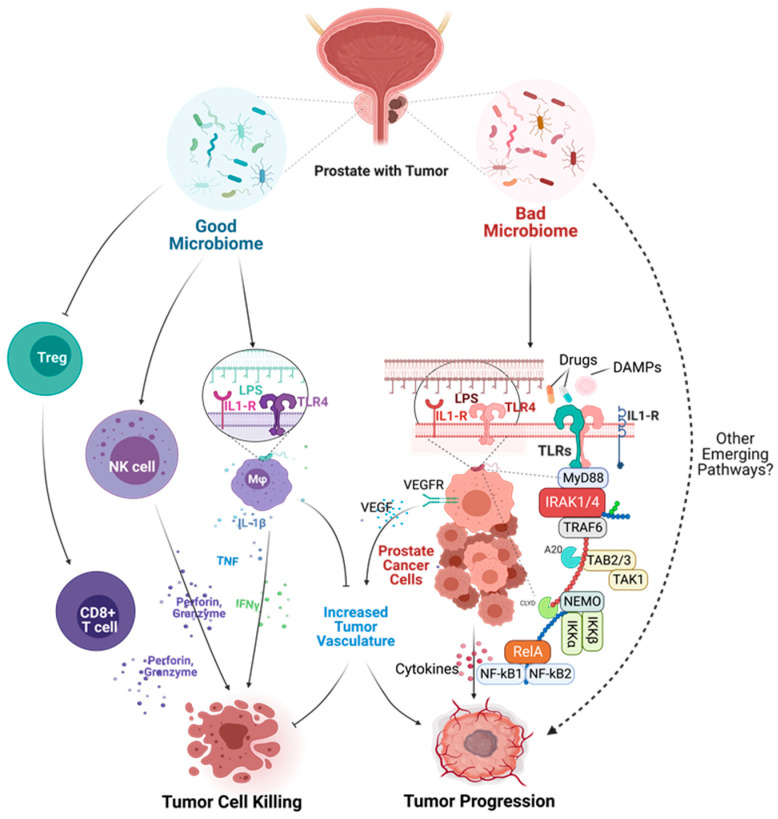
A schematic illustration of the prostate microbiome as it relates to the mechanisms involved in anti-tumor immune response versus tumor progression response in the prostate tumor microenvironment. Created with BioRender.com.
Figure 5
Figure 5
A schematic illustration of the activation process of TLR receptors and their downstream signaling molecules upon activation forming the TLR-MYD88-IRAK1/4-TRAF6-NF-κB/IRF or TLR3/TLR4-TRIF-IRF/NF-κB signaling pathways. The illustration also includes the location of common mammalian TLRs, either on the cell membrane or within the cell compartments (Endosome), and their corresponding ligands or agonists. Created with BioRender.com.
Figure 6
Figure 6
Diagrammatic illustration of common cellular and intracellular PRR receptors in bacteria, viruses, fungi, and protozoa. Created with Biorender.com.
Figure 7
Figure 7
Schematic Illustrations of the cell wall components of Gram-negative (A) and Gram-positive (B) bacterial organisms. The LPS of Gram-negative bacteria is very important for danger signaling through the activation of TLR4, while the LTA of Gram-positive bacteria activates the TLR2 signaling pathway. Created with BioRender.com.
Figure 8
Figure 8
A schematic illustration of the TLR/IL1/IRAK/NF-κB inflammatory signaling pathway axis. The diagram also displays the potential novel therapeutic targets against inflammation-driven PCa progression. In our lab, we are interested in understanding the role of IRAKs in prostate tumorigenesis as well as evaluating the potential of targeting their signaling pathways. IL1Rs and TLRs are activated by their ligands and/or PAMPs/DAMPs, thus inducing a series of downstream inflammatory signaling cascades regulated by IRAKs at the midstream level. It is worth elucidating the cellular and molecular mechanisms involved in chronic inflammation-driven cancer growth, metastasis, chemoresistance, metabolic reprogramming, stemness, immune evasion, and neuroendocrine (NE) differentiation. Created with BioRender.com.
Figure 9
Figure 9
The structural architecture of the protein domains of IRAK1–4. The illustration shows the different domains important for binding (Death domain and C-terminal domain), catalytic activity (Kinase domain), and autophosphorylation (Kinase domain and Pro/Ser/Thr domain).
Figure 10
Figure 10
Diagrammatic illustration showing the possible crosstalk between genes in the TLR/IRAK/NF-κB signaling pathway and PCa-associated oncogenes/tumor suppressors.
Figure 11
Figure 11
A schematic illustration of one of the possible novel therapeutic strategies that could be explored for the management of chronic inflammation-driven PCa, as envisaged in our lab.
Figure 12
Figure 12
A schematic illustration of the IL1-R/TLR/NF-κB pathway with emphasis on activation of different NF-κB subunits via the IRAK1/TRAF6-mediated pathway. Created with BioRender.com.
Figure 13
Figure 13
A schematical illustration of hallmarks of prostate cancer progression, including well-characterized hallmarks and the emerging hallmarks. Chronic or tumor-promoting inflammation, microbial dysbiosis, and genome instability are some of the emerging hallmarks. Created with BioRender.com.
Figure 14
Figure 14
A schematic illustration of the aggressive evolution of prostate tumor progression from androgen-sensitive to castration-resistant and from local to metastatic in the presence or absence of chronic inflammation. A few studies have provided evidence that chronic inflammation can enhance chemoresistance, castration resistance, and radio-resistance. Created with BioRender.com.

References

    1. Lee C.H., Akin-Olugbade O., Kirschenbaum A. Overview of Prostate Anatomy, Histology, and Pathology. Endocrinol. Metab. Clin. N. Am. 2011;40:565–575. doi: 10.1016/j.ecl.2011.05.012. - DOI - PubMed
    1. Pelucchi C., Talamini R., Negri E., Franceschi S., La Vecchia C. Genital and Urinary Tract Diseases and Prostate Cancer Risk. Eur. J. Cancer Prev. 2006;15:254–257. doi: 10.1097/01.cej.0000198897.40303.d4. - DOI - PubMed
    1. Zhang G., Yang P., Guo P., Miele L., Sarkar F.H., Wang Z., Zhou Q. Unraveling the Mystery of Cancer Metabolism in the Genesis of Tumor-Initiating Cells and Development of Cancer. Biochim. Biophys. Acta. 2013;1836:49–59. doi: 10.1016/j.bbcan.2013.03.001. - DOI - PubMed
    1. Coussens L.M., Werb Z. Inflammation and Cancer. Nature. 2002;420:860–867. doi: 10.1038/nature01322. - DOI - PMC - PubMed
    1. Brüggemann H., Al-Zeer M.A. Bacterial Signatures and Their Inflammatory Potentials Associated with Prostate Cancer. APMIS. 2020;128:80–91. doi: 10.1111/apm.13021. - DOI - PubMed

LinkOut - more resources