


Molecular Diagnosis and Identification of Novel Pathogenic Variants in a Large Cohort of Italian Patients Affected by Polycystic Kidney Diseases
- PMID: 37372416
- PMCID: PMC10298188
- DOI: 10.3390/genes14061236
Molecular Diagnosis and Identification of Novel Pathogenic Variants in a Large Cohort of Italian Patients Affected by Polycystic Kidney Diseases
Abstract
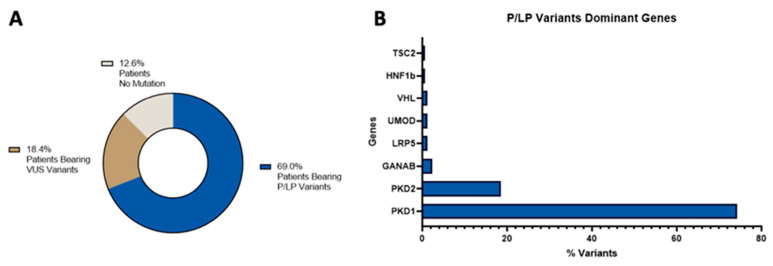
Polycystic Kidney Diseases (PKDs) consist of a genetically and phenotypically heterogeneous group of inherited disorders characterized by numerous renal cysts. PKDs include autosomal dominant ADPKD, autosomal recessive ARPKD and atypical forms. Here, we analyzed 255 Italian patients using an NGS panel of 63 genes, plus Sanger sequencing of exon 1 of the PKD1 gene and MPLA (PKD1, PKD2 and PKHD1) analysis. Overall, 167 patients bore pathogenic/likely pathogenic variants in dominant genes, and 5 patients in recessive genes. Four patients were carriers of one pathogenic/likely pathogenic recessive variant. A total of 24 patients had a VUS variant in dominant genes, 8 patients in recessive genes and 15 patients were carriers of one VUS variant in recessive genes. Finally, in 32 patients we could not reveal any variant. Regarding the global diagnostic status, 69% of total patients bore pathogenic/likely pathogenic variants, 18.4% VUS variants and in 12.6% of patients we could not find any. PKD1 and PKD2 resulted to be the most mutated genes; additional genes were UMOD and GANAB. Among recessive genes, PKHD1 was the most mutated gene. An analysis of eGFR values showed that patients with truncating variants had a more severe phenotype. In conclusion, our study confirmed the high degree of genetic complexity at the basis of PKDs and highlighted the crucial role of molecular characterization in patients with suspicious clinical diagnosis. An accurate and early molecular diagnosis is essential to adopt the appropriate therapeutic protocol and represents a predictive factor for family members.
Keywords: ADPKD; ARPKD; genetic complexity; next-generation sequencing; polycystic kidney diseases.
Conflict of interest statement
The authors declare no conflict of interest.
Figures
References
-
- Fujimaru T., Mori T., Sekine A., Mandai S., Chiga M., Kikuchi H., Ando F., Mori Y., Nomura N., Iimori S., et al. Kidney enlargement and multiple liver cyst formation implicate mutations in PKD1/2 in adult sporadic polycystic kidney disease. Clin. Genet. 2018;94:125–131. doi: 10.1111/cge.13249. - DOI - PubMed
-
- Suwabe T., Shukoor S., Chamberlain A.M., Killian J.M., King B.F., Edwards M., Senum S.R., Madsen C.D., Chebib F.T., Hogan M.C., et al. Epidemiology of Autosomal Dominant Polycystic Kidney Disease in Olmsted County. Clin. J. Am. Soc. Nephrol. 2020;15:69–79. doi: 10.2215/CJN.05900519. - DOI - PMC - PubMed
Publication types
MeSH terms
Substances
LinkOut - more resources
Full Text Sources
Research Materials
Miscellaneous
