


Unveiling the Prognostic Significance of BCL6+/CD10+ Mantle Cell Lymphoma: Meta-Analysis of Individual Patients and Systematic Review
- PMID: 37373354
- PMCID: PMC10298847
- DOI: 10.3390/ijms241210207
Unveiling the Prognostic Significance of BCL6+/CD10+ Mantle Cell Lymphoma: Meta-Analysis of Individual Patients and Systematic Review
Abstract
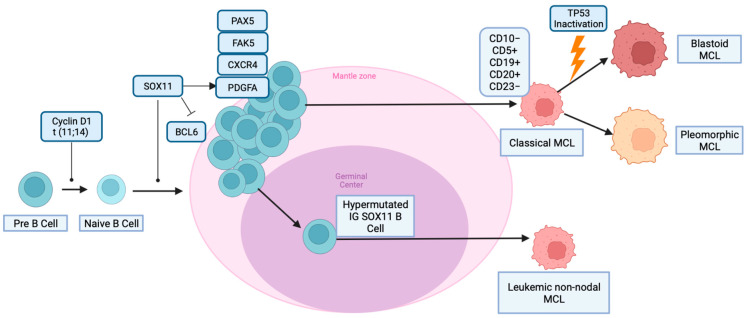
Mantle cell lymphoma (MCL) is a type of non-Hodgkin lymphoma (NHL) characterized by a hallmark translocation of t (11; 14). CD10 negativity has been used to differentiate MCL from other NHL types; however, recently, there has been an increase in the number of reported cases of CD10-positive MCL. This warrants further investigation into this rarer immunophenotype and its clinical significance. BCL6, which is a master transcription factor for the regulation of cell proliferation and key oncogene in B cell lymphomagenesis, has been reported to have co-expression with CD10 in MCL. The clinical significance of this aberrant antigen expression remains unknown. We conducted a systematic review by searching four databases and selected five retrospective analyses and five case series. Two survival analyses were conducted to determine if BCL6 positivity conferred a survival difference: 1. BCL6+ vs. BCL6- MCL. 2. BCL6+/CD10+ vs. BCL6-/CD10+ MCL. Correlation analysis was conducted to determine if BCL6 positivity correlated with the Ki67 proliferation index (PI). Overall survival (OS) rates were performed by the Kaplan-Meier method and log-rank test. Our analyses revealed that BCL6+ MCL had significantly shorter overall survival (median OS: 14 months vs. 43 months; p = 0.01), BCL6+/CD10+ MCL had an inferior outcome vs. BCL6+/CD10- MCL (median OS: 20 months vs. 55 months p = 0.1828), BCL6+ MCL had significantly higher percentages of Ki67% (Ki67% difference: 24.29; p = 0.0094), and BCL6 positivity had a positive correlation with CD10+ status with an odds ratio 5.11 (2.49, 10.46; p = 0.0000286). Our analysis showed that BCL6 expression is correlated with CD10 positivity in MCL, and BCL6 expression demonstrated an inferior overall survival. The higher Ki67 PI in BCL6+ MCL compared to BCL6- MCL further supports the idea that the BCL6+ immunophenotype may have prognostic value in MCL. MCL management should consider incorporating prognostic scoring systems adjusted for BCL6 expression. Targeted therapies against BCL6 may offer potential therapeutic options for managing MCL with aberrant immunophenotypes.
Keywords: BCL6; CD10; aberrant MCL immunophenotype; overall survival.
Conflict of interest statement
The authors declare no conflict of interest.
Figures


References
-
- Lynch D.T., Koya S., Acharya U., Kumar A. StatPearls. StatPearls Publishing; Tampa, FL, USA: 2022. Mantle Cell Lymphoma. - PubMed
-
- Nadeu F., Martin-Garcia D., Clot G., Díaz-Navarro A., Duran-Ferrer M., Navarro A., Vilarrasa-Blasi R., Kulis M., Royo R., Gutiérrez-Abril J., et al. Genomic and epigenomic insights into the origin, pathogenesis, and clinical behavior of mantle cell lymphoma subtypes. Blood. 2020;136:1419–1432. doi: 10.1182/blood.2020005289. - DOI - PMC - PubMed
-
- Akhter A., Mahe E., Street L., Pournazari P., Perizzolo M., Shabani-Rad M.-T., Stewart D.A., Mansoor A. CD10-positive mantle cell lymphoma: Biologically distinct entity or an aberrant immunophenotype? Insight, through gene expression profile in a unique case series. J. Clin. Pathol. 2015;68:844–848. doi: 10.1136/jclinpath-2015-202955. - DOI - PubMed
Publication types
MeSH terms
Substances
LinkOut - more resources
Full Text Sources
Research Materials
Miscellaneous
