


Obesity as a Risk Factor of Severe Outcome of COVID-19: A Pair-Matched 1:2 Case-Control Study
- PMID: 37373748
- PMCID: PMC10298877
- DOI: 10.3390/jcm12124055
Obesity as a Risk Factor of Severe Outcome of COVID-19: A Pair-Matched 1:2 Case-Control Study
Abstract
Background and aim: The nature of the association between obesity and poor prognosis of COVID-19 without the evaluation of other co-pathologies associated has not yet been clearly evaluated. The aim of the present pair-matched case-control study was to investigate the outcome of patients with SARS-CoV-2 infection in obese and non-obese patients matched considering gender, age, number of comorbidities, and Charlson Comorbidity Index.
Methods: All the adults hospitalized for SARS-CoV-2 infection and with BMI ≥ 30 kg/m2 were included (Cases). For each Case, two patients with BMI < 30 kg/m2 pair matched for gender, age (±5 years), number of comorbidities (excluding obesity), and Charlson Comorbidity Index (±1) were enrolled (Controls).
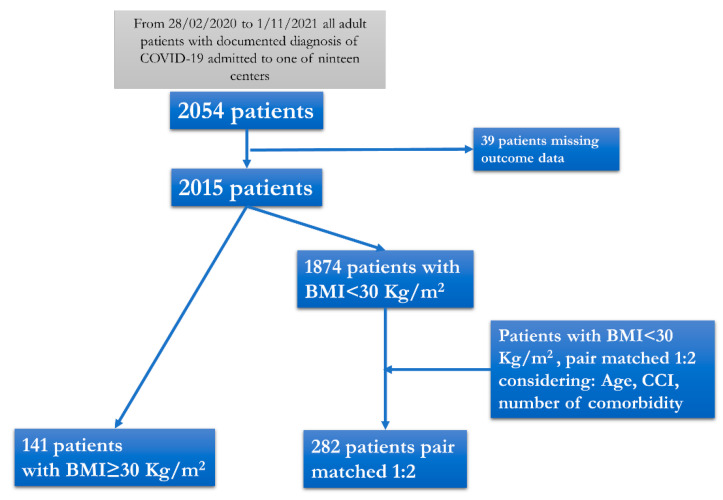
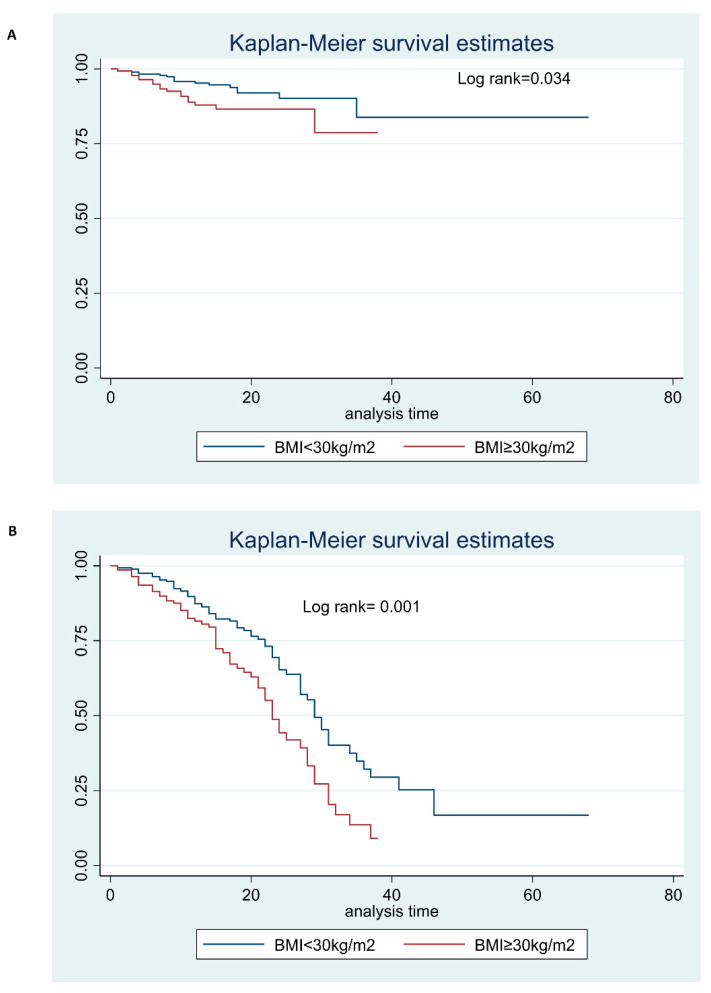
Results: Of the 1282 patients with SARS-CoV-2 infection followed during the study period, 141 patients with obesity and 282 patients without were enrolled in the case and control groups, respectively. Considering matching variables, there was no statistical difference between the two groups. Patients in the Control group developed more frequently a mild-moderate disease (67% vs. 46.1%, respectively), whereas obese patients were more prone to need intensive care treatment (41.8% vs. 26.6%, respectively; p = 0.001). Moreover, the prevalence of death during hospitalization was higher in the Case group than in the Control group (12.1% vs. 6.4%, p = 0.046).
Discussion: We confirmed an association between obesity and severe outcome of patients with COVID-19, also considering other factors associated with a severe outcome of COVID-19. Thus, in the case of SARS-CoV-2 infection, the subjects with BMI ≥ 30 kg/m2 should be evaluated for early antiviral treatment to avoid the development of a severe course.
Keywords: COVID-19; SARS-CoV-2 infection; mortality; obesity; severity of disease.
Conflict of interest statement
The authors declare no conflict of interest.
Figures
References
-
- WHO Coronavirus (COVID-19) Dashboard. WHO Coronavirus (COVID-19) Dashboard with Vaccination Data. [(accessed on 20 September 2022)]. Available online: https://covid19.who.int/
-
- Monari C., Sagnelli C., Maggi P., Sangiovanni V., Numis F.G., Gentile I., Masullo A., Rescigno C., Calabria G., Megna A.S., et al. More Severe COVID-19 in Patients with Active Cancer: Results of a Multicenter Cohort Study. Front. Oncol. 2021;11:662746. doi: 10.3389/fonc.2021.662746. - DOI - PMC - PubMed
-
- Russo A., Pisaturo M., Palladino R., Maggi P., Numis F.G., Gentile I., Sangiovanni V., Esposito V., Punzi R., Calabria G., et al. Prognostic Value of Transaminases and Bilirubin Levels at Admission to Hospital on Disease Progression and Mortality in Patients with COVID-19—An Observational Retrospective Study. Pathogens. 2022;11:652. doi: 10.3390/pathogens11060652. - DOI - PMC - PubMed
Grants and funding
LinkOut - more resources
Full Text Sources
Miscellaneous
