


A Review of the Role of Artificial Intelligence in Healthcare
- PMID: 37373940
- PMCID: PMC10301994
- DOI: 10.3390/jpm13060951
A Review of the Role of Artificial Intelligence in Healthcare
Abstract
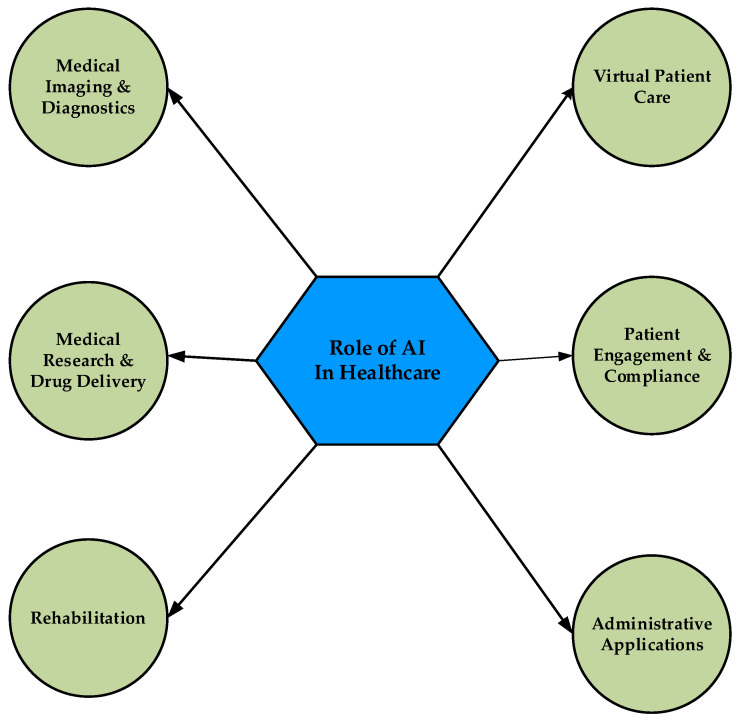
Artificial intelligence (AI) applications have transformed healthcare. This study is based on a general literature review uncovering the role of AI in healthcare and focuses on the following key aspects: (i) medical imaging and diagnostics, (ii) virtual patient care, (iii) medical research and drug discovery, (iv) patient engagement and compliance, (v) rehabilitation, and (vi) other administrative applications. The impact of AI is observed in detecting clinical conditions in medical imaging and diagnostic services, controlling the outbreak of coronavirus disease 2019 (COVID-19) with early diagnosis, providing virtual patient care using AI-powered tools, managing electronic health records, augmenting patient engagement and compliance with the treatment plan, reducing the administrative workload of healthcare professionals (HCPs), discovering new drugs and vaccines, spotting medical prescription errors, extensive data storage and analysis, and technology-assisted rehabilitation. Nevertheless, this science pitch meets several technical, ethical, and social challenges, including privacy, safety, the right to decide and try, costs, information and consent, access, and efficacy, while integrating AI into healthcare. The governance of AI applications is crucial for patient safety and accountability and for raising HCPs' belief in enhancing acceptance and boosting significant health consequences. Effective governance is a prerequisite to precisely address regulatory, ethical, and trust issues while advancing the acceptance and implementation of AI. Since COVID-19 hit the global health system, the concept of AI has created a revolution in healthcare, and such an uprising could be another step forward to meet future healthcare needs.
Keywords: artificial intelligence; ethics; governance; healthcare.
Conflict of interest statement
The authors declare no conflict of interest.
Figures
References
-
- Snowdon A. Digital Health: A Framework for Healthcare Transformation. 2020. [(accessed on 23 January 2023)]. Available online: https://www.gs1ca.org/documents/digital_health-affht.pdf.
-
- Tabriz A.A., Nouri E., Vu H.T., Nghiem V.T., Bettilyon B., Gholamhoseyni P., Kiapour N. What should accountable care organizations learn from the failure of health maintenance organizations? A theory based systematic review of the literature. Soc. Determ. Health. 2017;3:222–247. doi: 10.22037/SDH.V3I4.20919. - DOI
-
- Rand Review Chronic Conditions in America: Price and Prevalence. 2017. [(accessed on 11 July 2021)]. Available online: https://www.rand.org/blog/rand-review/2017/07/chronic-conditions-in-amer....
-
- World Health Organization Naming the Coronavirus Disease (COVID-19) and the Virus that Causes It. 2020. [(accessed on 6 July 2021)]. Available online: https://www.who.int/emergencies/diseases/novel-coronavirus-2019/technica....
Publication types
LinkOut - more resources
Full Text Sources
