


The Pathophysiology, Identification and Management of Fracture Risk, Sublesional Osteoporosis and Fracture among Adults with Spinal Cord Injury
- PMID: 37373955
- PMCID: PMC10300795
- DOI: 10.3390/jpm13060966
The Pathophysiology, Identification and Management of Fracture Risk, Sublesional Osteoporosis and Fracture among Adults with Spinal Cord Injury
Abstract
Background: The prevention of lower extremity fractures and fracture-related morbidity and mortality is a critical component of health services for adults living with chronic spinal cord injury (SCI).
Methods: Established best practices and guideline recommendations are articulated in recent international consensus documents from the International Society of Clinical Densitometry, the Paralyzed Veterans of America Consortium for Spinal Cord Medicine and the Orthopedic Trauma Association.
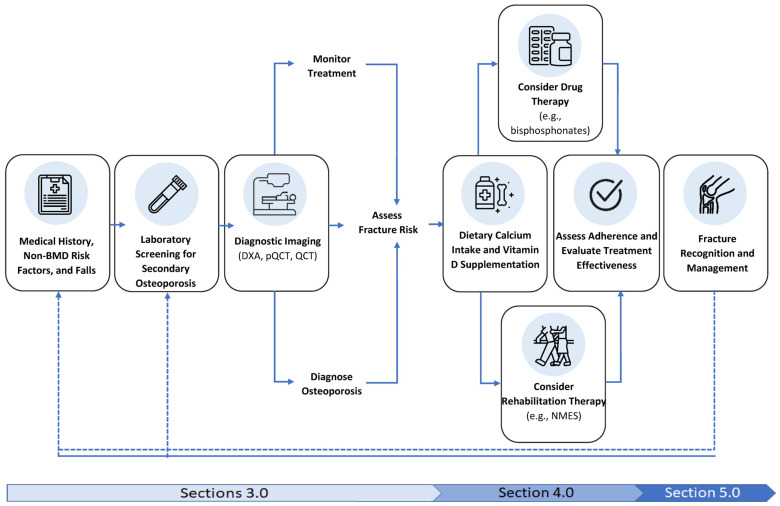
Results: This review is a synthesis of the aforementioned consensus documents, which highlight the pathophysiology of lower extremity bone mineral density (BMD) decline after acute SCI. The role and actions treating clinicians should take to screen, diagnose and initiate the appropriate treatment of established low bone mass/osteoporosis of the hip, distal femur or proximal tibia regions associated with moderate or high fracture risk or diagnose and manage a lower extremity fracture among adults with chronic SCI are articulated. Guidance regarding the prescription of dietary calcium, vitamin D supplements, rehabilitation interventions (passive standing, functional electrical stimulation (FES) or neuromuscular electrical stimulation (NMES)) to modify bone mass and/or anti-resorptive drug therapy (Alendronate, Denosumab, or Zoledronic Acid) is provided. In the event of lower extremity fracture, the need for timely orthopedic consultation for fracture diagnosis and interprofessional care following definitive fracture management to prevent health complications (venous thromboembolism, pressure injury, and autonomic dysreflexia) and rehabilitation interventions to return the individual to his/her pre-fracture functional abilities is emphasized.
Conclusions: Interprofessional care teams should use recent consensus publications to drive sustained practice change to mitigate fracture incidence and fracture-related morbidity and mortality among adults with chronic SCI.
Keywords: dietary supplements; drug therapy; fractures; osteoporosis; rehabilitation; spinal cord injuries.
Conflict of interest statement
Craven acknowledges grant support from CIHR, Ontario Ministry of Health and Long-Term Care, PVA Education Foundation, Praxis Spinal Cord Institute and Craig H Nielsen Foundation. Craven was the panel chair for the PVA Bone Health Guideline and is the current Chair of the Canadian Spinal Cord Injury- Rehabilitation Institute and a member of the Osteoporosis Canada Scientific Advisory Committee. Morse reports no conflict of interest and is currently receiving funding from MN State Department of Education, NIDILRR, PVA, and CHNF.
Figures
References
-
- Bourguignon L., Tong B., Geisler F., Schubert M., Röhrich F., Saur M., Weidner N., Rupp R., Kalke Y.-B.B., Abel R., et al. International surveillance study in acute spinal cord injury confirms viability of multinational clinical trials. BMC Med. 2022;20:225. doi: 10.1186/s12916-022-02395-0. - DOI - PMC - PubMed
Publication types
Grants and funding
LinkOut - more resources
Full Text Sources
Medical
Miscellaneous
