


Atrial Fibrillation and Chronic Coronary Ischemia: A Challenging Vicious Circle
- PMID: 37374152
- PMCID: PMC10305229
- DOI: 10.3390/life13061370
Atrial Fibrillation and Chronic Coronary Ischemia: A Challenging Vicious Circle
Abstract
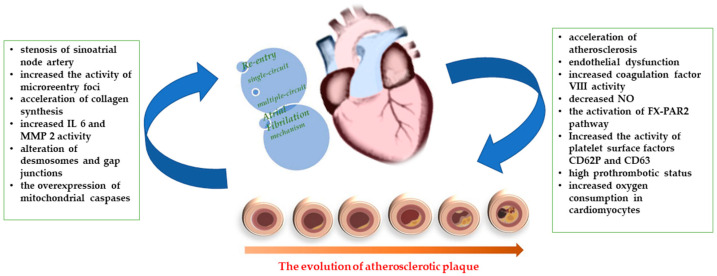
Atrial fibrillation, the most frequent arrhythmia in clinical practice and chronic coronary syndrome, is one of the forms of coronary ischemia to have a strong dual relationship. Atrial fibrillation may accelerate atherosclerosis and may increase oxygen consumption in the myocardium, creating a mismatch between supply and demand, thus promoting the development or worsening of coronary ischemia. Chronic coronary syndrome alters the structure and function of gap junction proteins, affecting the conduction of action potential and leading to ischemic necrosis of cardiomyocytes and their replacement with fibrous tissue, in this way sustaining the focal ectopic activity in atrial myocardium. They have many risk factors in common, such as hypertension, obesity, type 2 diabetes mellitus, and dyslipidemia. It is vital for the prognosis of patients to break this vicious circle by controlling risk factors, drug therapies, of which antithrombotic therapy may sometimes be challenging in terms of prothrombotic and bleeding risk, and interventional therapies (revascularization and catheter ablation).
Keywords: atrial fibrillation; chronic coronary syndrome; coronary artery disease; coronary ischemia; triple antithrombotic therapy.
Conflict of interest statement
The authors declare no conflict of interest.
Figures
References
-
- Lévy S., Steinbeck G., Santini L., Nabauer M., Maceda D.P., Kantharia B.K., Saksena S., Cappato R. Management of atrial fibrillation: Two decades of progress—A scientific statement from the European Cardiac Arrhythmia Society. J. Interv. Card. Electrophysiol. 2022;65:287–326. doi: 10.1007/s10840-022-01195-z. - DOI - PubMed
-
- Miftode R.-S., Costache I.-I., Constantinescu D., Mitu O., Timpau A.-S., Hancianu M., Leca D.-A., Miftode I.-L., Jigoranu R.-A., Oancea A.-F., et al. Syndecan-1: From a Promising Novel Cardiac Biomarker to a Surrogate Early Predictor of Kidney and Liver Injury in Patients with Acute Heart Failure. Life. 2023;13:898. doi: 10.3390/life13040898. - DOI - PMC - PubMed
Publication types
LinkOut - more resources
Full Text Sources
Miscellaneous
