


Viable Mycobacterium avium subsp. paratuberculosis Colonizes Peripheral Blood of Inflammatory Bowel Disease Patients
- PMID: 37375022
- PMCID: PMC10300928
- DOI: 10.3390/microorganisms11061520
Viable Mycobacterium avium subsp. paratuberculosis Colonizes Peripheral Blood of Inflammatory Bowel Disease Patients
Abstract
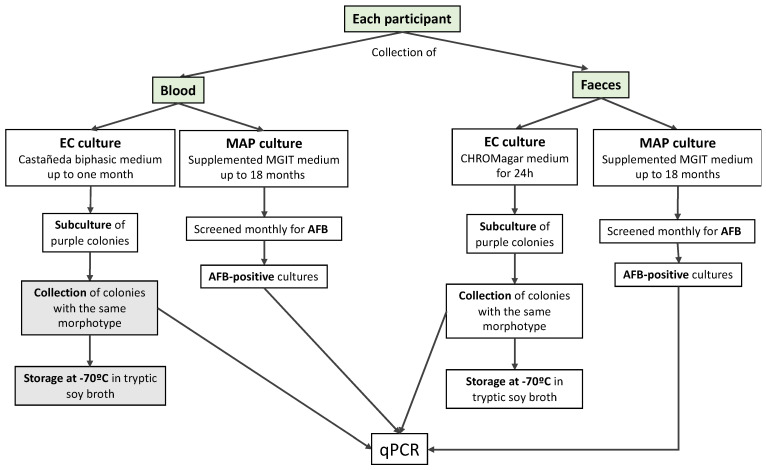
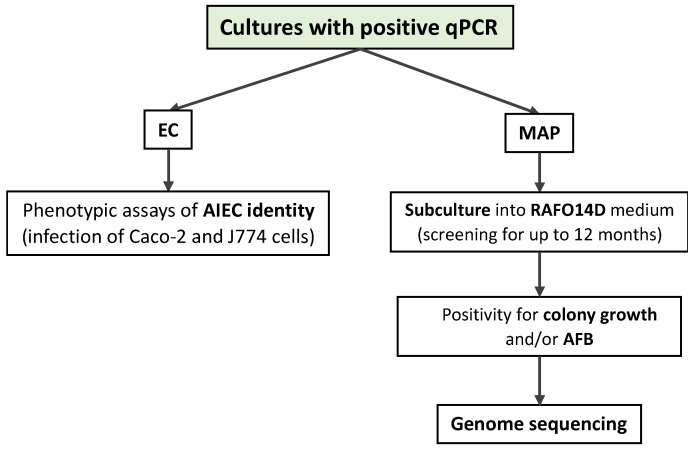
Pathobionts, particularly Mycobacterium avium subsp. paratuberculosis (MAP) and Escherichia coli isolates with adherence/invasive ability (AIEC) have been associated with inflammatory bowel disease (IBD), particularly Crohn's disease (CD). This study aimed to evaluate the frequency of viable MAP and AIEC in a cohort of IBD patients. As such, MAP and E. coli cultures were established from faecal and blood samples (with a total n = 62 for each) of patients with CD (n = 18), ulcerative colitis (UC, n = 15), or liver cirrhosis (n = 7), as well as from healthy controls (HC, n = 22). Presumptive positive cultures were tested by polymerase chain reaction (PCR), for a positive confirmation of MAP or E. coli identity. E. coli-confirmed isolates were then tested for AIEC identity using adherence and invasion assays in the epithelial cell line of Caco-2 and survival and replication assays in the macrophage cell line of J774. MAP sub-culture and genome sequencing were also performed. MAP was more frequently cultured from the blood and faecal samples of patients with CD and cirrhosis. E. coli presumptive colonies were isolated from the faecal samples of most individuals, in contrast to what was registered for the blood samples. Additionally, from the confirmed E. coli isolates, only three had an AIEC-like phenotype (i.e., one CD patient and two UC patients). This study confirmed the association between MAP and CD; however, it did not find a strong association between the presence of AIEC and CD. It may be hypothesized that the presence of viable MAP in the bloodstream of CD patients contributes to disease reactivation.
Keywords: Crohn’s disease; Escherichia coli; Mycobacterium avium; pathobionts; ulcerative colitis.
Conflict of interest statement
Fernando Magro served as speaker and received honoraria from: Abbvie, Biogen, Falk, Ferring, Hospira, Janssen, Laboratórios Vitoria, Lilly, Pfizer, Merck Sharp & Dohme, Sandoz, Takeda, UCB and Vifor. All other authors declare no competing interests.
Figures
References
-
- Estevinho M.M., Leão Moreira P., Silva I., Laranjeira Correia J., Santiago M., Magro F. A Scoping Review on Early Inflammatory Bowel Disease: Definitions, Pathogenesis, and Impact on Clinical Outcomes. Therap. Adv. Gastroenterol. 2022;15:17562848221142672. doi: 10.1177/17562848221142673. - DOI - PMC - PubMed
-
- Shin S.Y., Kim S., Choi J.W., Kang S.-B., Kim T.O., Seo G.S., Cha J.M., Chun J., Jung Y., Im J.P., et al. The Common and Unique Pattern of Microbiome Profiles among Saliva, Tissue, and Stool Samples in Patients with Crohn’s Disease. Microorganisms. 2022;10:1467. doi: 10.3390/microorganisms10071467. - DOI - PMC - PubMed
Grants and funding
LinkOut - more resources
Full Text Sources
Research Materials
