. 2023 Jun 18;11(6):1607.
doi: 10.3390/microorganisms11061607.

Use of Selected Lactic Acid Bacteria and Carob Flour for the Production of a High-Fibre and "Clean Label" Plant-Based Yogurt-like Product

Affiliations

Use of Selected Lactic Acid Bacteria and Carob Flour for the Production of a High-Fibre and "Clean Label" Plant-Based Yogurt-like Product

Chiara Demarinis et al. Microorganisms. .

Abstract

Carob, an underutilized crop with several ecological and economic advantages, was traditionally used as animal feed and excluded from the human diet. Yet, nowadays, its beneficial effects on health are making it an interesting candidate as a food ingredient. In this study, a carob-based yogurt-like product was designed and fermented with six lactic acid bacteria strains, whose performances after fermentation and during shelf life were assessed through microbial and biochemical characterization. The strains showed different aptitudes to ferment the rice-carob matrix. Particularly, Lactiplantibacillus plantarum T6B10 was among the strains with the lowest latency phase and highest acidification at the end of fermentation. T6B10 also showed discrete proteolysis during storage, so free amino acids were up to 3-fold higher compared to the beverages fermented with the other strains. Overall, fermentation resulted in the inhibition of spoilage microorganisms, while an increase in yeasts was found in the chemically acidified control. The yogurt-like product was characterized by high-fiber and low-fat content; moreover, compared to the control, fermentation decreased the predicted glycemic index (-9%) and improved the sensory acceptability. Thus, this work demonstrated that the combination of carob flour and fermentation with selected lactic acid bacteria strains represents a sustainable and effective option to obtain safe and nutritious yogurt-like products.

Keywords: carob pulp; fermentation; plant-based beverage.


Conflict of interest statement

The authors declare no conflict of interest.

Figures

Figure 1
Figure 1
Flow chart of the YL-making process. YLs were fermented with Enterococcus faecium CA16, Leuconostoc pseudomesenteroides DSM20193, Lacticaseibacillus rhamnosus SP1, Lactiplantibacillus plantarum T6B10, Levilactobacillus brevis AM7, and Weissella cibaria P9 (CA16, 20193, SP1, T6B10, AM7, P9 are the respective YLs) at 30 °C for 16 h. Ct: incubated but not inoculated control.
Figure 2
Figure 2
Free amino acids concentrations (mg/L) in YLs before (t0) and after incubation at 30 °C for 16 h (tf). CA16, 20193, SP1, T6B10, AM7, P9 are the YLs fermented with Enterococcus faecium CA16, Leuconostoc pseudomesenteroides DSM20193, Lactobacillus rhamnosus SP1, Lactiplantibacillus plantarum T6B10, Levilactobacillus brevis AM7, and Weissella cibaria P9, respectively. A control sample (Ct) corresponding to a not inoculated, but chemically acidified, YL was also characterized. The data are the means of three independent experiments ± standard deviations (n = 3).
Figure 3
Figure 3
Free amino acids concentrations (mg/L) in YLs after 15 (t15, panel (A)) and 30 (t30, panel (B)) days of storage at 4 °C. CA16, 20193, SP1, T6B10, AM7, and P9 are the YLs fermented with Enterococcus faecium CA16, Leuconostoc pseudomesenteroides DSM20193, Lactobacillus rhamnosus SP1, Lactiplantibacillus plantarum T6B10, Levilactobacillus brevis AM7, and Weissella cibaria P9, respectively. A control sample (Ct) corresponding to a not inoculated, but chemically acidified, YL was also characterized. The data are the means of three independent experiments ± standard deviations (n = 3).
Figure 4
Figure 4
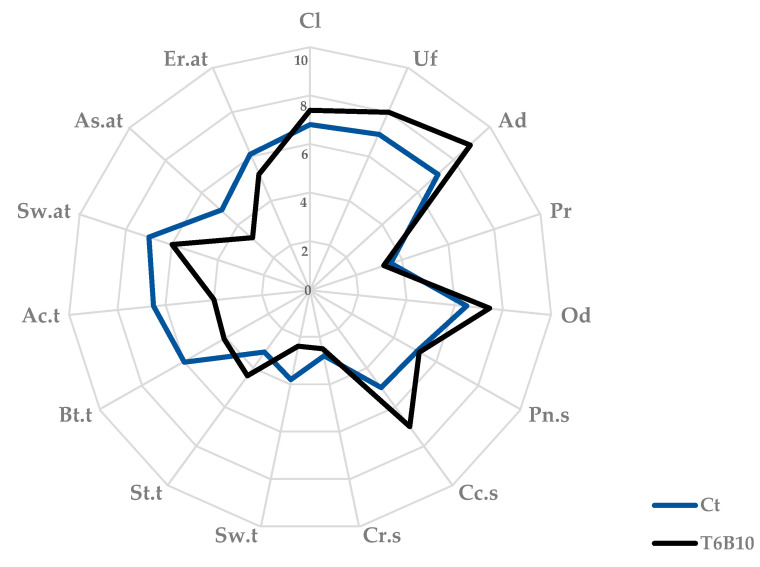
Sensory analysis of the yogurt-like T6B10, fermented with Lactiplantibacillus plantarum T6B10 at 30 °C for 16 h (tf). A control sample (Ct) corresponding to a not inoculated, but chemically acidified, YL incubated in the same conditions was included in the analysis. Descriptors: color intensity (Cl), uniformity (Uf), adherence to spoon (Ad), and presence of particles for the appearance (Pr); overall odor intensity (Od), pungent smell (Pn.s), cocoa (Cc.s), and creamy (Cr.s) smell for the odor; sweet (Sw.t), salty (St.t), bitter (Bt.t), and acidic (Ac.t) for the taste; sweet (Sw.at), astringent (As.at), and earthy (Er.at) for the aftertaste evaluation.

References

    1. Brassesco M.E., Brandão T.R., Silva C.L., Pintado M. Carob bean (Ceratonia siliqua L.): A new perspective for functional food. Trends Food Sci. Technol. 2021;114:310–322. doi: 10.1016/j.tifs.2021.05.037. - DOI
    1. Gioxari A., Amerikanou C., Nestoridi I., Gourgari E., Pratsinis H., Kalogeropoulos N., Andrikopoulos N.K., Kaliora A.C. Carob: A sustainable opportunity for metabolic health. Foods. 2022;11:2154. doi: 10.3390/foods11142154. - DOI - PMC - PubMed
    1. Nasar-Abbas S.M., Huma Z., Vu T., Khan M.K., Esbenshade H., Jayasena V. Carob Kibble: A bioactive-rich food ingredient. Compr. Rev. Food Sci. Food Saf. 2016;15:63–72. doi: 10.1111/1541-4337.12177. - DOI - PubMed
    1. Loullis A., Pinakoulaki E. Carob as cocoa substitute: A review on composition, health benefits and food applications. Eur. Food Res. Technol. 2018;244:959–977. doi: 10.1007/s00217-017-3018-8. - DOI
    1. Prajapati V.D., Jani G.K., Moradiya N.G., Randeria N.P., Nagar B.J., Naikwadi N.N., Variya B.C. Galactomannan: A versatile biodegradable seed polysaccharide. Int. J. Biol. Macromol. 2013;60:83–92. doi: 10.1016/j.ijbiomac.2013.05.017. - DOI - PubMed

LinkOut - more resources