


White-Toothed Shrews (Genus Crocidura): Potential Reservoirs for Zoonotic Leptospira spp. and Arthropod-Borne Pathogens?
- PMID: 37375471
- PMCID: PMC10304557
- DOI: 10.3390/pathogens12060781
White-Toothed Shrews (Genus Crocidura): Potential Reservoirs for Zoonotic Leptospira spp. and Arthropod-Borne Pathogens?
Abstract
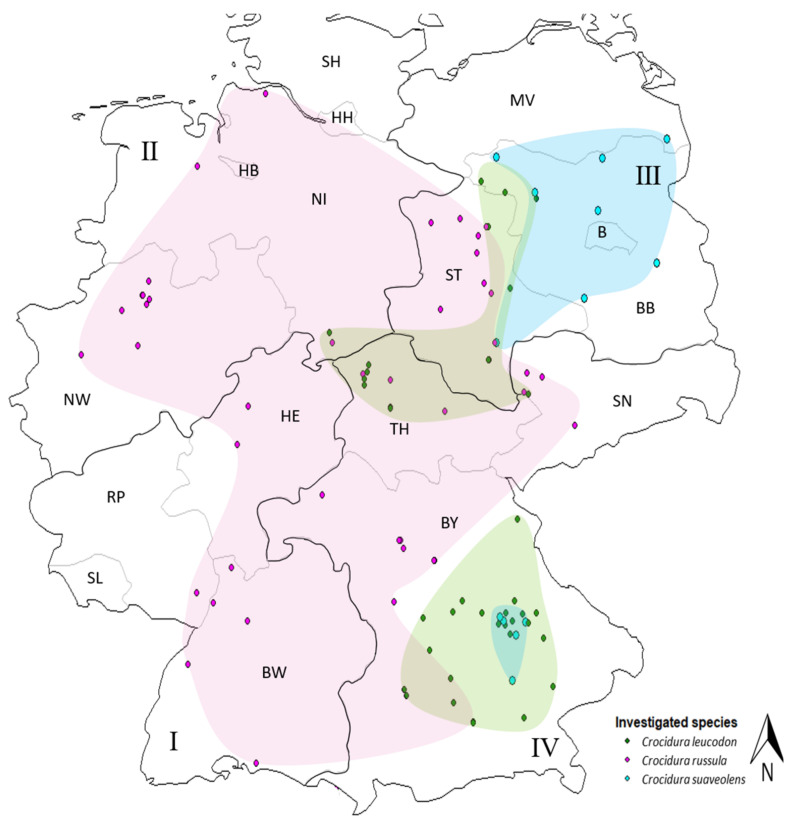
Three species of white-toothed shrews of the order Eulipotyphla are present in central Europe: the bicolored (Crocidura leucodon), greater (Crocidura russula) and lesser (Crocidura suaveolens) white-toothed shrews. Their precise distribution in Germany is ill-defined and little is known about them as reservoirs for zoonotic pathogens (Leptospira spp., Coxiella burnetii, Brucella spp., Anaplasma phagocytophilum, Babesia spp., Neoehrlichia mikurensis and Bartonella spp.). We investigated 372 Crocidura spp. from Germany (n = 341), Austria (n = 18), Luxembourg (n = 2) and Slovakia (n = 11). West European hedgehogs (Erinaceus europaeus) were added to compare the presence of pathogens in co-occurring insectivores. Crocidura russula were distributed mainly in western and C. suaveolens mainly in north-eastern Germany. Crocidura leucodon occurred in overlapping ranges with the other shrews. Leptospira spp. DNA was detected in 28/227 C. russula and 2/78 C. leucodon samples. Further characterization revealed that Leptospira kirschneri had a sequence type (ST) 100. Neoehrlichia mikurensis DNA was detected in spleen tissue from 2/213 C. russula samples. Hedgehogs carried DNA from L. kirschneri (ST 100), L. interrogans (ST 24), A. phagocytophilum and two Bartonella species. This study improves the knowledge of the current distribution of Crocidura shrews and identifies C. russula as carrier of Leptospira kirschneri. However, shrews seem to play little-to-no role in the circulation of the arthropod-borne pathogens investigated.
Keywords: Anaplasma phagocytophilum; Babesia spp.; Bartonella spp.; Brucella spp.; Coxiella burnetii; Leptospira spp.; Neoehrlichia mikurensis; distribution; reservoir; shrew.
Conflict of interest statement
The authors declare no conflict of interest. The funders had no role in the design of the study; in the collection, analyses, or interpretation of data; in the writing of the manuscript; or in the decision to publish the results.
Figures


References
-
- Wilson D.E., Mittermaier R.A., editors. Handbook of the Mammals of the World: Volume 8. Insectivores, Sloths and Colugos. Lynx Edicions; Barcelona, Spain: 2017.
-
- Hutterer R., Balete D.S., Giarla T.C., Heaney L.R., Esselstyn J.A. A new genus and species of shrew (Mammalia: Soricidae) from Palawan Island, Philippines. J. Mammal. 2018;99:518–536. doi: 10.1093/jmammal/gyy041. - DOI
-
- Esselstyn J.A., Achmadi A.S., Handika H., Swanson M.T., Giarla T.C., Rowe K.C. Fourteen New, Endemic Species of Shrew (Genus Crocidura) from Sulawesi Reveal a Spectacular Island Radiation. Bull. Am. Mus. Nat. Hist. 2021;454:3–105. doi: 10.1206/0003-0090.454.1.1. - DOI
Grants and funding
- 01KI1903SA/Federal Ministry of Education and Research, Germany
- 01KI1903B/Federal Ministry of Education and Research
- 3718 484 250/Federal Environment Agency
- 3714 67 407 0/German Federal Ministry for the Environment, Nature Conservation, Building and Nuclear Safety
- 3716 48 431 0/German Federal Ministry for the Environment, Nature Conservation and Nuclear Safety
LinkOut - more resources
Full Text Sources
Miscellaneous
