


Body Composition in Fussy-Eating Children, with and without Neurodevelopmental Disorders, and Their Parents, Following a Taste Education Intervention
- PMID: 37375692
- PMCID: PMC10305450
- DOI: 10.3390/nu15122788
Body Composition in Fussy-Eating Children, with and without Neurodevelopmental Disorders, and Their Parents, Following a Taste Education Intervention
Abstract
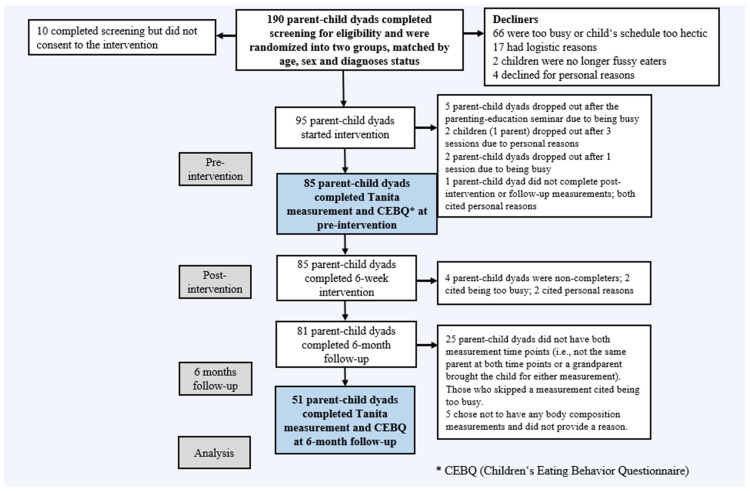
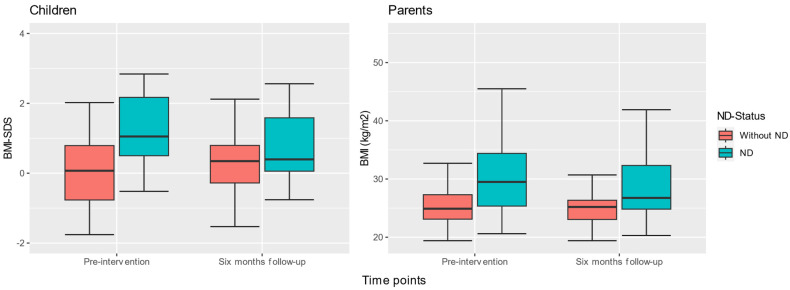
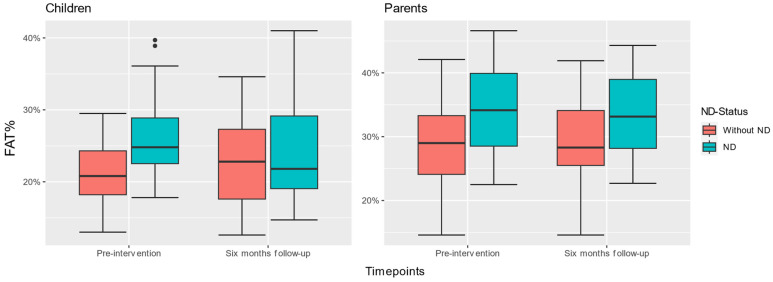
Fussy eaters may have an increased risk of becoming overweight or obese as adolescents, with fussy eating and weight status also correlating with neurodevelopmental disorders (NDs) such as autism spectrum disorder (ASD) and attention deficit/hyperactivity disorder (ADHD). Further, maternal and children's weight status relationships are well-established. In this study, we analyzed the body composition of parent-child dyads using bioelectrical impedance analysis (BIA). Fifty-one children aged 8-12 years, with an ND (n = 18) and without (n = 33), and their parents, participated in a 7-week food-based Taste Education intervention with 6-month follow-up. The paired t-test was used to compare differences in body composition based on children's ND status. In logistic regression analysis, odds of children being in the overweight/obese or overfat/obese categories increased by a factor of 9.1 and 10.6, respectively, when having NDs, adjusting for parents' BMI (body mass index) or fat percentage (FAT%). Children with NDs and their parents had significantly higher mean BMI-SDS (BMI standard deviation score) and FAT% at pre-intervention than children without NDs and their parents. Mean BMI-SDS and FAT% lowered significantly between time points for children with NDs and their parents but not for children without NDs or their parents. The findings underline the need for additional exploration into the relationships between children's and parents' body composition based on children's ND status.
Keywords: ADHD; BMI; autism spectrum disorder; bioelectrical impedance analysis; body composition measurements; fat percentage; fussy eating; neurodevelopmental disorders; parent–child dyads; standard deviation scores.
Conflict of interest statement
The authors declare no conflict of interest. The funders had no role in the design of the study; in the collection, analyses, or interpretation of data; in the writing of the manuscript; or in the decision to publish the results.
Figures
References
-
- Hampl S.E., Hassink S.G., Skinner A.C., Armstrong S.C., Barlow S.E., Bolling C.F., Avila Edwards K.C., Eneli I., Hamre R., Joseph M.M., et al. Clinical Practice Guideline for the Evaluation and Treatment of Children and Adolescents With Obesity. Pediatrics. 2023;151:e2022060640. doi: 10.1542/peds.2022-060640. - DOI - PubMed
-
- Abarca-Gómez L., Abdeen Z.A., Hamid Z.A., Abu-Rmeileh N.M., Acosta-Cazares B., Acuin C., Adams R.J., Aekplakorn W., Afsana K., Aguilar-Salinas C.A., et al. Worldwide trends in body-mass index, underweight, overweight, and obesity from 1975 to 2016: A pooled analysis of 2416 population-based measurement studies in 128·9 million children, adolescents, and adults. Lancet. 2017;390:2627–2642. doi: 10.1016/S0140-6736(17)32129-3. - DOI - PMC - PubMed
MeSH terms
Grants and funding
LinkOut - more resources
Full Text Sources
Medical
