


Polymers and Bioactive Compounds with a Macrophage Modulation Effect for the Rational Design of Hydrogels for Skin Regeneration
- PMID: 37376103
- PMCID: PMC10301883
- DOI: 10.3390/pharmaceutics15061655
Polymers and Bioactive Compounds with a Macrophage Modulation Effect for the Rational Design of Hydrogels for Skin Regeneration
Abstract
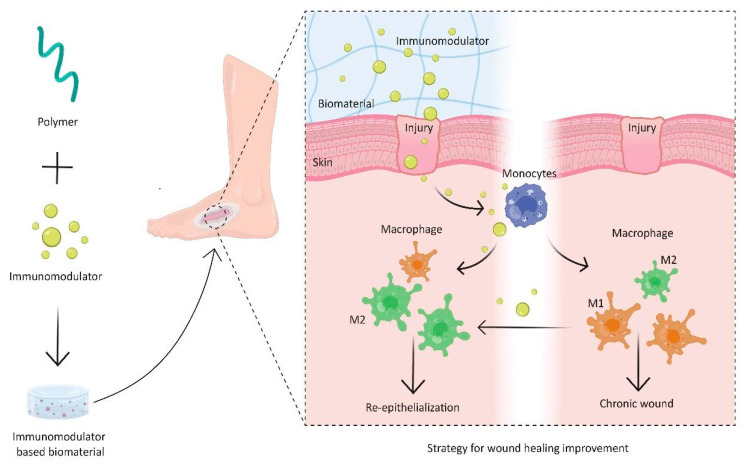
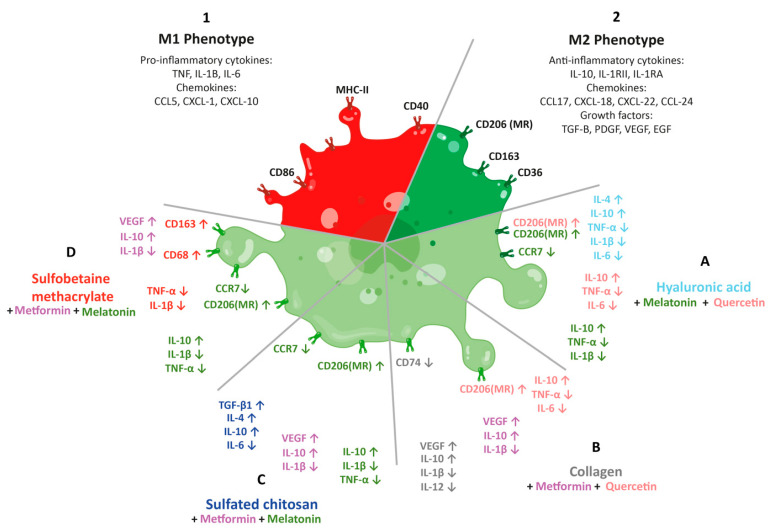
The development of biomaterial platforms for dispensing reagents of interest such as antioxidants, growth factors or antibiotics based on functional hydrogels represents a biotechnological solution for many challenges that the biomedicine field is facing. In this context, in situ dosing of therapeutic components for dermatological injuries such as diabetic foot ulcers is a relatively novel strategy to improve the wound healing process. Hydrogels have shown more comfort for the treatment of wounds due to their smooth surface and moisture, as well as their structural affinity with tissues in comparison to hyperbaric oxygen therapy, ultrasound, and electromagnetic therapies, negative pressure wound therapy or skin grafts. Macrophages, one of the most important cells of the innate immune system, have been described as the key not only in relation to the host immune defense, but also in the progress of wound healing. Macrophage dysfunction in chronic wounds of diabetic patients leads to a perpetuating inflammatory environment and impairs tissue repair. Modulating the macrophage phenotype from pro-inflammatory (M1) to anti-inflammatory (M2) could be a strategy for helping to improve chronic wound healing. In this regard, a new paradigm is found in the development of advanced biomaterials capable of inducing in situ macrophage polarization to offer an approach to wound care. Such an approach opens a new direction for the development of multifunctional materials in regenerative medicine. This paper surveys emerging hydrogel materials and bioactive compounds being investigated to induce the immunomodulation of macrophages. We propose four potential functional biomaterials for wound healing applications based on novel biomaterial/bioactive compound combination that are expected to show synergistic beneficial outcomes for the local differentiation of macrophages (M1-M2) as a therapeutic strategy for chronic wound healing improvement.
Keywords: biomaterials; inmunomodulation; macrophages M1–M2; polymers; wound-healing.
Conflict of interest statement
The authors declare no conflict of interest.
Figures
Similar articles
-
Therapeutic Properties of M2 Macrophages in Chronic Wounds: An Innovative Area of Biomaterial-Assisted M2 Macrophage Targeted Therapy.Stem Cell Rev Rep. 2025 Feb;21(2):390-422. doi: 10.1007/s12015-024-10806-3. Epub 2024 Nov 18. Stem Cell Rev Rep. 2025. PMID: 39556244 Review.
-
Immunomodulation in diabetic wounds healing: The intersection of macrophage reprogramming and immunotherapeutic hydrogels.J Tissue Eng. 2024 Jul 27;15:20417314241265202. doi: 10.1177/20417314241265202. eCollection 2024 Jan-Dec. J Tissue Eng. 2024. PMID: 39071896 Free PMC article. Review.
-
The Role of Macrophages in Acute and Chronic Wound Healing and Interventions to Promote Pro-wound Healing Phenotypes.Front Physiol. 2018 May 1;9:419. doi: 10.3389/fphys.2018.00419. eCollection 2018. Front Physiol. 2018. PMID: 29765329 Free PMC article. Review.
-
Immunomodulatory biomaterial-based wound dressings advance the healing of chronic wounds via regulating macrophage behavior.Regen Biomater. 2022 Sep 6;9:rbac065. doi: 10.1093/rb/rbac065. eCollection 2022. Regen Biomater. 2022. PMID: 36267154 Free PMC article. Review.
-
Vascularized polypeptide hydrogel modulates macrophage polarization for wound healing.Acta Biomater. 2023 Jan 1;155:218-234. doi: 10.1016/j.actbio.2022.11.002. Epub 2022 Nov 15. Acta Biomater. 2023. PMID: 36396041
Cited by
-
Hydrogels for Peripheral Nerve Repair: Emerging Materials and Therapeutic Applications.Gels. 2025 Feb 9;11(2):126. doi: 10.3390/gels11020126. Gels. 2025. PMID: 39996669 Free PMC article. Review.
-
Advances in the Insulin-Heart Axis: Current Therapies and Future Directions.Int J Mol Sci. 2024 Sep 22;25(18):10173. doi: 10.3390/ijms251810173. Int J Mol Sci. 2024. PMID: 39337658 Free PMC article. Review.
References
-
- WHO New WHA Resolution to Bring Much Needed Boost to Diabetes Prevention and Control Efforts. [(accessed on 5 May 2023)]; Available online: https://www.who.int/news/item/27-05-2021-new-wha-resolution-to-bring-muc....
Grants and funding
LinkOut - more resources
Full Text Sources
