


Epidemiology and SARS-CoV-2 Infection Patterns among Youth Followed at a Large Los Angeles Health Network during 2020-2022: Clinical Presentation, Prevalent Strains, and Correlates of Disease Severity
- PMID: 37376413
- PMCID: PMC10300956
- DOI: 10.3390/vaccines11061024
Epidemiology and SARS-CoV-2 Infection Patterns among Youth Followed at a Large Los Angeles Health Network during 2020-2022: Clinical Presentation, Prevalent Strains, and Correlates of Disease Severity
Abstract
Background: Outcomes of SARS CoV-2 infection in infants, children and young adults are reported less frequently than in older populations. The evolution of SARS-CoV-2 cases in LA County youths followed at a large health network in southern California over two years was evaluated.
Methods: A prospective cohort study of patients aged 0-24 years diagnosed with COVID-19 was conducted. Demographics, age distribution, disease severity, circulating variants of concern (VOCs), and immunization rates were compared between first and second pandemic years. Logistic regression estimated odds ratios (OR) and 95% confidence intervals (CI) of factors associated with severe/critical COVID-19.
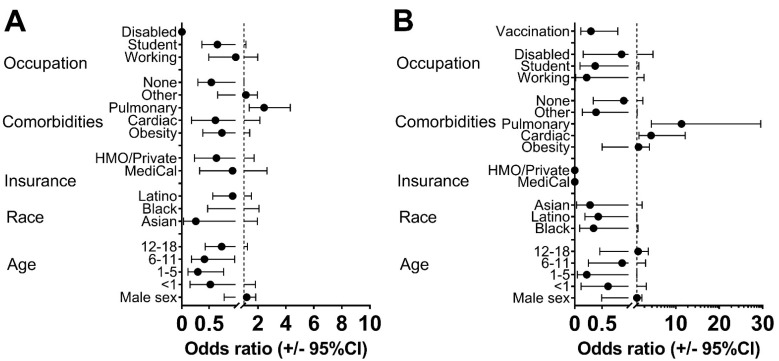
Results: In total, 61,208 patients 0-24 years of age were tested for SARS-CoV-2 by polymerase chain reaction (PCR); 5263 positive patients (8.6%) with available data were identified between March 2020 and March 2022. In Year 1, 5.8% (1622/28,088) of youths tested positive, compared to 11% (3641/33,120) in Year 2 (p < 0.001). Most youths had mild/asymptomatic illness over two years. SARS-CoV-2 positivity was >12% across all age groups in the second half of Year 2, when Omicron prevailed. Pulmonary disease was associated with higher risk of severe COVID-19 in both years (OR: 2.4, 95% CI: 1.4-4.3, p = 0.002, Year 1; OR: 11.3, 95% CI: 4.3-29.6, Year 2, p < 0.001). Receipt of at least one COVID-19 vaccine dose was protective against severe COVID-19 (OR: 0.3, 95% CI: 0.11-0.80, p < 0.05).
Conclusions: Despite different VOCs and higher rates of test positivity in Year 2 compared to Year 1, most youths with COVID-19 had asymptomatic/mild disease. Underlying pulmonary conditions increased the risk of severe COVID-19, while vaccination was highly protective against severe disease in youths.
Keywords: COVID-19 vaccination; Los Angeles County; SARS-CoV-2 disease severity; VOCs; pediatric COVID-19; youth.
Conflict of interest statement
The authors have no competing interests to declare.
Figures


References
-
- CDC COVID Data Tracker Demographic Trends of COVID-19 Cases and Deaths in the US Reported to the CDC. [(accessed on 13 March 2023)]; Available online: www.cdc.gov/covid-data-tracker/index.html#demographics.
-
- Couture A., Lyons B.C., Mehrotra M.L., Sosa L., Ezike N., Ahmed F.S., Brown C.M., Yendell S., Azzam I.A., Katić B.J., et al. Severe Acute Respiratory Syndrome Coronavirus 2 Seroprevalence and Reported Coronavirus Disease 2019 Cases in US Children, August 2020–May 2021. Open Forum Infect. Dis. 2022;9:ofac044. doi: 10.1093/ofid/ofac044. - DOI - PMC - PubMed
-
- Hurst J.H., Heston S.M., Chambers H.N., Cunningham H.M., Price M.J., Suarez L., Crew C.G., Bose S., Aquino J.N., Carr S.T., et al. SARS-CoV-2 infections among children in the biospecimens from respiratory virus-exposed kids (BRAVE kids) study. medRxiv. 2020 doi: 10.1101/2020.08.18.20166835. - DOI - PMC - PubMed
Grants and funding
LinkOut - more resources
Full Text Sources
Miscellaneous
