


Safety Goggles with Elastic Headband to Improve N95 Fit Following Failed Quantitative Fit Test
- PMID: 37378367
- PMCID: PMC10291674
- DOI: 10.5005/jp-journals-10071-24473
Safety Goggles with Elastic Headband to Improve N95 Fit Following Failed Quantitative Fit Test
Abstract
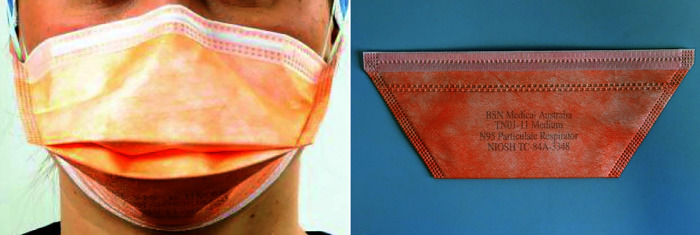
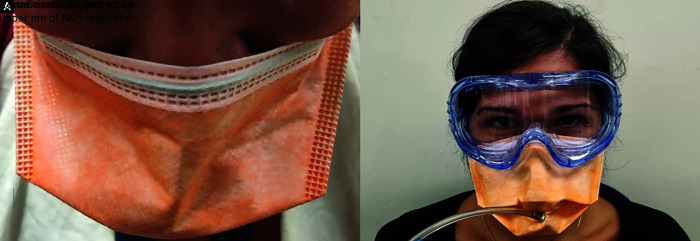
Introduction: N95 respirators, together with eye protection, form vital elements of personal protective equipment (PPE) for healthcare workers (HCW) caring for patients with respiratory infections, such as COVID-19. Duckbill N95 respirators are widely used but have a high failure rate when Fit Tested. The commonest site for inward leaks is the region between the nose and maxilla. Safety goggles with an elastic headband may press the upper rim of the respirator against the face, thereby reducing inward leaks. We hypothesized that the use of safety goggles with an elastic headband will improve the overall fit-factor of a duckbill N95 respirator and increase the proportion of users who pass a quantitative Fit Test.
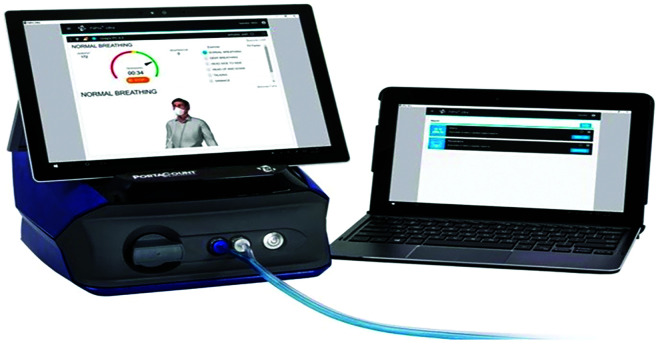
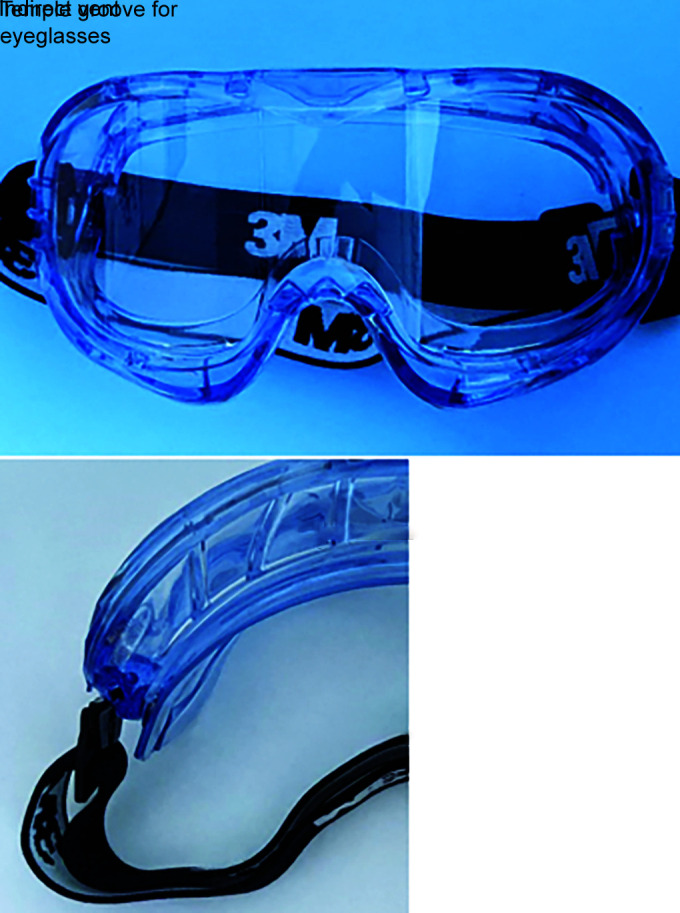
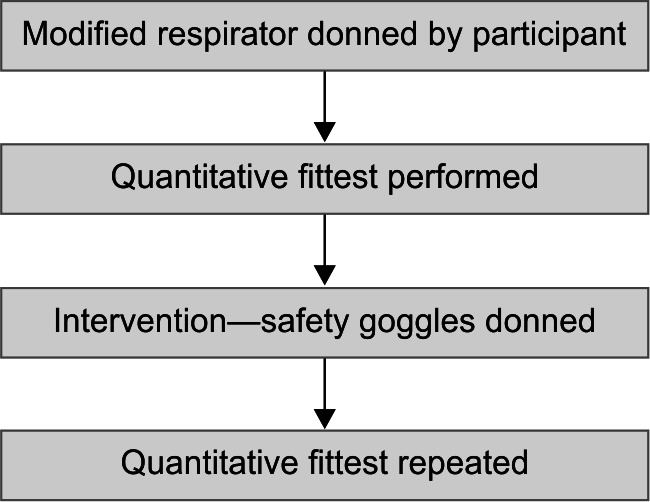
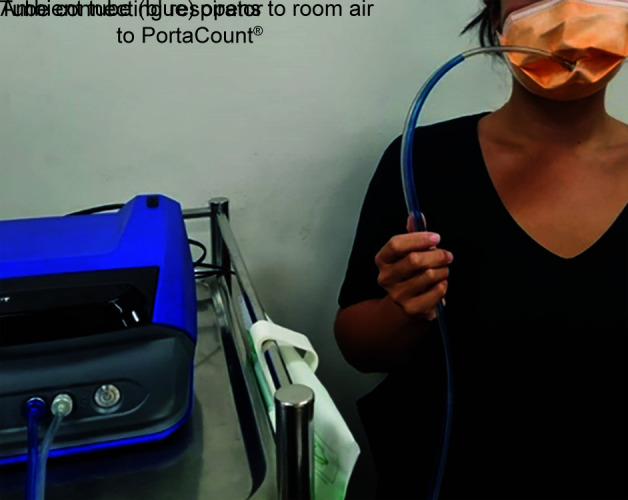
Methods: About 60 volunteer HCWs, who had previously failed quantitative Fit Testing with a duckbill N95 respirator, participated in this before-and-after intervention study. A PortaCount® 8048 was used for quantitative Fit Testing. The test was first performed with a duckbill N95 respirator only. It was then repeated after participants donned a pair of safety goggles (3M Fahrenheit, ID 70071531621).
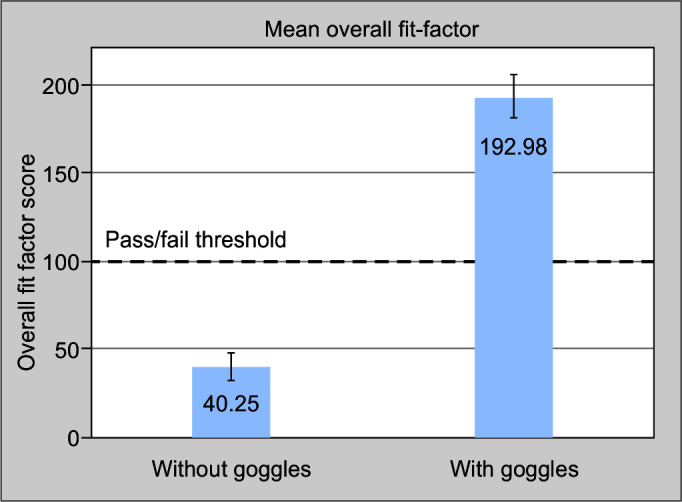
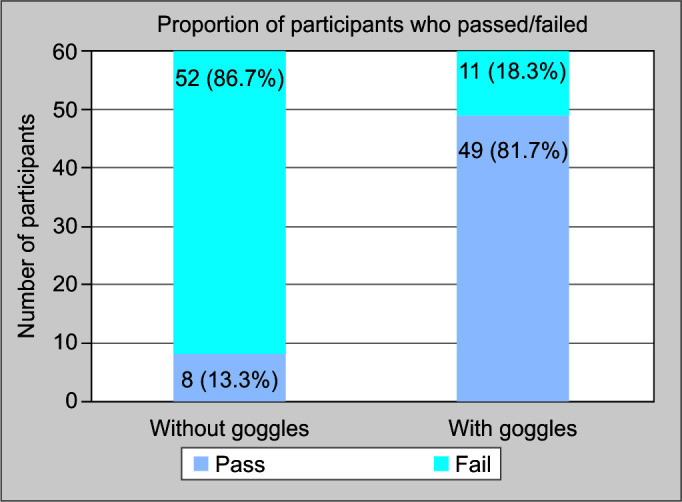
Results: Before the intervention, i.e., with the respirator only, 8 (13.3%) participants passed their Fit Test. This increased to 49 (81.7%) after the application of safety goggles (OR 42, 95% CI 7.14-1697.9, p < 0.0001). The adjusted mean overall fit factor, using Tobit regression analysis, increased from 40.3 to 193.0 (t = 12.32, p < 0.001).
Conclusion: The use of safety goggles with an elastic headband significantly increases the proportion of users who pass a quantitative Fit Test and improves the fit-factor of a duckbill N95 respirator.
How to cite this article: Kamal M, Bhatti M, Stewart WC, Johns M, Collins D, Shehabi Y, et al. Safety Goggles with Elastic Headband to Improve N95 Fit Following Failed Quantitative Fit Test. Indian J Crit Care Med 2023;27(6):386-391.
Keywords: COVID-19; Eye protection; Fit Test; Goggles; N95 respirators; Personal protective equipment.
Copyright © 2023; The Author(s).
Conflict of interest statement
Source of support: Nil Conflict of interest: None
Figures

References
-
- WHO. Infection Prevention and Control during Healthcare when Coronavirus Disease (COVID-19) is Suspected or Confirmed; 2021
-
- Australian Department of Health. Guidance on the Use of Personal Protective Equipment (PPE) in Hospitals during the COVID-19 Outbreak; 2020
-
- NSW Clinical Excellence Commission. Respiratory Protection Program Manual. 2020 1st edition;
LinkOut - more resources
Full Text Sources