


Quantification of Organophosphorus Insecticide Removed by Gastric Lavage in Acutely Poisoned Patients: An Observational Study
- PMID: 37378371
- PMCID: PMC10291665
- DOI: 10.5005/jp-journals-10071-24475
Quantification of Organophosphorus Insecticide Removed by Gastric Lavage in Acutely Poisoned Patients: An Observational Study
Abstract
Introduction: The effectiveness of gastric lavage in organophosphorus (OP) poisoning has not been established. We assessed the ability of gastric lavage to remove OP insecticides as a preliminary stage in assessing effectiveness.
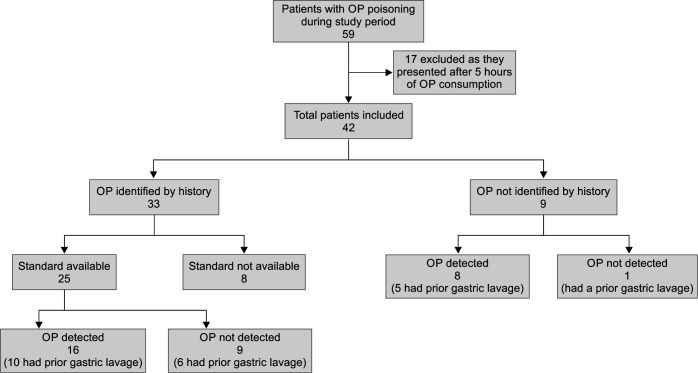
Patients and methods: Organophosphorus poisoning patients presenting within 6 hours were included, irrespective of prior gastric lavage. A nasogastric tube was placed and gastric contents aspirated, followed by at least three cycles of gastric lavage with 200 mL of water. Samples from the initial aspirate and the first three lavage cycles were sent for identification and quantification of the OP compounds. Patients were monitored for complications of gastric lavage.
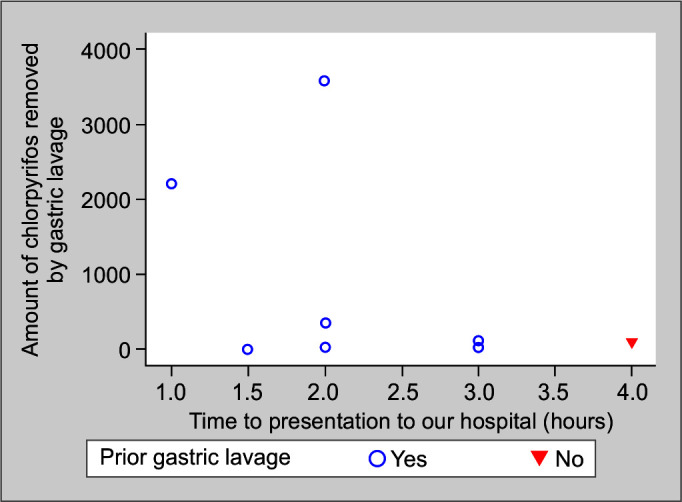
Results: Around 42 patients underwent gastric lavage. Eight (19.0%) patients were excluded from the study because of a lack of analytical standards for ingested compounds. Insecticides were detectable in the lavage samples of 24 of 34 (70.6%) patients. Lipophilic OP compounds were detected in 23 of 24 patients, while no hydrophilic OP compounds could be detected in six patients with reported ingestion of hydrophilic compounds. For chlorpyrifos poisoning (n = 10), only 0.65 mg (SD 1.2) of the estimated ingested amount (n = 5) of 8,600 mg (SD 3,200) was recovered by gastric lavage. The mean proportion of the compound removed by initial gastric aspirate was 79.4% and subsequent three cycles removed 11.5, 6.6, and 2.7%.
Conclusion: Lipophilic OP insecticides could be quantified in the stomach contents of OP poisoning patients with the first aspiration or lavage being most effective. The amount removed was very low; hence, routine use of gastric lavage for OP poisoning patients arriving within 6 hours is unlikely to be beneficial.
How to cite this article: Mathansingh AJ, Jose A, Fleming JJ, Abhilash KPP, Chandiraseharan VK, Lenin A, et al. Quantification of Organophosphorus Insecticide Removed by Gastric Lavage in Acutely Poisoned Patients: An Observational Study. Indian J Crit Care Med 2023;27(6):397-402.
Keywords: Efficacy; Gastric lavage; Insecticide poisoning; Organophosphorus.
Copyright © 2023; The Author(s).
Conflict of interest statement
Source of support: Nil Conflict of interest: None
Figures
References
-
- Gunnell D, Eddleston M, Phillips MR, Konradsen F. The global distribution of fatal pesticide self-poisoning: Systematic review. BMC Public Health. 2007;7(1):357. Available from: https://bmcpublichealth.biomedcentral.com/articles/10.1186/1471-2458-7-357. - DOI - PMC - PubMed
LinkOut - more resources
Full Text Sources
Research Materials
Miscellaneous