Observational Study
. 2023 Aug 1;159(8):837-847.
doi: 10.1001/jamadermatol.2023.1729.

Cutaneous Manifestations, Clinical Characteristics, and Prognosis of Patients With Systemic Sclerosis Sine Scleroderma: Data From the International EUSTAR Database

Collaborators, Affiliations
Observational Study

Cutaneous Manifestations, Clinical Characteristics, and Prognosis of Patients With Systemic Sclerosis Sine Scleroderma: Data From the International EUSTAR Database

Alain Lescoat et al. JAMA Dermatol. .

Abstract

Importance: Systemic sclerosis (SSc) sine scleroderma (ssSSc) is a subset of SSc defined by the absence of skin fibrosis. Little is known about the natural history and skin manifestations among patients with ssSSc.

Objective: To characterize the clinical phenotype of patients with ssSSc compared with patients with limited cutaneous SSc (lcSSc) and diffuse cutaneous SSc (dcSSc) within the EUSTAR database.

Design, setting, and participants: This longitudinal observational cohort study based on the international EUSTAR database included all patients fulfilling the classification criteria for SSc assessed by the modified Rodnan Skin score (mRSS) at inclusion and with at least 1 follow-up visit; ssSSc was defined by the absence of skin fibrosis (mRSS = 0 and no sclerodactyly) at all available visits. Data extraction was performed in November 2020, and data analysis was performed from April 2021 to April 2023.

Main outcomes and measures: Main outcomes were survival and skin manifestations (onset of skin fibrosis, digital ulcers, telangiectasias, puffy fingers).

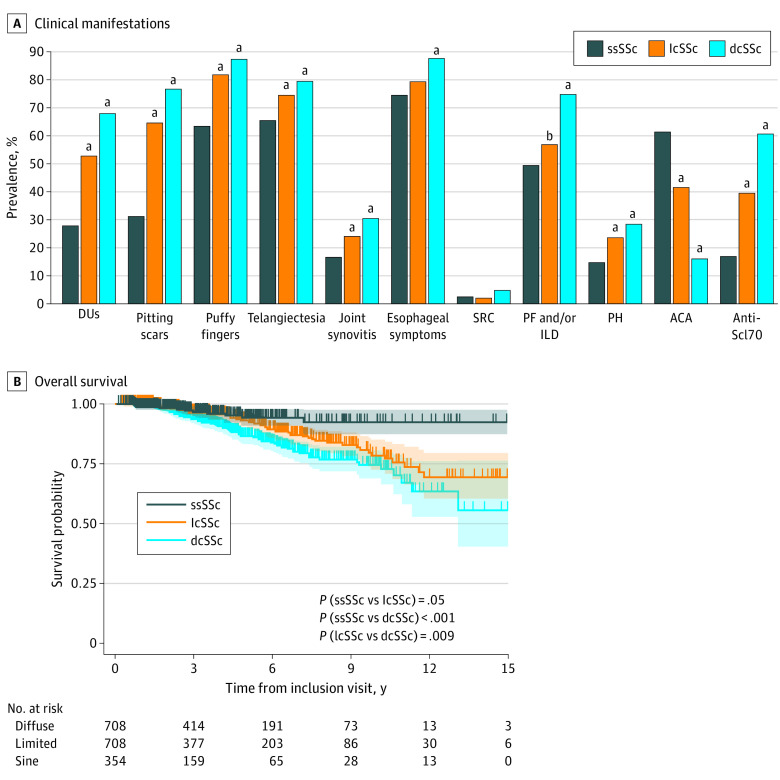
Results: Among the 4263 patients fulfilling the inclusion criteria, 376 (8.8%) were classified as having ssSSc (mean [SD] age, 55.3 [13.9] years; 345 [91.8%] were female). At last available visit, in comparison with 708 patients with lcSSc and 708 patients with dcSSc with the same disease duration, patients with ssSSc had a lower prevalence of previous or current digital ulcers (28.2% vs 53.1% in lcSSc; P < .001; and 68.3% in dcSSc; P < .001) and puffy fingers (63.8% vs 82.4% in lcSSc; P < .001; and 87.6% in dcSSc; P < .001). By contrast, the prevalence of interstitial lung disease was similar in ssSSc and lcSSc (49.8% and 57.1%; P = .03) but significantly higher in dcSSc (75.0%; P < .001). Skin telangiectasias were associated with diastolic dysfunction in patients with ssSSc (odds ratio, 4.778; 95% CI, 2.060-11.081; P < .001). The only independent factor for the onset of skin fibrosis in ssSSc was the positivity for anti-Scl-70 antibodies (odds ratio, 3.078; 95% CI, 1.227-7.725; P = .02). Survival rate was higher in patients with ssSSc (92.4%) compared with lcSSc (69.4%; P = .06) and dcSSc (55.5%; P < .001) after up to 15 years of follow-up.

Conclusions and relevance: Systemic sclerosis sine scleroderma should not be neglected considering the high prevalence of interstitial lung disease (>40%) and SSc renal crisis (almost 3%). Patients with ssSSc had a higher survival than other subsets. Dermatologists should be aware that cutaneous findings in this subgroup may be associated with internal organ dysfunction. In particular, skin telangiectasias in ssSSc were associated with diastolic heart dysfunction.


Conflict of interest statement

Conflict of Interest Disclosures: Dr Carreira reported grants from Spanish Ministry of Health during the conduct of the study. Dr de Vries-Bouwstra reported speaker and consultancy fees from Boehringer Ingelheim, grants from Galapagos, grants from Janssen (speaker fees), and consultancy for AbbVie outside the submitted work. Dr J. Distler reported consultancy relationships with Actelion, Active Biotech, Anamar, Arxx, Bayer Pharma, Boehringer Ingelheim, Celgene, Galapagos, GSK, Inventiva, JB Therapeutics, Medac, Pfizer, Ruiyi, and UCB; research funding from Anamar, Active Biotech, Array Biopharma, aTyr, BMS, Bayer Pharma, Boehringer Ingelheim, Celgene, Galapagos, GSK, Inventiva, Novartis, Sanofi-Aventis, Redx, and UCB; and stock ownership of 4D Science; and serving as scientific head of FibroCure outside the submitted work. Dr Smith reported grants from Research Foundation Flanders (FWO) (research support), Belgian Fund for Scientific Research in Rheumatic Diseases (FWRO) (research grant), Boehringer Ingelheim (research support), and Janssen-Cilag (educational chair); personal fees from Boehringer Ingelheim (consultancy and speaker fees), Janssen-Cilag (consultancy and speaker fees, advisory board), and Galapagos (speaker fees); and other from Boehringer Ingelheim (travel arrangements for American College of Rheumatology congress) outside the submitted work. Dr Hoffmann-Vold reported grants, personal fees, and nonfinancial support from Boehringer Ingelheim; grants from Janssen; and personal fees from Arxx, Janssen, Medscape, Roche, Genentech, and Merck Sharp & Dohme outside the submitted work. Dr O. Distler reported consultancy relationship with and/or has received research funding from and/or has served as a speaker for the following: 4P-Pharma, AbbVie, Acceleron, Alcimed, Altavant, Amgen, AnaMar, Arxx, AstraZeneca, Blade, Bayer, Boehringer Ingelheim, Corbus, CSL Behring, Galderma, Galapagos, Glenmark, Gossamer, Horizon, Janssen, Kymera, Lupin, Medscape, Merck, Miltenyi Biotec, Mitsubishi Tanabe, Novartis, Prometheus, Redx Pharma, Roivant, and Topadur outside the submitted work; and patent issued for mir-29 for the treatment of systemic sclerosis (US8247389, EP2331143). Dr Khanna reported personal fees from Boehringer Ingelheim during the conduct of the study; personal fees (consultant) from AstraZeneca, Boehringer Ingelheim, Horizon, UCB, CSL Behring, Prometheus, and Bausch Health outside the submitted work. Dr Allanore reported personal fees from Boehringer, Sanofi, Celltrion, and Roche during the conduct of the study; and personal fees from Boehringer, Sanofi, AbbVie, AstraZeneca, and Sandoz outside the submitted work. No other disclosures were reported.

Figures

Figure.
Figure.. Comparison of Clinical Presentation and Survival of Patients With ssSSc vs Cutaneous Subsets (lcSSc and dcSSc)
A, Prevalence of main SSc-related clinical manifestations in the 3 SSc subsets (χ2 test or Fisher test as appropriate; P value for comparisons of ssSSc with lcSSc and ssSSc with dcSSc, detailed results and comparisons for other manifestations are provided in eTable 2 in Supplement 1). B, Comparison of overall survival in patients with ssSSc, lcSSc, and dcSSc (censored at after 15 years of follow-up). Shaded areas represent 95% CIs. ACA indicates anticentromere antibodies; dcSSc, diffuse cutaneous systemic sclerosis; DUs, digital ulcers; ILD, interstitial lung disease; lcSSc, limited cutaneous systemic sclerosis; PF, pulmonary fibrosis; PH, pulmonary hypertension; SRC, history of scleroderma renal crisis; SSc, systemic sclerosis; ssSSc, systemic sclerosis sine scleroderma. aP < .001. bP = .03.

References

    1. Denton CP, Khanna D. Systemic sclerosis. Lancet. 2017;390(10103):1685-1699. doi: 10.1016/S0140-6736(17)30933-9 - DOI - PubMed
    1. Lescoat A, Cavalin C, Ehrlich R, et al. The nosology of systemic sclerosis: how lessons from the past offer new challenges in reframing an idiopathic rheumatological disorder. Lancet Rheumatol. 2019;1(4):e257-e264. doi: 10.1016/S2665-9913(19)30038-4 - DOI - PubMed
    1. Sobanski V, Lescoat A, Launay D. Novel classifications for systemic sclerosis: challenging historical subsets to unlock new doors. Curr Opin Rheumatol. 2020;32(6):463-471. doi: 10.1097/BOR.0000000000000747 - DOI - PubMed
    1. Jouvray M, Launay D, Dubucquoi S, et al. Whole-body distribution and clinical association of telangiectases in systemic sclerosis. JAMA Dermatol. 2018;154(7):796-805. doi: 10.1001/jamadermatol.2018.0916 - DOI - PMC - PubMed
    1. Lescoat A, Varga J, Matucci-Cerinic M, Khanna D. New promising drugs for the treatment of systemic sclerosis: pathogenic considerations, enhanced classifications, and personalized medicine. Expert Opin Investig Drugs. 2021;30(6):635-652. doi: 10.1080/13543784.2021.1923693 - DOI - PMC - PubMed

Publication types

Supplementary concepts