


EUropean real-world outcomes with Pulsed field ablatiOn in patients with symptomatic atRIAl fibrillation: lessons from the multi-centre EU-PORIA registry
- PMID: 37379528
- PMCID: PMC10320231
- DOI: 10.1093/europace/euad185
EUropean real-world outcomes with Pulsed field ablatiOn in patients with symptomatic atRIAl fibrillation: lessons from the multi-centre EU-PORIA registry
Abstract
Aims: Pulsed field ablation (PFA) is a new, non-thermal ablation modality for pulmonary vein (PV) isolation in patients with atrial fibrillation (AF). The multi-centre EUropean Real World Outcomes with Pulsed Field AblatiOn in Patients with Symptomatic AtRIAl Fibrillation (EU-PORIA) registry sought to determine the safety, efficacy, and learning curve characteristics for the pentaspline, multi-electrode PFA catheter.
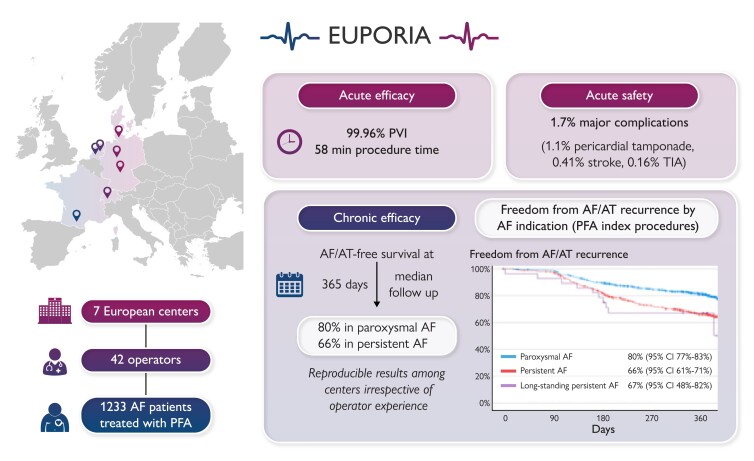
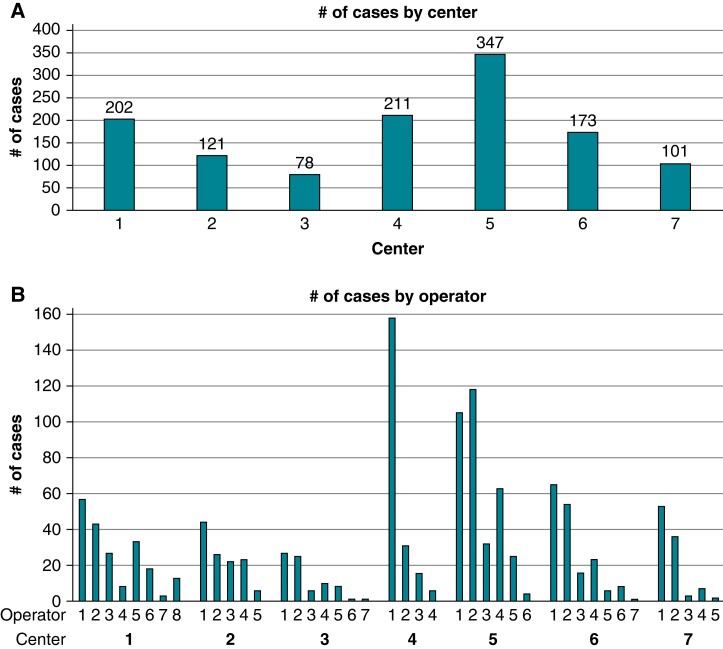
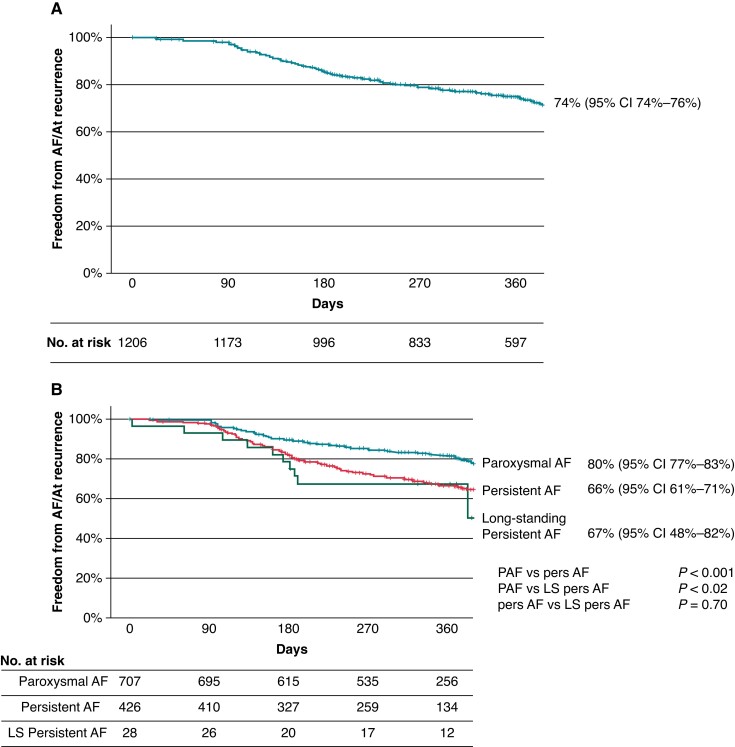
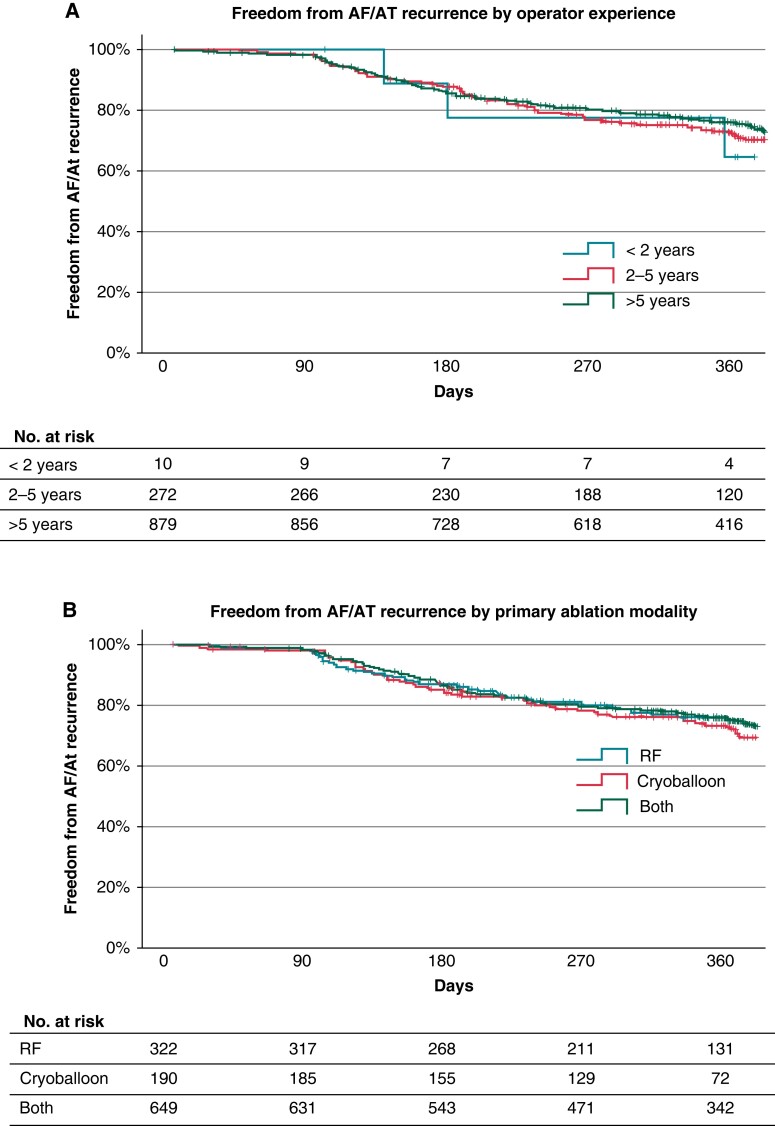
Methods and results: All-comer AF patients from seven high-volume centres were consecutively enrolled. Procedural and follow-up data were collected. Learning curve effects were analysed by operator ablation experience and primary ablation modality. In total, 1233 patients (61% male, mean age 66 ± 11years, 60% paroxysmal AF) were treated by 42 operators. In 169 patients (14%), additional lesions outside the PVs were performed, most commonly at the posterior wall (n = 127). Median procedure and fluoroscopy times were 58 (interquartile range: 40-87) and 14 (9-21) min, respectively, with no differences due to operator experience. Major complications occurred in 21/1233 procedures (1.7%) including pericardial tamponade (14; 1.1%) and transient ischaemic attack or stroke (n = 7; 0.6%), of which one was fatal. Prior cryoballoon users had less complication. At a median follow-up of 365 (323-386) days, the Kaplan-Meier estimate of arrhythmia-free survival was 74% (80% for paroxysmal and 66% for persistent AF). Freedom from arrhythmia was not influenced by operator experience. In 149 (12%) patients, a repeat procedure was performed due to AF recurrence and 418/584 (72%) PVs were durably isolated.
Conclusion: The EU-PORIA registry demonstrates a high single-procedure success rate with an excellent safety profile and short procedure times in a real-world, all-comer AF patient population.
Keywords: Ablation; Atrial fibrillation; Electroporation; Pulsed field ablation.
© The Author(s) 2023. Published by Oxford University Press on behalf of the European Society of Cardiology.
Conflict of interest statement
Conflict of interest: B.S. is a consultant for and has received honoraria as well as research funding from Abbott, Medtronic, Boston Scientific, and Biosense Webster. S.B. has received honoraria from Medtronic and Biosense Webster. K.R.J.C. is a consultant for and has received honoraria as well as research funding from Abbott, Medtronic, Boston Scientific, and Biosense Webster. S.B. is consultant for Medtronic, Boston Scientific, Microport, and Zoll. R.A.: none. R.M.: none. T.R. has received research grants from the Goldschmidt-Jacobson Foundation, the Swiss National Science Foundation, the Swiss Heart Foundation, and the sitem insel support fund, all for work outside the submitted study. He has received speaker/consulting honoraria or travel support from Abbott/SJM, Bayer, Biosense-Webster, Biotronik, Boston-Scientific, Daiichi Sankyo, Farapulse, Medtronic, and Pfizer-BMS, all for work outside the submitted study. He has received support for his institution’s fellowship program from Abbott/SJM, Biosense-Webster, Biotronik, Boston-Scientific, and Medtronic for work outside the submitted study. L.R. received research grants from Medtronic and speaker/consulting honoraria from Abbott and Medtronic. T.K.: none. K.N. is a consultant for Biosense Webster, Boston Scientific, Field Medical, and LifeTech Scientific. A.F.: educational grant from Boston Scientific. N.R.: consultant for Boston Scientific. J.H.: speakers fees from Boston Scientific and Biosense Webster. M.H.R.: none. A.O.: none. P.v.d.V.: none. Y.B. has received research grants from Medtronic and Atricure. He has received speaker/consulting honoraria from Abbott/SJM and Boston-Scientific, all for work outside the submitted study. B.A.M.: none. C.W.S. and E.M.A.: salaried employees of Boston Scientific.
Figures
Comment in
-
Ablation by lightning bolts: euphoria after EU-PORIA?Europace. 2023 Aug 2;25(9):euad218. doi: 10.1093/europace/euad218. Europace. 2023. PMID: 37477945 Free PMC article. No abstract available.
References
-
- Meyre P, Blum S, Berger S, Aeschbacher S, Schoepfer H, Briel Met al. Risk of hospital admissions in patients with atrial fibrillation: a systematic review and meta-analysis. Can J Cardiol 2019;35:1332–43. - PubMed
-
- Andrade JG, Wells GA, Deyell MW, Bennett M, Essebag V, Champagne Jet al. Cryoablation or drug therapy for initial treatment of atrial fibrillation. N Engl J Med 2021;384:305–15. - PubMed
-
- Kirchhof P, Camm AJ, Goette A, Brandes A, Eckardt L, Elvan Aet al. Early rhythm-control therapy in patients with atrial fibrillation. N Engl J Med 2020;383:1305–16. - PubMed
-
- Wazni OM, Dandamudi G, Sood N, Hoyt R, Tyler J, Durrani Set al. Cryoballoon ablation as initial therapy for atrial fibrillation. N Engl J Med 2021;384:316–24. - PubMed
MeSH terms
Grants and funding
LinkOut - more resources
Full Text Sources
Medical
Research Materials
